Research Team Led by Professor Eun-Yeol Lee at Kyung Hee University
[Asia Economy Reporter Kim Bong-su] Domestic researchers have discovered an improved microorganism that digests methane, a greenhouse gas emitted during livestock farming and rice cultivation, to biosynthesize plant growth-promoting hormones. This is expected to be a key to simultaneously achieving greenhouse gas reduction and eco-friendly agriculture.
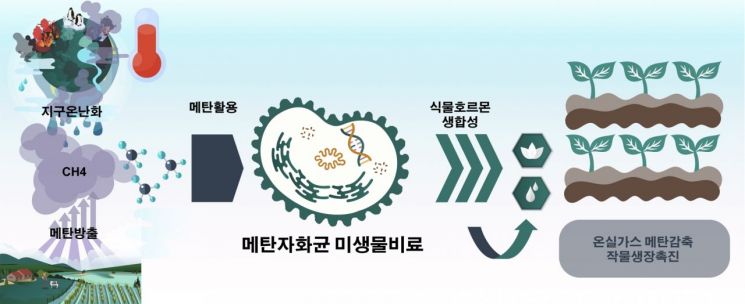
The National Research Foundation of Korea announced on the 11th that Professor Eun-yeol Lee's research team at Kyung Hee University has developed an eco-friendly microbial fertilizer platform technology that can convert methane emitted in the agricultural sector into plant growth hormones.
Methanotrophs, microorganisms that use methane as a carbon source and energy source, can convert methane under ambient temperature and pressure conditions into high value-added products such as alcohols, organic acids, olefins, and biopolymers, and are actually used in protein feed and other applications. However, this is the first attempt to convert methane into plant growth hormones.
The research team engineered the metabolic pathway of methanotrophs to convert atmospheric methane into hormones that promote plant growth and root development. They reconstructed the metabolic pathway in methanotrophs to digest methane into the amino acid L-tryptophan, increasing tryptophan productivity, and further converted it into the plant hormone indole-3-acetic acid. L-tryptophan is an essential amino acid used in feed, and South Korea currently holds the world's number one market share.
In fact, the germination shoot elongation rate and root elongation rate of wheat seeds treated with microbial fertilizer containing these engineered methanotrophs were found to be 2 times and 3.6 times higher, respectively, compared to the control group.
Professor Lee said, “The remaining challenge is the regulation on the use of genetically recombined microbial fertilizers. Field test studies are needed to verify the effects of methanotroph microbial fertilizers in well-controlled, limited environments.”
The research results were published online on the 20th of last month in the international journal Chemical Engineering Journal in the field of chemical engineering.
© The Asia Business Daily(www.asiae.co.kr). All rights reserved.
![Clutching a Stolen Dior Bag, Saying "I Hate Being Poor but Real"... The Grotesque Con of a "Human Knockoff" [Slate]](https://cwcontent.asiae.co.kr/asiaresize/183/2026021902243444107_1771435474.jpg)















