Samsung Electronics Aims to Advance Basic Science and Foster Global Science and Technology Experts
Invests 1.5 Trillion Won Since 2013
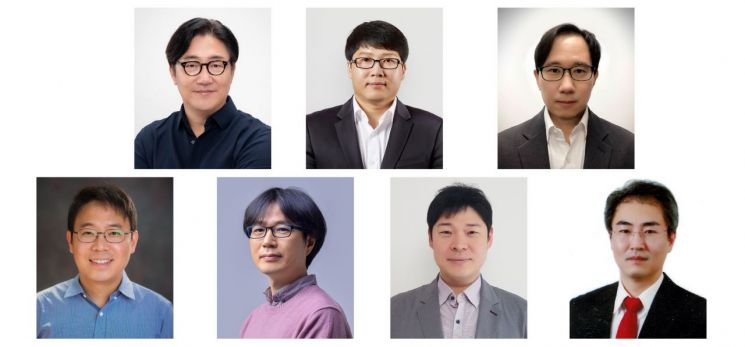 Professors selected for the Samsung Future Technology Development Project in the second half of 2021: POSTECH's Professor Kim Taekyung (top left, clockwise), UNIST's Professor Park Kyungdeok, Gachon University's Professor Kim Iksu, POSTECH's Professor Gong Byungdon, Seoul National University's Professor Heo Choonggil, GIST's Professor Lee Jongsuk, and KAIST's Professor Kim Jinkook.
 [Photo by Samsung Electronics]
[Asia Economy Reporter Kim Heung-soon] The Samsung Future Technology Promotion Foundation and Samsung Electronics Future Technology Promotion Center announced on the 11th the 22 research projects to be supported in the second half of 2021 under the 'Samsung Future Technology Promotion Project.' A total research fund of 34.07 billion KRW will be provided, including 17.27 billion KRW for 10 projects in basic science, 9.2 billion KRW for 6 projects in materials, and 7.6 billion KRW for 6 projects in ICT.
Pioneering New Fields
Research on Fundamental Approaches to Disease Treatment
In basic science, a total of 10 projects were selected, including those pioneering academically new fields in mathematics, physics, chemistry, and life sciences, as well as projects expected to have ripple effects such as fundamental approaches to disease treatment. Professor Kim Tae-kyung of the Department of Life Sciences at POSTECH challenges research on the familiar yet unknown area of 'memory' through the project 'Tracking and Reconstruction of Memory Traces Based on Genome Activity Potentials.'
Professor Park Kyung-duk of the Department of Physics at Ulsan National Institute of Science and Technology (UNIST) is undertaking research to control the movement of excitons (Exciton: a state where an electron and a hole are bound by electrical forces and appear as a single particle) in regions smaller than 1 nm³. This research aims to create a new nano-optical platform and is expected to observe new physical phenomena within the scope of molecular physics and nanoscience.
Professor Kim Ik-soo of the Department of Microbiology at Gachon University plans to conduct research that records and meticulously tracks various processes of cell differentiation. This research is expected to provide solutions for treating various diseases by modifying pathways through which cells deteriorate and transition into diseases.
Genetic Disease Therapeutics
Research on Solving Electronic Device Heat Issues
In the materials field, six projects are supported across a broad range of research areas including genetic disease therapeutics and solutions to electronic device heat issues. Professor Kim Jin-guk of the Graduate School of Medical Science and Engineering at Korea Advanced Institute of Science and Technology (KAIST) is challenging research to discover genes that can bind to specific sites of mRNA (messenger ribonucleic acid) to increase protein expression, aiming to treat rare diseases.
If successfully conducted, this research is expected to be utilized in developing new drugs to treat currently untreatable neurogenetic diseases such as frontotemporal dementia and Angelman syndrome (a rare hereditary disease characterized by developmental delay, facial abnormalities, seizures, and convulsions).
Professor Lee Jong-seok of the Department of Physics and Optical Science at Gwangju Institute of Science and Technology (GIST) will conduct research to understand and effectively remove heat movement occurring at nanoscale interfaces. This is expected to provide important clues to solving the heat dissipation problem, which is increasingly critical as the size of electronic devices such as semiconductors becomes smaller.
Next-Generation Communication
Core Technologies for Future Industries such as Autonomous Driving
In the ICT field, six projects were selected in areas aimed at strengthening future industrial competitiveness, including next-generation communication and autonomous driving. Professor Heo Chung-gil of the Department of Computer Engineering at Seoul National University plans to develop technology that can quickly verify the safety of complex software systems. If successful, this technology is expected to be useful in fields such as autonomous driving, medical systems, and finance, where even small errors can cause significant losses.
Professor Gong Byung-don of the Department of Electronic and Electrical Engineering at POSTECH plans to develop a high-output RF (Radio Frequency) device by accelerating electrons close to the speed of light. This research is expected to secure core elemental technologies needed for future new industries such as 6G communication and autonomous driving radar.
Meanwhile, the 'Samsung Future Technology Promotion Project' is a public-interest scientific research support project implemented by Samsung Electronics since 2013 with a total support fund of 1.5 trillion KRW, aiming to advance Korea's basic science and nurture world-class scientific and technological talents.
Including the current research projects, a total of 705 projects have been supported with 921.5 billion KRW in research funds: 239 projects in basic science, 230 in materials, and 236 in ICT, benefiting over 13,000 researchers.
Research outcomes have also been continuously achieved. A total of 2,550 papers have been published in international academic journals, including 420 papers in top-tier journals such as Science (10 papers), Nature (7 papers), and Cell (1 paper).
© The Asia Business Daily(www.asiae.co.kr). All rights reserved.
![Clutching a Stolen Dior Bag, Saying "I Hate Being Poor but Real"... The Grotesque Con of a "Human Knockoff" [Slate]](https://cwcontent.asiae.co.kr/asiaresize/183/2026021902243444107_1771435474.jpg)















