"I will make it the world's first country to provide basic income"
Serious funding issues... Realism controversy likely to grow
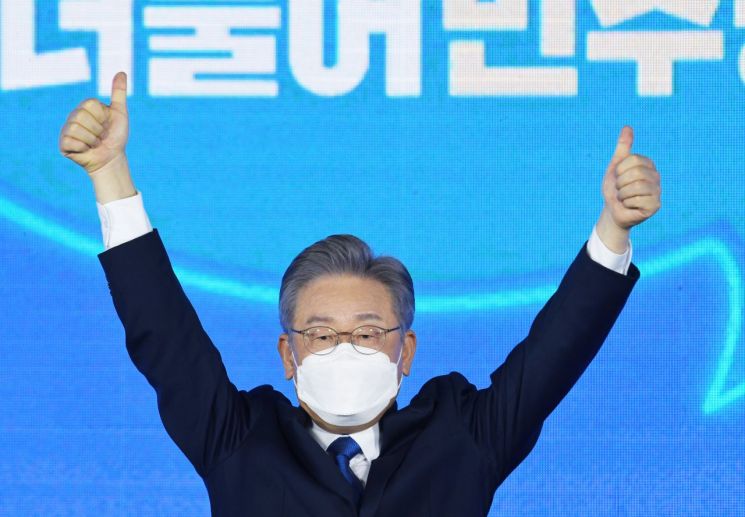 On the afternoon of the 10th, at the SK Olympic Handball Gymnasium in Olympic Park, Songpa-gu, Seoul, Lee Jae-myung, Governor of Gyeonggi Province, confirmed as a presidential candidate, raises both hands high to greet during the joint speech meeting in Seoul for the selection of candidates for the 20th presidential election. (Image source=Yonhap News)
[Sejong=Asia Economy Reporter Moon Chaeseok] Lee Jae-myung, confirmed as the Democratic Party presidential candidate, announced, "We will create the world's first country to provide universal basic income," raising expectations that the basic income pledge will become more concrete. The 'basic series'?including universal basic income, basic housing, and basic finance?targeting all citizens, is a policy not attempted even by the Moon Jae-in administration, which championed income-led growth, and has already sparked concerns and debates about its feasibility.
The core is "Providing universal basic income, basic loans, and basic housing"
The key point in Lee's acceptance speech on the 10th was the welfare 'basic series' of basic income, basic housing, and basic finance. The goal is to guarantee economic basic rights such as income, housing, and finance to alleviate polarization and revive the economy. In particular, the basic income policy involves providing 1 million KRW annually to all citizens and 2 million KRW to youth in the form of non-refundable local currency each year.
Lee pledged to start by paying 250,000 KRW in 2023 (1.25 million KRW for youth) and gradually increase the amount to realize "1 million KRW annually within the term." To secure more than 50 trillion KRW in funding, he plans to introduce new tax items such as land holding tax and carbon tax and undertake fiscal structure reforms. Specifically, he aims to secure 25 trillion KRW by revising nearly half of the 59.5 trillion KRW worth of tax exemptions and reductions scheduled for next year.
Not only basic income but also housing and finance... 'Universal provision'
Basic housing is a policy to supply 1 million public housing units where anyone without a home, including the middle class, can live for over 30 years in high-quality homes built near transit stations at construction cost-level affordable rents. Basic finance involves providing basic loans up to 10 million KRW in the form of overdraft accounts with flexible deposits and withdrawals.
The basic loan will be offered on long-term terms of 10 to 20 years with interest rates slightly higher than preferential rates, currently around 3%, and will ultimately be available to all citizens starting with youth aged 20 to 30. Additionally, Lee explained that a basic savings system will be introduced nationwide with interest rates higher than regular deposits and limits between 5 to 10 million KRW, which will be used as funding for the basic loans.
Concerns about the 'basic series' being "excessive" already emerging
Experts have expressed concerns about the effectiveness, feasibility, and overall economic impact of Lee's 'basic series.' Many believe that tax increases are inevitable to provide basic income without reducing existing welfare expenditures. The consensus is that large-scale tax hikes or government bond issuance for 'tax redistribution' to secure policy funding would impose a significant burden on the Korean economy.
Professor Sung Tae-yoon of Yonsei University's Department of Economics said, "Especially since basic income is not a one-time expenditure but requires annual funding, it is a policy that needs continuous revenue sources. Unless the state directly owns a specific resource like oil to generate large-scale income, it will be difficult to continuously secure large-scale budgets through specific-purpose tax sources."
© The Asia Business Daily(www.asiae.co.kr). All rights reserved.
![Clutching a Stolen Dior Bag, Saying "I Hate Being Poor but Real"... The Grotesque Con of a "Human Knockoff" [Slate]](https://cwcontent.asiae.co.kr/asiaresize/183/2026021902243444107_1771435474.jpg)











