Exceeding Living Noise (Loudspeaker) Standards, Noise Increased by Up to 31.8% Compared to Usual
Environmental Factors Like Tropical Nights and Night Lighting Also Affect Cicada Chirping
[Asia Economy Reporter Lim Cheol-young] It has been revealed that the cicada cries were unusually loud on summer nights due to excessively bright nighttime lighting.
On the 11th, the Seoul Institute of Health and Environment Research announced the results of a noise survey on cicada cries conducted from July to September at five locations including apartment complexes, commercial facilities, and urban parks in Seoul. The survey was conducted at a total of five sites: three residential areas consisting of large apartment complexes (Gangnam-gu A Apartment, Gangnam-gu B Apartment, Songpa-gu C Apartment), one commercial area (Jamsil Station Intersection), and one urban park (Seocho Culture and Arts Park).
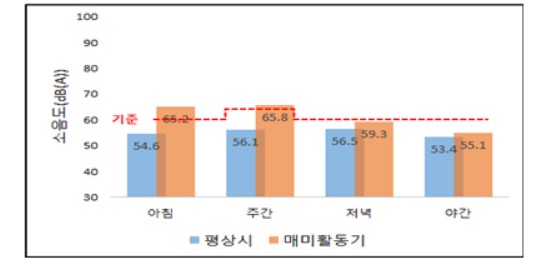
According to the institute's survey, the cicada cries were actually loud enough to exceed the noise standards for daily life noise equivalent to loudspeaker sounds. Noise from cicada activity increased by 2.0 to 31.8% compared to usual noise levels, and when analyzing only the cicada activity period, the rate of exceeding daily noise standards and the duration of exceedance per day were found to be 0-50% and 0-19 hours, respectively. Since there are no separate regulatory standards for cicada cries, the standards for daily life noise (loudspeaker) were applied.
The institute analyzed that "the reason why cicada cries differ depending on the survey location is due to various factors such as dominant species in the habitat, species type, habits, population density, natural enemies, and natural environments like green spaces."
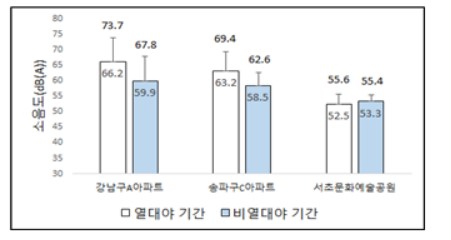
In addition, environmental factors caused by human activities such as tropical nights and nighttime lighting were also found to potentially cause noise problems from cicada cries late into the night. In apartment complexes affected by the urban heat island effect, noise levels during tropical nights were significantly 8-10% higher than during non-tropical nights, while in urban parks with abundant greenery and relatively lower temperatures, the periods of tropical nights were fewer and noise levels showed no significant difference compared to non-tropical nights.
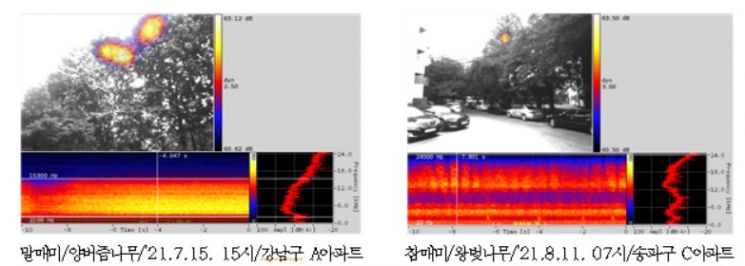
Based on acoustic camera observations showing sound source locations and sound patterns, the institute analyzed that the species causing noise from cicada cries in urban areas are three types: Malmaemi, Chammaemi, and Sseureummaemi. Malmaemi and Chammaemi inhabit residential spaces such as gardens within apartment complexes and green areas in commercial districts, while Sseureummaemi inhabits urban parks rich in greenery, showing different dominant species depending on the environment.
Accordingly, the institute suggested measures such as changing habitat environments through tree replacement, expanding green spaces, and using eco-friendly lighting to reduce cicada cries and minimize citizen discomfort. First, they advised replacing or mixing broadleaf trees such as Mongolian oak and cherry trees, which are host plants for Malmaemi and Chammaemi, with conifers like Korean nut pine, Japanese red pine, Korean pine, or fruit trees to encourage the habitat and feeding activities of natural predators such as birds and squirrels. They also recommended creating and expanding green buffer zones such as natural parks, urban parks, and small ecological gardens that can serve as soundproof forests and mitigate urban heat island effects. Furthermore, they proposed replacing excessively bright nighttime lighting with eco-friendly lighting or adjusting light intensity to prevent cicada cries.
Shin Yong-seung, director of the Seoul Institute of Health and Environment Research, said, “Due to climate change and urbanization, the population of certain cicada species has increased, raising concerns about citizen discomfort caused by cicada cries, which led us to conduct this survey.” He added, “We will continue research to find ways for citizens and insects to coexist naturally, such as creating and expanding green spaces.”
© The Asia Business Daily(www.asiae.co.kr). All rights reserved.



















