Higher Support Response Rate Than Other Allies
Taiwan Support Approval Up 11%P From Last Year
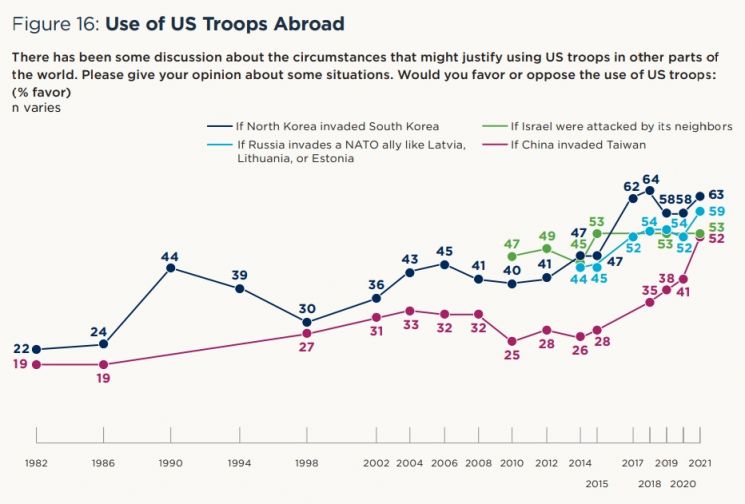
[Asia Economy Reporter Hyunwoo Lee] A survey conducted by the Chicago Council on Global Affairs (CCGA), a U.S. public opinion think tank, revealed that 63% of Americans responded that U.S. troops should support South Korea in the event of a North Korean invasion. The response rate indicating the need to support South Korea was the highest among the major U.S. allies and partner countries.
On the 7th (local time), the Chicago Council on Global Affairs (CCGA) released the results of the "Perceptions of the Biden Administration's Foreign Policy" survey conducted from July 7 to 26 on its website. According to the survey results, 63% of respondents answered that U.S. troops should support South Korea's defense if North Korea attacks South Korea.
The response rate to this question increased by 5 percentage points from 58% last year, marking the second-highest figure after the record high of 64% in 2018. This is attributed to heightened awareness of North Korea's repeated ballistic missile launches and violations of United Nations Security Council resolutions.
Response rates regarding support for other U.S. allies were lower compared to support for South Korea. The response rate for U.S. military support if NATO member countries such as Latvia, Lithuania, and Estonia were invaded by Russia was 59%. Additionally, Israel, known as a key U.S. ally, received a 53% response rate for support in case of invasion by neighboring countries.
The response rate for U.S. military support if Taiwan were invaded by China reached 52%, marking the first time a majority response was recorded. This is an 11 percentage point increase from 41% in last year's survey. This is analyzed as an effect of the establishment of military agreements aimed at countering China, such as the Quad and AUKUS, including military confrontations between the U.S. and China in the South China Sea, as well as increased Chinese military demonstrations and provocations around the Taiwan Strait.
The CCGA stated, "This is the result of the Biden administration focusing its foreign policy on restoring alliances," and added, "Public support for the use of U.S. military power for the security of allies or partners has remained stable or increased compared to the Donald Trump administration."
Meanwhile, the response rate for perceiving South Korea as an ally was 41%, following France (52%), Germany (45%), and Japan (44%). Including responses that viewed South Korea as a necessary partner (26%), 67% of all respondents viewed relations with South Korea favorably. In contrast, 62% responded that North Korea is a hostile country, and 10% said it is a rival requiring competition.
Additionally, 63% of respondents expressed favorable views toward South Korean President Moon Jae-in. Only 5% had favorable views of North Korean Supreme Leader Kim Jong-un, while 93% did not. Regarding North Korea, 76% supported official peace agreement negotiations in exchange for halting the nuclear weapons program, while only 24% supported peace agreement negotiations while allowing nuclear weapons possession.
Seventy percent of respondents said that North Korea should be isolated and pressured with economic sanctions as long as it continues to develop its nuclear weapons program. Among them, 35% supported military action to force North Korea to abandon its nuclear weapons.
© The Asia Business Daily(www.asiae.co.kr). All rights reserved.
![Clutching a Stolen Dior Bag, Saying "I Hate Being Poor but Real"... The Grotesque Con of a "Human Knockoff" [Slate]](https://cwcontent.asiae.co.kr/asiaresize/183/2026021902243444107_1771435474.jpg)















