Female employees 'Black mascara prohibited', male employees 'Hairstyles must show forehead'
"Is this Joseon Dynasty?" vs "This is proper etiquette" divided opinions
Expert "Excessive dress code restricts freedom of choice"
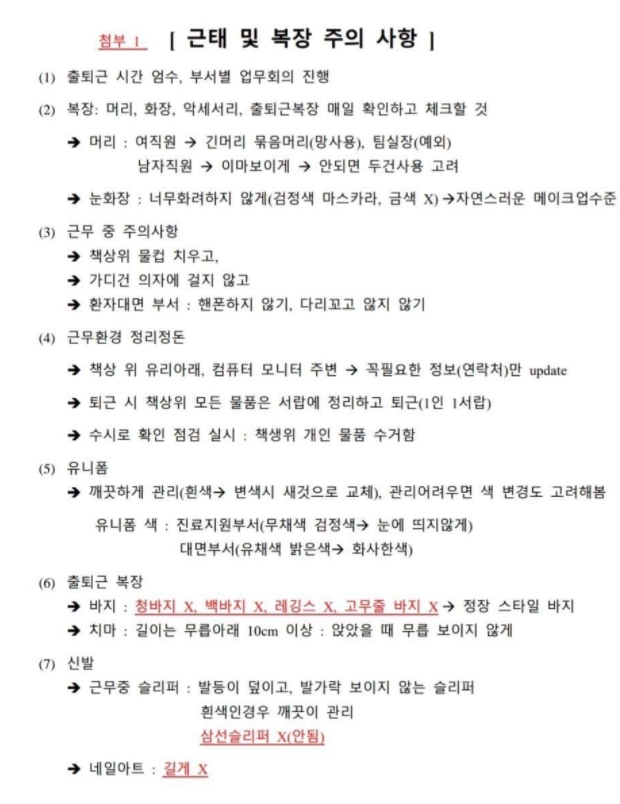 On the 2nd, the 'Attendance and Dress Code Notice' of a hospital in Ansan-si, Gyeonggi Province was posted on the Facebook account 'Nurse Bamboo Forest.' Photo by Facebook capture
[Asia Economy Reporter Kang Joo-hee] At a hospital in Ansan, Gyeonggi Province, there have been claims that excessive dress code regulations are being imposed on employees, such as "skirt length must be at least 10cm below the knee" and "black mascara is prohibited."
Opinions among citizens who saw this were divided. While some criticized the rules as outdated, others believed that such dress etiquette should be observed in the workplace. Experts suggested that dress codes aimed at enhancing the company's image should be within the bounds of common sense.
On the 2nd, a post appeared on the Facebook account "Nurse Bamboo Forest" stating, "It's almost 2022, but there is a hospital acting like it's the 1980s," along with a notice titled "Attendance and Dress Code Precautions" from the hospital. The notice clearly specifies regulations regarding precautions during work, tidying up the work environment, and dress code for commuting (pants, skirts, shoes), among others.
While some regulations covered basic workplace requirements, some were somewhat excessive. The notice states that for pants, "jeans, white pants, leggings, and elastic-waist pants" are prohibited, and only "formal style pants" are allowed. Regarding skirts, it is stipulated that "the length must be at least 10cm below the knee, and the knees should not be visible when sitting."
For hairstyles, female employees with long hair or tied hair must use a hairnet, and male employees must show their forehead. If not, they are instructed to wear a head covering. The female employee section also includes the phrase "team leader exception."
Additionally, there are rules such as "eye makeup should not be too flashy," "black or gold mascara is prohibited," "long nail art is prohibited," and "slippers that expose toes are prohibited." Precautions during work include "do not cross legs," "do not use mobile phones," and "do not hang cardigans on chairs."
Netizens who saw this reacted by calling the regulations outdated. Comments on the post included "It smells like a strict authoritarian," "You shouldn't go to such places in the first place," and "Is this the Joseon Dynasty?" expressing general disbelief. One netizen, who identified as a nurse with 24 years of experience, criticized, "I'm ashamed in front of my juniors. Even if you can't lead the trend, at least follow it."
On the other hand, some believed that such dress etiquette should be maintained. One netizen said, "Although it's specifically stated, most people follow similar rules," adding, "Wearing leggings or short skirts at work seems inappropriate."
Meanwhile, according to a survey, 8 out of 10 office workers feel frustrated by company dress code restrictions. In a 2019 survey conducted by Saramin targeting 1,763 office workers, 79.6% of respondents said "there are company dress code restrictions," and among those working at companies with dress codes, 54% said "they feel inconvenienced by it." Furthermore, 78.7% responded positively to the idea of relaxing dress codes at work.
Conversely, among the 375 office workers who viewed dress code relaxation negatively, reasons included "it seems disrespectful in the workplace" (57.1%), "there could be inappropriate dressers" (42.1%), "formal attire is necessary due to the nature of the work" (19.5%), and "discipline might weaken" (16.3%).
Regarding the dress code notice, a hospital official told Asia Economy in a phone interview, "Recently, some employees have been growing their hair excessively long or wearing large accessories. Since this is a profession that deals with patients, it was intended to encourage neat attire." They added, "The 'commuting dress code' mentioned in the notice was mistakenly written; it should be 'work attire.' Commuting dress is fine however employees want, but during work, wearing jeans or short skirts is discouraged."
An expert pointed out that excessive dress regulations without reasonable grounds could infringe on freedom of choice. Labor attorney Kim Hyo-shin (Sonamu Labor Law Office) said, "Dress codes aimed at enhancing the company's image should be at a level acceptable by general common sense. In this hospital notice, restrictions on clothing other than leggings seem unnecessary, and the rule that slippers must not expose toes is excessive. Also, the clause that exempts team leaders constitutes discrimination against other employees."
They continued, "There is no specific law that penalizes internal dress codes. Complaints about excessive dress regulations can be submitted to the Anti-Corruption and Civil Rights Commission."
© The Asia Business Daily(www.asiae.co.kr). All rights reserved.
![Clutching a Stolen Dior Bag, Saying "I Hate Being Poor but Real"... The Grotesque Con of a "Human Knockoff" [Slate]](https://cwcontent.asiae.co.kr/asiaresize/183/2026021902243444107_1771435474.jpg)

















