[Asia Economy Yeongnam Reporting Headquarters Reporter Choi Soon-kyung] Hapcheon-gun, Gyeongsangnam-do announced on the 5th that the ‘Samga Burial Mounds’ (三嘉古墳群) have been preliminarily designated as a national historic site through the Cultural Heritage Administration.
The Samga Burial Mounds are scheduled to be designated as a nationally designated cultural heritage historic site after a 30-day public notice period to collect opinions, followed by a review by the Cultural Heritage Committee. The Hapcheon Samga Burial Mounds are a large-scale inland burial mound cluster in Gyeongnam and are recognized as representative Gaya tomb remains of Hapcheon along with the Okjeon Burial Mounds.
The burial mound cluster is a group of tombs of a power that grew based on cultural exchanges through the Namgang River, with over 330 large and small earthen mounded tombs confirmed.
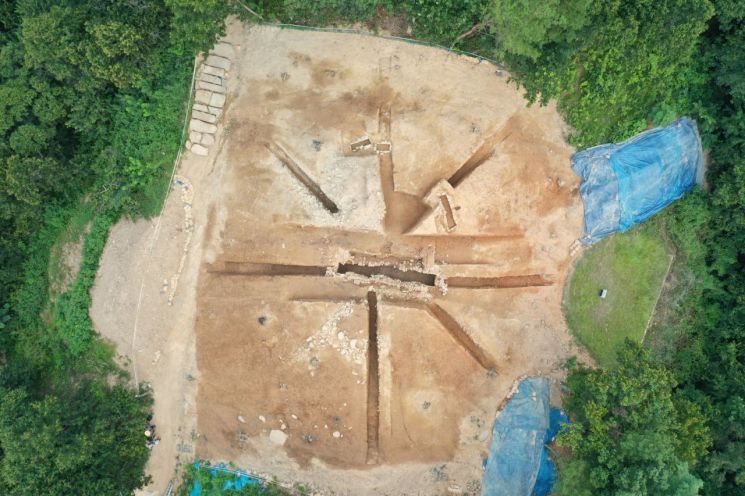
Since the first excavation survey in 1981, a total of eight trial and excavation surveys have been conducted until 2021. During this period, about 40 earthen mounded tombs, 50 wooden coffin tombs, and 120 stone coffin tombs have been identified.
In particular, continuous investigations have been carried out starting with a detailed surface survey in 2018, followed by Gajigu Tomb No. 24 in 2019, Dajigu Tombs No. 69 and 70 in 2020, and Gajigu Tomb No. 52 in 2021.
Through excavation surveys at the Hapcheon Samga Burial Mounds, the unique tomb structure of the Samga-style burial mounds in the Samga area has been confirmed in small to medium-sized earthen mounded tombs.
The Samga-style burial mound involves burying the main burial chamber within a single mound, then cutting into part of the mound to create a new main burial chamber. This process is repeated multiple times, resulting in the completion of one large mound. A characteristic feature is expanding the burial area without destroying each main burial chamber.
Samga-style burial mounds have been identified not only around the Samga Burial Mounds but also in the Soori Burial Mounds, Angye-ri Burial Mounds, Uiryeong Cheongok-ri Burial Mounds, as well as in the Namgang River basin’s Sancheong Myeongdong Burial Mounds and Jinju Gajwadong Burial Mounds.
County Governor Moon Jun-hee stated, “We have been working with Gyeongsangnam-do to proceed with the national historic site designation of the Samga Burial Mounds,” and added, “We will do our best to ensure that maintenance and research investigations on the burial mounds proceed smoothly even after the historic site designation.”
© The Asia Business Daily(www.asiae.co.kr). All rights reserved.