Low Interest Rate Trend Keeps Interest Payments
at 7-8 Trillion Won Without Significant Increase
Funding Costs to Rise if Interest Rates Increase Further
Government: "Considering Possible Rate Hikes, Setting Higher Bond Interest Rates"
Experts: "Preemptive Securing of Fiscal Capacity... Bold Spending Restructuring Needed"
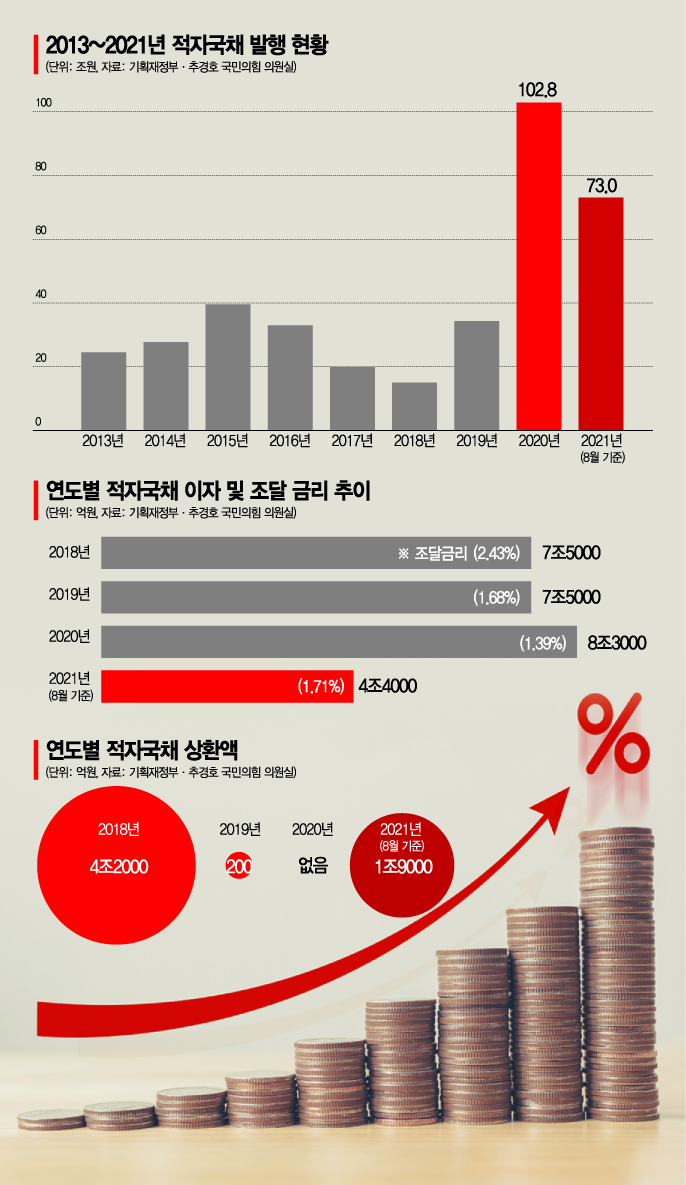
[Asia Economy Reporter Jang Sehee] Deficit bonds require interest payments from taxpayers' money, so their issuance must be approached with caution. Under the Moon Jae-in administration, not only the scale but also the speed of issuance has accelerated, inevitably leading to a burden on the public. Especially considering that the Bank of Korea has already raised the base interest rate once and is likely to raise it again within the year, the interest burden on deficit bonds is expected to increase accordingly.
According to the '2018?2021 Deficit Bond Interest Status' submitted by the Ministry of Economy and Finance to Choo Kyung-ho, a member of the National Assembly's Planning and Finance Committee from the People Power Party, the interest payment on deficit bonds last year amounted to 8.3 trillion won. In 2018 and 2019, the payments were 7.5 trillion won each year. As of August this year, the interest payment on deficit bonds was 4.4 trillion won.
◆ Interest Payments of 7 to 8 Trillion Won... Impact of Low Interest Rates = Although the issuance scale of deficit bonds increased by 55% compared to the previous administration under the Moon government, the interest payments did not increase significantly due to 'low interest rates.'
An official from the Ministry of Economy and Finance explained, "Interest payments are influenced by the issuance interest rate," adding, "Because the recent low interest rate trend progressed rapidly, the interest payments did not rise significantly relative to the issuance scale."
Looking at the average annual government bond procurement interest rate, it fell from 2.43% in 2018 to 1.68% in 2019, and further down to 1.39% last year. The average government bond procurement interest rate up to August this year is 1.71%.
Although the government bond procurement interest rate remained low due to the low interest rate trend, if further rate hikes are implemented in the future, the procurement interest rate for newly issued government bonds will inevitably rise.
Representative Choo pointed out, "If additional rate hikes occur, the resulting fiscal burden is expected to increase further," emphasizing, "Proactive preparation is necessary."
The Bank of Korea raised the base interest rate from 0.5% to 0.75% in August, moving away from the ultra-low interest rate environment. Considering the recent surge in household debt and inflationary pressures, the possibility of another base rate hike within this month cannot be ruled out.
Bank of Korea Governor Lee Ju-yeol stated in August, "We plan to gradually adjust the degree of monetary policy easing in line with the extent of economic improvement," suggesting that an additional rate hike could occur as early as this month.
◆ Additional Rate Hikes... Increased Interest Cost Burden = Experts also predict that the interest burden will increase further due to additional rate hikes. Professor Andonghyun of Seoul National University’s Department of Economics said, "An additional rate hike is expected either this month or next month," adding, "The interest cost burden will also increase significantly."
Professor An also emphasized the need to proactively secure fiscal capacity, considering the potential increase in interest burden. He stated, "The national debt-to-GDP ratio is expected to approach 60% at 58.8% by 2025," and stressed, "From now on, part of the increased tax revenue should be used for repayment to secure fiscal capacity."
Professor Kim Sangbong of Hansung University’s Department of Economics also highlighted, "If deficit bonds are newly issued after the rate hike, the interest burden could increase sharply," and stressed, "We need to proceed with repayment through expenditure restructuring." He added, "Since Korea is not a key currency country, there are not many buyers even if government bonds are excessively issued."
Professor Kim Taegi of Dankook University’s Department of Economics emphasized, "Bold restructuring is necessary, such as eliminating temporarily increased expenditures during the COVID-19 situation."
The government views the risk as not significant in the future, considering that it has set government bond interest rates higher in anticipation of rate hikes and market interest rate increases. In fact, the government raised the government bond interest rate from 2.4% this year to 2.6% next year, an increase of 0.2 percentage points. However, given the rapid increase in national debt due to COVID-19 and other factors, the government intends to manage this thoroughly.
Deputy Minister Ahn Dogeol of the Ministry of Economy and Finance previously stated, "National debt is increasing rapidly, and the medium- to long-term fiscal conditions, such as low birthrate and aging population, are not very favorable," adding, "We will intensify efforts to maintain fiscal soundness in line with the economic recovery."
However, the government's practice of setting high interest rates for treasury bonds has also been criticized during the national audit. This is because the habit of overestimating costs by setting high interest rates has been repeated.
According to data received by Yong Hye-in, a member of the National Assembly's Planning and Finance Committee from the Basic Income Party, from the Ministry of Economy and Finance, the government allocated an average of 19.9 trillion won for treasury bond interest budgets when submitting the main budget proposal for 10 years from 2012 to 2021, but the National Assembly reduced it to an average of 18.7 trillion won. The actual execution cost was only 17.5 trillion won. This means the government overestimated the budget by an average of 2.4 trillion won annually.
An official from the Ministry of Economy and Finance explained, "Since interest rates appear to be rising as a trend, they have been set somewhat higher," adding, "Even if interest rates rise, the impact will likely be limited to newly issued bonds after the rate hike."
© The Asia Business Daily(www.asiae.co.kr). All rights reserved.

















