Network Usage Fees Also Raised at Audit... Google and Netflix Representatives Testify
Criticism of OTT Promotion Policies as Mere Words... Controversy Over Fairness with Overseas Companies
"There is no policy, only reverse discrimination."
While the global online video service (OTT) giant Netflix has set unprecedented records with its original Korean content "Squid Game," domestic OTT providers are suffering in silence. This is because the government-promised domestic OTT promotion policies, including tax credits, have stalled without even taking the first step. Amid a prolonged policy vacuum, controversy over reverse discrimination against overseas OTTs like Netflix?which generate huge revenues in Korea but do not pay any network usage fees?is intensifying. Currently, the network usage fee issue is also under scrutiny in the National Assembly’s audit.
◇Network Free Riding and OTT Policies on the National Assembly Audit Table
According to the National Assembly and industry sources on the 5th, the National Assembly Science, Technology, Information and Broadcasting and Communications Committee’s audit will mainly address controversies over the ‘power abuse’ of online platform companies, as well as the network free riding by overseas content providers (CPs) including Netflix, and OTT promotion policies.
Network free riding was also pointed out on the first day of the audit on the 1st. Lawmakers from both ruling and opposition parties in the committee are paying attention to the fact that amid the rapid growth of the OTT market due to the spread of non-face-to-face activities caused by COVID-19, certain overseas CPs are placing a heavy burden on domestic networks, leading to consumer harm.
On the 5th, direct stakeholders involved in network usage fees such as Netflix, Google, and Facebook are scheduled to attend, drawing attention. Netflix previously lost the first trial in a lawsuit claiming it has no obligation to pay network usage fees but has appealed the decision. Google also does not pay network usage fees.
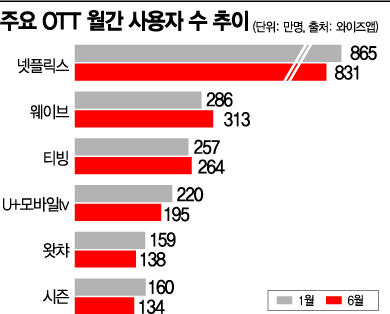
On the other hand, domestic OTT providers, which have lower revenues and are operating at a loss compared to overseas operators, pay network usage fees regularly every year. Based on last year’s figures, operating losses were 16.9 billion KRW for Wavve, 6.1 billion KRW for TVING, and 12.6 billion KRW for Watcha. An industry insider criticized, "Overseas operators generate large revenues through domestic operations but do not bear costs such as network usage fees and taxes related to business management," adding, "This is reverse discrimination, placing domestic companies at a competitive disadvantage not only in terms of capital but also costs."
Kim Sang-hee, Deputy Speaker of the National Assembly, pointed out, "Some operators are causing a surge in network traffic, and among the top 10 operators, overseas CPs account for more than 80% in reality," emphasizing, "There is a need to improve the system to prevent free riding."
Independent lawmaker Yang Jeong-sook also criticized Netflix for lowering its operating profit margin by transferring 77% of its domestic revenue to its headquarters as commission, thereby evading taxes, stating, "Netflix’s overall revenue and corporate value have greatly increased thanks to the success of K-content, so it must fulfill its responsibilities in Korea. Urgent measures are needed to prevent tax and network usage fee evasion." Last year, Netflix’s domestic revenue was in the 400 billion KRW range, but corporate tax was only about 2.17 billion KRW.
◇No News on OTT Promotion Policies Including Tax Support
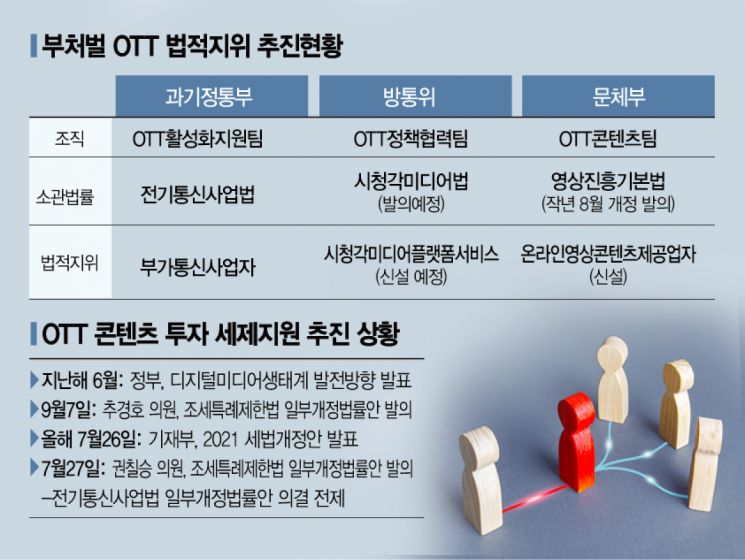
Criticism is also mounting that the government, which should lead efforts to improve reverse discrimination, has not prepared even minimal support or promotion policies for domestic OTT providers. As ministries compete to secure jurisdiction over OTT, the establishment of relevant systems is being neglected.
Wavve, a leading domestic OTT, expressed concerns in a report submitted to the National Assembly ahead of the audit, stating, "Due to legislative competition and regulatory tightening among ministries, the policy direction of the ‘minimum regulation principle’ has been lost," and "Institutional improvements such as amendments to the Telecommunications Business Act to strengthen domestic OTT competitiveness, self-rating systems, and tax support are being delayed."
Last June, the government announced a plan to develop the digital media ecosystem, expanding the current production cost tax credit to OTT and granting a self-rating system for OTT content without going through the Video Rating Board. However, even after a year, no legal basis for OTT has been established. The ‘Amendment to the Restriction of Special Taxation Act,’ which includes tax support, can only be enacted after the legal basis for OTT is established.
Moreover, as the Korea Communications Commission, Ministry of Science and ICT, and Ministry of Culture, Sports and Tourism compete over OTT legislation, concerns are growing that the ‘minimum regulation principle’ at the inter-ministerial level is fading and that regulations may be strengthened only on domestic platforms.
Wavve argued, "Although online platforms compete beyond borders, regulations are being tightened only on domestic platform companies, raising concerns about another form of reverse discrimination," and insisted that urgent measures are needed to maintain ▲the minimum regulation principle ▲create a fair competitive environment by eliminating reverse discrimination against global operators ▲and establish effective government support plans for the OTT market.
© The Asia Business Daily(www.asiae.co.kr). All rights reserved.


















