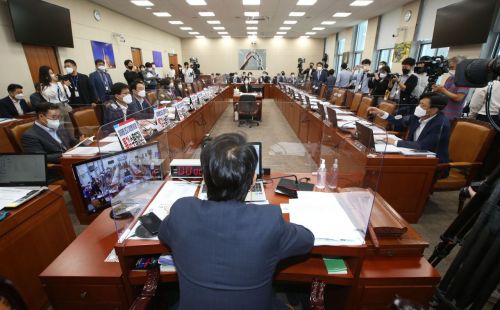
[Asia Economy Reporter Seulgina Jo] On the first day of the last National Assembly audit during the Moon Jae-in administration on the 1st, the National Assembly Science, Technology, Information and Broadcasting and Communications Committee's audit raised issues regarding platform monopolies, 5G mobile communication, and the controversy over overseas content providers (CPs) such as Netflix, which generate massive traffic domestically but do not pay any network usage fees. On the upcoming audit on the 5th, a Netflix witness is expected to appear, and the 'free-riding on networks' controversy is anticipated to be addressed more intensively.
Kim Sang-hee, Deputy Speaker of the National Assembly, pointed out during the audit targeting the Ministry of Science and ICT that "some operators are causing a surge in network traffic, and among the top 10 operators, six are overseas companies," adding, "Their share practically accounts for more than 80%."
With the rapid expansion of the online video service (OTT) market fueled by the spread of non-face-to-face activities due to COVID-19, it was explained that certain overseas CPs are placing a heavy burden on domestic networks, leading to consumer harm. Deputy Speaker Kim emphasized, "Although network stability obligations were imposed on five operators accounting for more than 1% of traffic and having over one million users, there has been no effect at all," and stressed, "We need to induce overseas CPs to invest."
The controversy over free-riding on networks by global CPs including Netflix is not new. Despite earning huge profits based on domestic infrastructure, they do not pay network usage fees, which has been repeatedly criticized in the National Assembly. This sharply contrasts with domestic CPs such as Naver and Kakao, which pay hundreds of billions of won annually in network usage fees to Internet Service Providers (ISPs), cooperating in stable network management and network expansion. However, Netflix, which is currently refusing to pay network usage fees domestically and is engaged in legal battles, has been confirmed to pay network usage fees to overseas ISPs such as Comcast, Verizon, and AT&T.
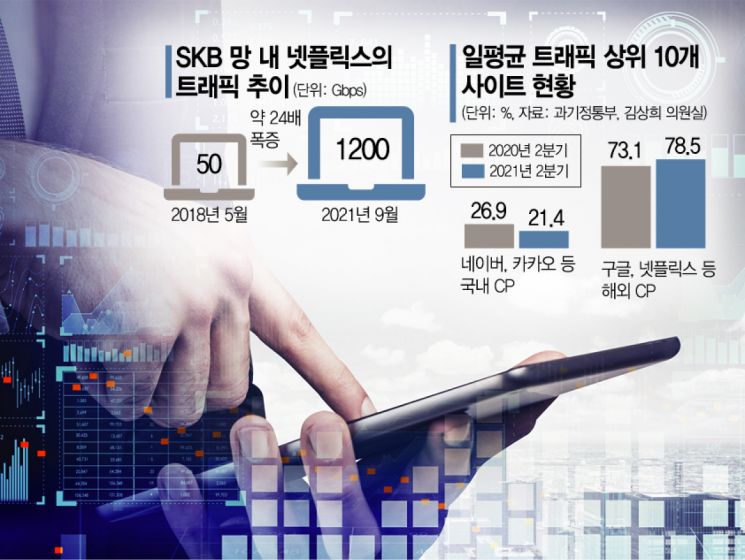
After losing a declaratory judgment lawsuit against SK Broadband claiming non-existence of debt, Netflix filed an appeal in disagreement. In response to Netflix's refusal to accept even the first trial court ruling, SK Broadband filed a counterclaim on the 30th of last month under the civil law principle of unjust enrichment to claim actual network usage fees for three years. This is the first direct refund lawsuit regarding network usage fees worldwide.
In particular, looking at Netflix's recent actions, despite the passage of the amendment to the Telecommunications Business Act last year, known as the 'Netflix Free-Riding Prevention Act,' which introduced provisions to secure service stability for value-added telecommunications businesses, it has been confirmed that it was insufficient to prevent overseas CPs from free-riding on networks. Deputy Speaker Kim said on this day, "There is a need for institutional improvements to prevent free-riding," and urged, "We are preparing related legislation, and we ask the government to actively participate."
Minister Lim also expressed the need for government-level guideline legislation. He responded, "There are no measures for the massive traffic caused by overseas CPs," and "Network usage fees are subject to voluntary negotiation between operators, but overall guideline legislation is necessary."
The controversy over free-riding on networks by overseas CPs including Netflix is expected to be addressed more intensively at the National Assembly Science and ICT Committee's audit on the 5th. Netflix Services Korea has been selected as a general witness.
Netflix is expected to emphasize at this hearing that it is revitalizing the content ecosystem through investment in Korean content. Netflix recently held a 'Partner Day' media event and released survey results showing an economic ripple effect of 5.6 trillion won over five years through investment in Korean content. As movements targeting platform operators have continued across standing committees ahead of the audit, Netflix hurriedly began emphasizing coexistence and mutual growth.
However, criticism is pouring in that Netflix's actions, which call for mutual growth while ignoring the obligation to pay network usage fees and tax avoidance controversies, are inappropriate. The long-standing issues pointed out in the National Assembly regarding payment of network usage fees and tax obligations are being ignored, and there are criticisms that boasting about coexistence and mutual growth lacks sincerity. Some express concerns that Netflix, which is reaping significant benefits worldwide from Korean content hits like 'D.P' and 'Squid Game,' may monopolize domestic content rights and intellectual property (IP), potentially reducing Korea to a content subcontractor in the future.
Meanwhile, during the Science and ICT Committee audit, voices calling for regulation of domestic platform companies such as Naver and Kakao, recently embroiled in monopoly controversies, were raised across party lines. However, the Ministry of Science and ICT took a cautious stance, stating that the positive aspects of platforms should not be overlooked.
Additionally, lawmakers from both ruling and opposition parties criticized the still expensive 5G fees and quality even in the third year of service commercialization. Regarding the construction of 28 GHz 5G base stations, known as 'real 5G,' it is expected that the three mobile carriers will practically be unable to meet the mandatory construction rate within the year, prompting calls for government policy changes that consider market realities.
© The Asia Business Daily(www.asiae.co.kr). All rights reserved.