KDI September North Korean Economic Review Paper
"Expanding Engagement with the North Korean Market in Inter-Korean Economic Cooperation"
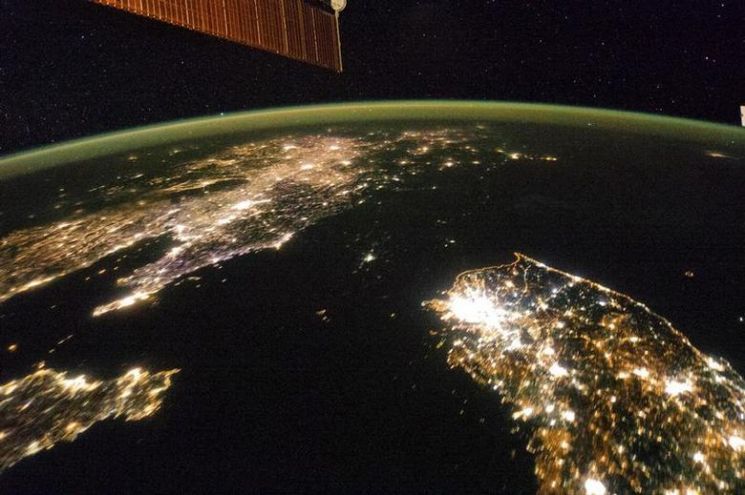
[Sejong=Asia Economy Reporter Moon Chaeseok] A study has revealed that since 2017, the entire North Korea, except for some regions where trade has been activated despite strengthened United Nations (UN) sanctions, has suffered significant economic damage. Nighttime luminosity decreased by about 5.4% annually, and most areas without active trade were estimated to have been directly hit.
Senior Researcher Kim Daul of the Institute for Unification and Peace Studies explained this in the paper titled "Determinants of Regional Economic Levels and the Effects of Sanctions in North Korea during the Kim Jong-un Era: An Analysis through Nighttime Luminosity," published in the September issue of the "North Korean Economic Review" released by the Korea Development Institute (KDI) on the 30th. This study analyzed the economic levels of city and county-level regions during Kim Jong-un's tenure using North Korean satellite nighttime luminosity data. The effects of UN sanctions were analyzed across three sectors: markets, trade, and official industries, which connect to the North Korean economy.
The factors having the greatest impact on North Korea's economic growth were found to be "market size" and "accessibility to trade hubs." When the market size increased by one quartile (a unit dividing 100% into four parts, with one unit being 25%, i.e., 0.25), the regional nighttime luminosity rose by an average of 5.3%. According to Researcher Kim, since the 2017 UN sanctions, the average nighttime luminosity across North Korean regions has decreased by about 5.4%, which implies that the market size has shrunk by 25%. In 2017, the UN imposed sanctions citing North Korea's nuclear tests, including a complete ban on imports of North Korean coal, iron ore, and seafood by UN member states; a ban on imports of North Korean textiles and finished clothing products; and export bans on industrial machinery and transportation equipment to North Korea.
Researcher Kim explained, "The sanctions (by the UN) have on average reduced regional nighttime luminosity in North Korea by 5.4% annually, which is a shock comparable to the market size shrinking by one quartile." He added, "During the period of sanctions, the positive effects of market size and trade hub accessibility disappeared, resulting in no difference in nighttime luminosity between regions with large market sizes and high trade accessibility and those without. This suggests that sanctions affect the regional economy of North Korea beyond just the trade sector, where direct restrictions are imposed."
Researcher Kim advised that South-North economic cooperation policies should be implemented after thoroughly assessing not only trade sanctions but also market conditions throughout North Korean regions. He suggested, "From the perspective of regional economies, the factors contributing to North Korea's economy during the Kim Jong-un era are markets and trade, with markets having a universal impact. When evaluating North Korea's economic performance, it is necessary to consider the private economic sector, including markets, importantly. If the expansion of markets is set as a detailed goal in inter-Korean economic cooperation, it will be possible to achieve both economic development and the mitigation of regional inequality in North Korea."
© The Asia Business Daily(www.asiae.co.kr). All rights reserved.
![Clutching a Stolen Dior Bag, Saying "I Hate Being Poor but Real"... The Grotesque Con of a "Human Knockoff" [Slate]](https://cwcontent.asiae.co.kr/asiaresize/183/2026021902243444107_1771435474.jpg)















