"No Hostile Intentions Toward North Korea" Reiterating Existing Principles
Alert to North Korea's Nuclear Force Enhancement... US, UK, France Convene Security Council
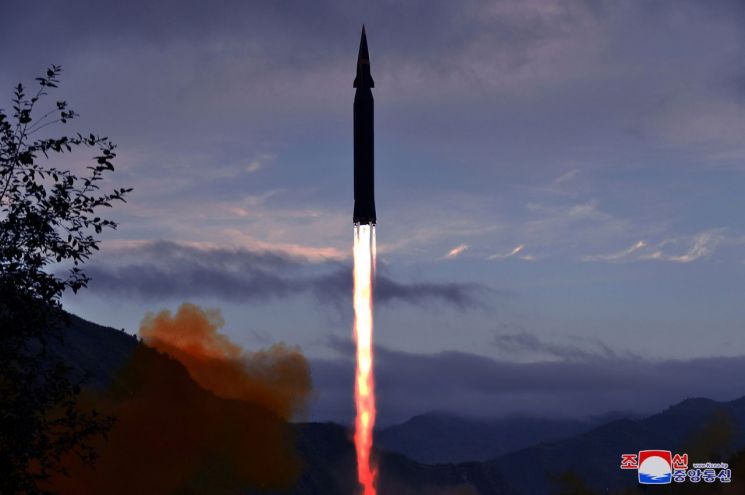
[Asia Economy Reporter Hyunwoo Lee] In response to North Korean Supreme Leader Kim Jong-un's speech claiming that the U.S. government continues its hostile policy toward North Korea, the U.S. State Department urged diplomatic engagement, stating that it has no hostile intent and is ready to engage in talks with North Korea without preconditions. However, regarding North Korea's recent test launch of a new missile, the U.S. announced it would convene a United Nations Security Council (UNSC) meeting, indicating its intention to pursue both diplomatic and security responses in line with existing policies. Experts predict that the U.S. North Korea policy will not undergo significant changes, as the U.S. government currently prioritizes domestic issues such as COVID-19 and views North Korea's provocations as still manageable.
On the 29th (local time), a U.S. State Department spokesperson responded in writing to domestic media inquiries about Kim Jong-un's remarks, stating, "The United States harbors no hostile intent toward North Korea," and "We are prepared to meet with North Korea without preconditions and hope that North Korea will respond positively to our outreach."
He added, "Our policy is a coordinated and pragmatic approach that seeks diplomacy with North Korea and remains open to diplomatic engagement," and "We strongly support inter-Korean cooperation and believe it plays a crucial role in creating a more stable environment on the Korean Peninsula." This is interpreted as a fundamental response aligned with the 'pragmatic approach' North Korea policy framework announced by the Biden administration in April.
Additionally, the U.S. government is reported to have led the effort, along with the United Kingdom and France, to convene a UNSC meeting. According to AFP, the Security Council plans to hold a closed-door meeting on the 30th to respond to reports of North Korea's hypersonic missile test launch, at the request of the U.S., U.K., and France. AFP noted that all Western countries except China and Russia, two of the five permanent members of the Security Council, are participating, suggesting that the U.S. likely spearheaded this meeting.
While keeping diplomatic channels open with North Korea, the U.S. government is analyzed to have led the Security Council meeting to pressure North Korea through sanctions, consistent with its existing policy of combining diplomacy with security measures. From the U.S. perspective, there is concern that if North Korea acquires and deploys hypersonic missiles?currently under development competition by Russia and China?it could impact regional security dynamics.
Kin Moy, U.S. State Department Principal Deputy Assistant Secretary for East Asian and Pacific Affairs, emphasized in a keynote speech at the annual forum co-hosted by the Korea Foundation and the U.S. think tank Atlantic Council in Washington the previous day, "North Korea's missile launches violate multiple United Nations Security Council resolutions and pose a threat to neighboring countries and the international community." He further pointed out, "North Korea's illicit weapons of mass destruction and ballistic missile programs constitute a serious threat to international peace and security and undermine the global nonproliferation regime."
Experts analyzed that while the recent provocation involving a new missile is threatening, it is unlikely to prompt immediate significant changes in the U.S. North Korea policy framework. James Kim, Director of the U.S. Studies Center at the Asan Institute for Policy Studies, explained, "From the U.S. perspective, domestic issues such as COVID-19 and economic problems are the most urgent. Although North Korea continues provocations like missile launches, it has not conducted any public nuclear tests since 2017, maintaining provocations at a level manageable from the U.S. standpoint, making it difficult to attract immediate major attention."
© The Asia Business Daily(www.asiae.co.kr). All rights reserved.
![Clutching a Stolen Dior Bag, Saying "I Hate Being Poor but Real"... The Grotesque Con of a "Human Knockoff" [Slate]](https://cwcontent.asiae.co.kr/asiaresize/183/2026021902243444107_1771435474.jpg)
















