Card Approval Amount Increases for 7 Consecutive Months Since February
Government Subsidies Expected to Boost Q4 Growth
Fee Revenue in Deficit... Concerns Over Card Industry's Profitability Perception
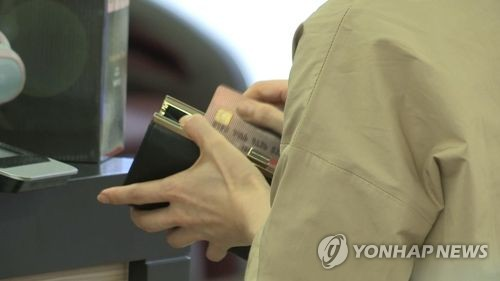
[Asia Economy Reporter Ki Ha-young] Despite the 4th wave of COVID-19, card approval amounts have maintained an increasing trend for seven consecutive months. Due to government subsidies such as the Win-Win National Support Fund and Consumption Support Fund, card spending is expected to increase in the fourth quarter as well. However, the card industry seems worried that this might be perceived as generating large profits. There are concerns that this could be used as justification for lowering merchant fees ahead of the fee reassessment scheduled for November.
According to the Credit Finance Association on the 29th, the total card (credit, check, prepaid) approval amount last month was 80.7 trillion KRW, an 8.6% increase compared to the previous year. During the same period, the number of approvals also rose by 4.8% year-on-year to 1.99 billion transactions.
Card approval amounts have been increasing for seven consecutive months since February. After a 1.9% decline in January, the growth rates were 8.9% in February, 20.5% in March, and 18.3% in April, marking nearly 20% growth for two consecutive months. Subsequently, the growth slowed to 5.4% in May, 7% in June, 6% in July, and 8.6% in August, but the amount remained above 80 trillion KRW each month, maintaining the upward trend. This is analyzed as pent-up consumption being released and consumers adapting to the prolonged COVID-19 situation. Notably, even though the number of confirmed cases exceeded 2,000 from July, entering the 4th wave of COVID-19, consumer sentiment did not significantly decline.
From this month, the increase in card approval amounts is expected to accelerate further due to various government subsidies. Following the Win-Win National Support Fund, which was paid to 88% of the entire population, the Win-Win Consumption Support Fund, a card cashback system, will be implemented from the 1st of next month, likely boosting card spending. The Consumer Confidence Index (CCSI) for September also rebounded after three months. According to the Bank of Korea, the September CCSI was 103.8, 1.3 points higher than in August.
However, the card industry is concerned that the increase in card approval amounts might be perceived as generating large profits. They worry this could lead to misunderstandings that card companies are profiting from government subsidies despite operating at a loss in fee revenue. Especially with the fee rate reassessment scheduled for November, they are anxious that politicians might use this as a basis to demand fee reductions to support small business owners and self-employed individuals facing financial difficulties. The Card Company Labor Union Council also held a press conference related to card fee reductions the day before, stating, "Questions and answers are expected at this year's National Assembly audit," and expressing concerns that "there might be calls to lower fees proportionally to the profits made from disaster relief funds and demands for fund contributions." They added, "At 96% of merchants who receive preferential fee rates, losses accumulate as sales occur," and argued, "The qualified cost reassessment system, which only benefits big tech companies, should be abolished."
© The Asia Business Daily(www.asiae.co.kr). All rights reserved.
![Clutching a Stolen Dior Bag, Saying "I Hate Being Poor but Real"... The Grotesque Con of a "Human Knockoff" [Slate]](https://cwcontent.asiae.co.kr/asiaresize/183/2026021902243444107_1771435474.jpg)















