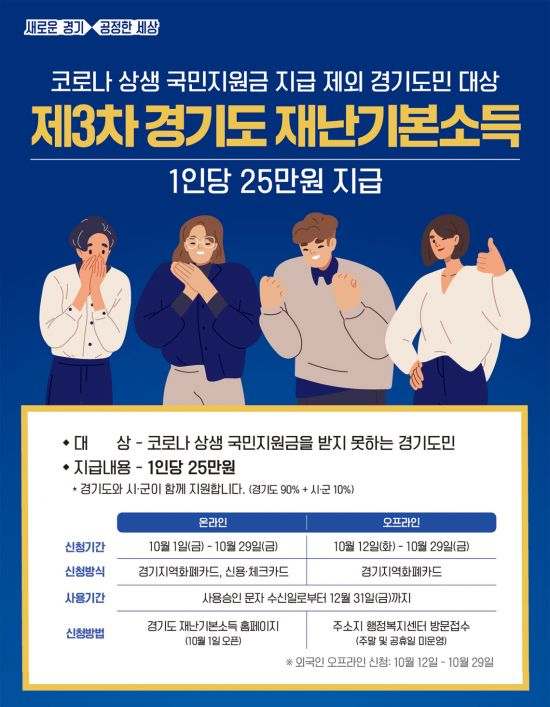
[Asia Economy (Suwon) = Reporter Lee Young-gyu] The application for the third round of Gyeonggi-do Disaster Basic Income, led by Lee Jae-myung, will begin on October 1. The third Gyeonggi-do Disaster Basic Income provides 250,000 KRW per person to approximately 2.537 million residents in the top 12% income bracket of Gyeonggi-do who were excluded from the government's national support fund. Governor Lee Jae-myung is drawing attention as the first to implement this initiative among metropolitan local governments nationwide.
Gyeonggi-do announced on the 29th that, as of midnight on June 30, it will provide the same amount as the government’s national support fund to the top 12% income earners (2.521 million Korean nationals and 16,000 foreigners) residing in Gyeonggi-do who were excluded from the government’s national support fund, and will accept applications starting October 1.
The application method will be the same as the first and second rounds, either online or on-site. Online applications will be accepted from October 1 to 29, between 9 a.m. and 10 p.m. Applicants can choose to apply using the existing Gyeonggi local currency card or one of 13 major credit card companies. On the Gyeonggi-do Disaster Basic Income application website, which opens at 9 a.m. on October 1, applicants can verify their eligibility and select the card company to receive the basic income, which can then be used with a valid card from the selected company.
Unlike the first and second rounds, the online application will apply an odd-even system based on the last digit of the birth year instead of a day-of-the-week system. The odd-even system will be in effect from October 1 to 4. On October 1 and 3, residents with an odd last digit in their birth year can apply, while on October 2 and 4, residents with an even last digit can apply. From October 5 onward, applications will be accepted regardless of birth year on weekends and holidays.
Residents who find online application difficult can apply on-site from October 12 to 29. By bringing identification and visiting the administrative welfare center in their registered residential area, applicants can receive the basic income on the spot via a Gyeonggi local currency card available at the center or recharge it onto an existing card. Applications are accepted from 9 a.m. to 6 p.m. on weekdays (Monday to Friday). On weekends and holidays, local governments will operate autonomously.
To minimize on-site congestion, an odd-even system based on the last digit of the birth year will be applied during the first four days of on-site applications. Therefore, on October 12 and 14, residents with an even last digit can apply, and on October 13 and 15, residents with an odd last digit can apply. From October 18 to 29, all residents can apply regardless of birth year.
Foreigners eligible for the third Gyeonggi-do Disaster Basic Income include marriage immigrants, permanent residents, and those registered in households with at least one Korean national who were excluded from the government’s national support fund.
Foreigners can only apply on-site at administrative welfare centers from October 12 to 29.
The usage period for the Disaster Basic Income is until December 31, starting from the date the approval text message is received. Any unused funds after this period will be reclaimed. The places where the Disaster Basic Income can be used are the same as those for the government’s national support fund. Payments made with credit or debit cards at eligible locations within the resident’s registered city or county will automatically deduct from the Disaster Basic Income balance.
Earlier, Governor Lee Jae-myung held a press conference on the 15th, stating, "Since K-quarantine is an achievement made together by all citizens, compensation should be fairly distributed to all who actively cooperated with the government’s quarantine measures and sacrificed." He expressed expectations that "the Gyeonggi-do Disaster Basic Income, provided as a temporary local currency, will flow into neighborhood markets and become a much-needed relief for small business owners and micro-entrepreneurs during difficult times."
© The Asia Business Daily(www.asiae.co.kr). All rights reserved.
![Clutching a Stolen Dior Bag, Saying "I Hate Being Poor but Real"... The Grotesque Con of a "Human Knockoff" [Slate]](https://cwcontent.asiae.co.kr/asiaresize/183/2026021902243444107_1771435474.jpg)
















