[Asia Economy Reporter Kwon Jae-hee] Brexit, the United Kingdom's withdrawal from the European Union (EU), has been pointed out as the cause of the truck driver shortage, which is blamed for the fuel hoarding and essential goods distribution crisis in the UK, sparking renewed controversy.
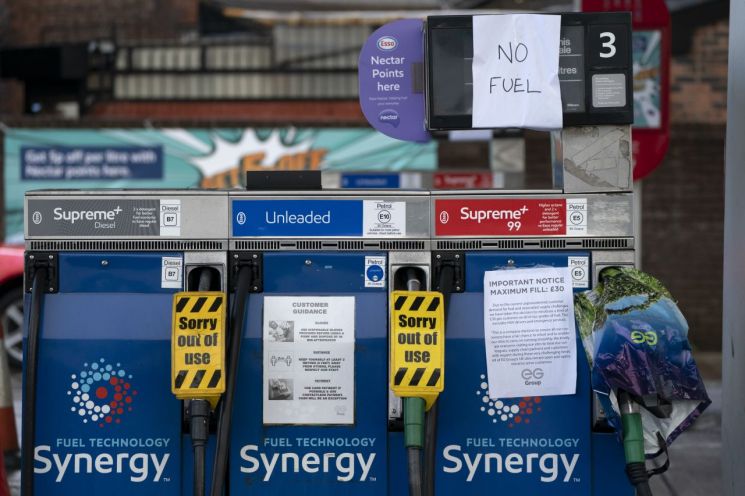
According to major foreign media on the 27th (local time), as oil company BP announced that it would temporarily close some gas stations due to a shortage of truck drivers, a fuel crisis has unfolded in the UK for the fourth consecutive day.
The Petroleum Retailers Association, representing 65% of gas stations nationwide, stated that about 5,500 of its members, accounting for two-thirds, were out of fuel that day.
The government and the oil industry attribute the cause of the situation not to a fuel shortage but to panic buying by consumers.
However, some experts point out that the more fundamental cause lies in the shortage of truck drivers who deliver fuel to gas stations.
It is currently estimated that the UK lacks more than 100,000 truck drivers.
Due to this phenomenon, logistics and deliveries have been paralyzed across the board, affecting not only gas stations but also supermarkets and fast-food outlets.
What stands out immediately is the disappearance of drivers from EU member countries. Naturally, there is a flood of criticism questioning whether Brexit was the right decision.
After the UK's withdrawal from the EU at the end of January last year, European workers left the UK.
As companies are no longer as free as before to hire European workers, the UK is indeed suffering from a manpower gap.
The number of EU nationals driving large transport vehicles in the UK increased from 10,000 in 2010 to 45,000 in 2017, but dropped to 42,000 at the beginning of last year and further decreased to 25,000 between March and June of the same year.
Delays in issuing new licenses due to the COVID-19 pandemic have exacerbated this driver shortage crisis.
UK logistics research firm Transport Intelligence reported that 15,000 European drivers returned to their home countries due to COVID-19.
Recently, Grant Shapps, UK Secretary of State for Transport, argued that the driver shortage phenomenon is similar in the EU.
However, the UK daily The Guardian reported that the EU avoided a situation like the UK's by preventing manpower gaps through mutual aid among countries.
The UK government is currently considering deploying the military to resolve the logistics driver shortage crisis.
The government, however, is concerned that issuing negative signals might worsen the situation and thus does not intend to immediately resort to military intervention.
Instead, it has extended certain large vehicle driving licenses and temporarily suspended antitrust law enforcement to allow oil companies to share supply information and coordinate deliveries.
Additionally, letters have been sent to holders of large vehicle licenses encouraging them to return to work, and job training for 4,000 large vehicle drivers is underway, while companies have been urged to improve wages and working conditions.
Furthermore, contrary to Brexit, the government decided to issue three-month temporary visas to 5,000 foreign truck drivers.
However, experts point out that these stopgap measures by the UK government may be too short-term to attract drivers and resolve the crisis.
© The Asia Business Daily(www.asiae.co.kr). All rights reserved.
![Clutching a Stolen Dior Bag, Saying "I Hate Being Poor but Real"... The Grotesque Con of a "Human Knockoff" [Slate]](https://cwcontent.asiae.co.kr/asiaresize/183/2026021902243444107_1771435474.jpg)















