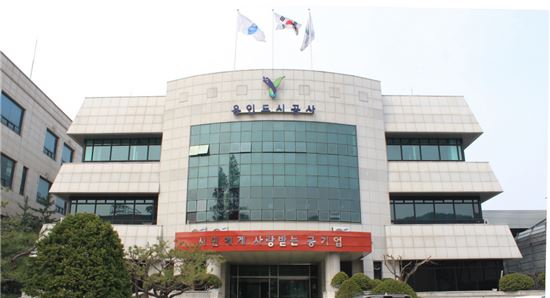
 Yongin Urban Corporation
[Asia Economy Reporter Kim Daehyun] The former president of Yongin Urban Corporation, who was prosecuted for receiving bribes from a construction company, has had his prison sentence confirmed by the Supreme Court.
On the 28th, the Supreme Court Division 1 (Presiding Justice Park Jeonghwa) announced that it upheld the lower court's ruling sentencing former Yongin Urban Corporation president Kim to 2 years and 6 months in prison on charges of bribery.
Previously, in 2015, Kim was prosecuted on charges of accepting 50 million won and three bottles of whiskey from a construction company employee, Mr. A, in exchange for facilitating the progress of the Bojeong District urban development project in Yongin City. It was investigated that Kim and the construction company signed a memorandum of understanding stating that the construction company, not Yongin Urban Corporation, would carry out the urban development project construction.
On the other hand, Kim's side argued in court that some of the money was received due to personal creditor-debtor relationships.
The first and second trials both sentenced Kim to 2 years and 6 months in prison. The first trial court criticized, "The testimonies of Mr. A and others are consistent, and there is no motive for them to give false testimony unfavorable to the defendant," adding, "Despite the very serious social nature of the crime, the defendant showed no signs of remorse, as he informed employees about what to say and points to note during investigations and tried to cover up the crime."
The second trial court also dismissed Kim's appeal, stating, "The first trial's sentencing is not excessively harsh and does not exceed the reasonable range of discretion."
The Supreme Court also agreed with this judgment. The Supreme Court stated, "The lower court did not err in the establishment of bribery charges, the principle of prohibition of disadvantageous changes, nor did it omit any judgment."
© The Asia Business Daily(www.asiae.co.kr). All rights reserved.
![Clutching a Stolen Dior Bag, Saying "I Hate Being Poor but Real"... The Grotesque Con of a "Human Knockoff" [Slate]](https://cwcontent.asiae.co.kr/asiaresize/183/2026021902243444107_1771435474.jpg)














