Even After the Legislative Notice Period
'Highest in the First Half Under Moon Government' Brain and Heart Diseases Excluded
Severity Criteria for Occupational Diseases Excluded at Business Request
"Prevention Over Punishment" Government Justification Fades
Both Labor and Management Dissatisfied... Concerns Over Widening Industrial Conflicts
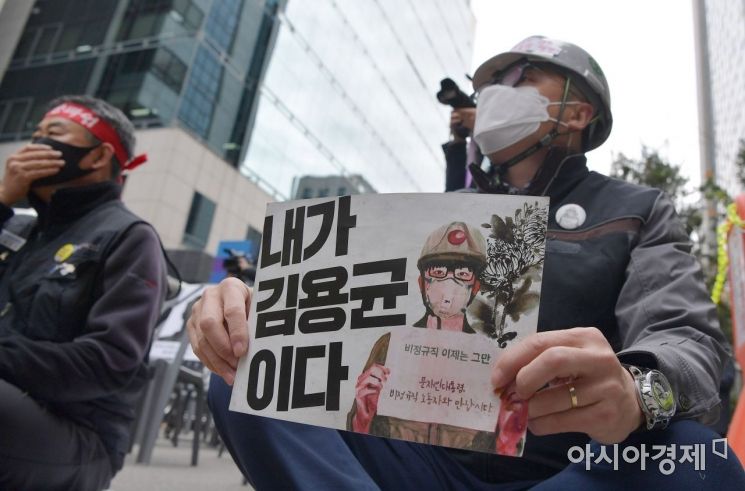
[Sejong=Asia Economy Reporter Moon Chaeseok] After a 40-day legislative notice period, the government approved the Enforcement Decree of the Serious Accidents Punishment Act (Serious Accidents Act) at the Cabinet meeting on the 28th. Despite the announcement of this decree ahead of the law’s enforcement in January next year, diseases frequently occurring as industrial accidents, such as cerebrocardiovascular diseases (cerebrocardiovascular diseases), were excluded from the scope of occupational diseases, and no severity criteria were presented, increasing dissatisfaction among both labor and management.
Exclusion of Cerebrocardiovascular and Musculoskeletal Diseases from 'Occupational Diseases'
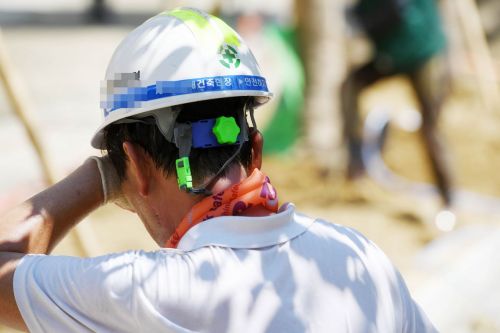 A worker wiping sweat at a construction site in Gaepo-dong, Gangnam-gu, Seoul. Photo by Mun Ho-nam munonam@
The government announced that it reviewed and approved the Serious Accidents Act enforcement decree at the 42nd Cabinet meeting that day. The list of 24 occupational diseases includes ▲acute poisoning caused by various chemical agents ▲reactive airway dysfunction syndrome ▲heatstroke, among others. Here, 'diseases equivalent to acute poisoning' were selected based on the clarity of causality (acute), preventability by the employer, and severity of damage. In the case of heatstroke, the scope was narrowed to 'heatstroke accompanied by elevated core body temperature' to reduce ambiguity.
Additionally, provisions were supplemented regarding ▲scope regulations for major public disasters targeting public-use facilities ▲obligations to implement safety and health management systems for major industrial accidents, raw materials/products, public-use facilities, and public transportation ▲principles for imposing fines related to safety and health education attendance ▲obligation to publicly announce the occurrence of major industrial accidents.
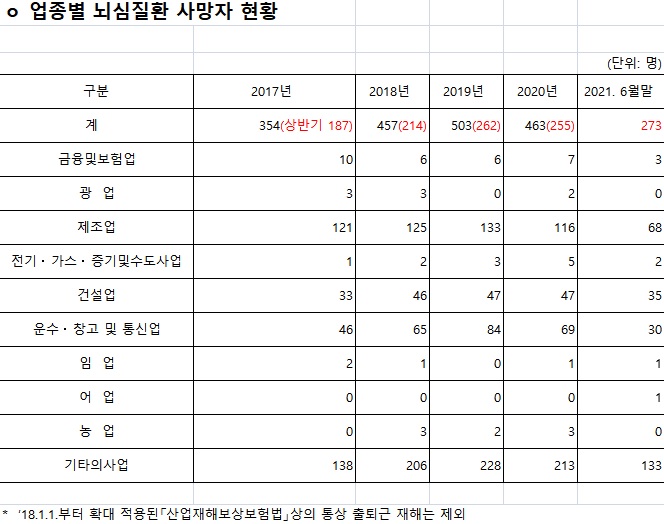 Status of fatal accidents in the last 5 years of work. The number of victims of cerebrovascular disease industrial accident deaths was the highest this year as of the first half, since the first year of the Moon Jae-in administration in 2017. (Data provided by Song Ok-ju, Office of the Democratic Party of Korea)
Although the 40-day legislative notice period ended after July, cerebrocardiovascular and musculoskeletal diseases were not included in the list of occupational diseases under the Serious Accidents Act. Notably, cerebrocardiovascular diseases, which occurred most frequently since the Moon Jae-in administration began in the first half of this year, were not reflected in the regulations.
According to data on 'fatal accidents in the last five years' received by Song Okju, a member of the National Assembly’s Environment and Labor Committee from the Ministry of Employment and Labor, the number of fatal industrial accidents due to cerebrocardiovascular diseases from January to June this year was 273. The number showed an increasing trend annually: 187 in 2017, 214 in 2018, 262 in 2019, 255 in 2020, and 273 in 2021, based on the first half of each year.
The government explained that occupational diseases are recognized only when 'direct and scientific causality,' not just 'substantial causality,' is proven. Since the enforcement decree of the Serious Accidents Act was created on the premise of 'punishing management responsibility,' if a disease is classified as an occupational disease, the occurrence of related fatal industrial accidents among workers could lead to punishment, so a cautious approach was taken.
A government official said, "There are many cases where personal health factors affect the occurrence of cerebrocardiovascular diseases, and it takes considerable time for the disease to progress, making it very difficult to confirm a direct and scientific causal relationship between the employer’s failure to take appropriate preventive measures and the occurrence of cerebrocardiovascular industrial accidents," adding, "Including cerebrocardiovascular diseases as occupational diseases by law was judged to potentially lead to excessive regulation."
Exclusion of 'Severity Criteria' Requested by Management... "Concerns Over Field Confusion"
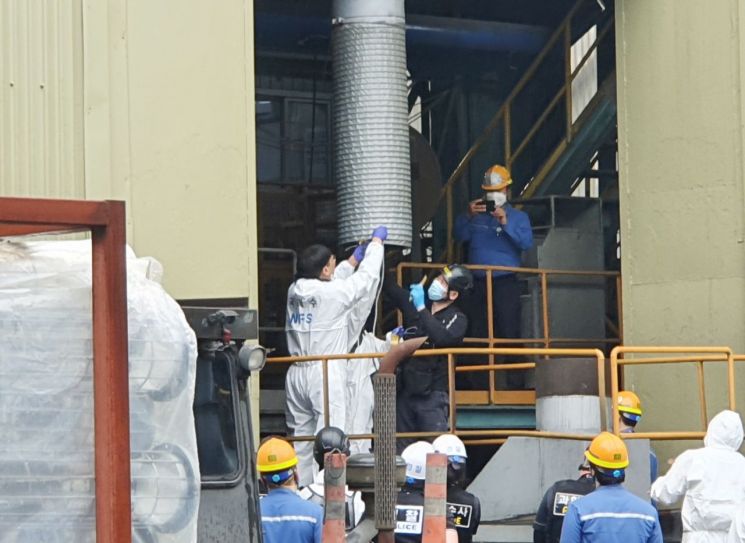
Requests from management to include ▲severity of occupational diseases ▲budget scale for safety and health management by industry and workplace size to reduce confusion at industrial sites were not properly reflected. Major industrial accidents include cases where 'one or more deaths occur,' 'two or more injured persons require treatment for six months or longer due to the same accident,' or 'three or more occupational disease cases occur within one year due to the same harmful factor.'
If any one of these conditions is violated, the management responsible can face 'imprisonment for one year or more or a fine of up to 1 billion KRW,' and for injuries or diseases, 'imprisonment for up to seven years or a fine of up to 100 million KRW.' Although the obligations are heavy, the regulations are ambiguous, leading to complaints during the legislative notice period that 'lawbreakers will be mass-produced,' and similar backlash is expected even after the Cabinet’s approval.
In response, the government explained that it has specified the obligations of management to establish safety and health management systems as concretely as possible, such as 'appropriate budget allocation' and 'faithful performance of duties.' During the Cabinet approval process, the government added clauses to the enforcement decree requiring ▲budget allocation and execution necessary for improving harmful and dangerous factors ▲inspection and improvement checks of harmful and dangerous factors at least once every six months.
The government plans to implement ▲sector-specific notifications and guidelines ▲regional training ▲consulting support through on-site support teams before the law’s enforcement on January 27. A government official said, "To protect the lives and safety of the public, the government will do its best to support what companies and our society must do."
© The Asia Business Daily(www.asiae.co.kr). All rights reserved.
![Clutching a Stolen Dior Bag, Saying "I Hate Being Poor but Real"... The Grotesque Con of a "Human Knockoff" [Slate]](https://cwcontent.asiae.co.kr/asiaresize/183/2026021902243444107_1771435474.jpg)

















