As of 2020, a total of 23 services, 18.5 billion KRW invested, benefiting 959 complexes and 790,000 people
Cost-benefit analysis of housing life services shows over 3 times return
Plans to enhance services to strengthen care, win-win cooperation, and ethical management sectors
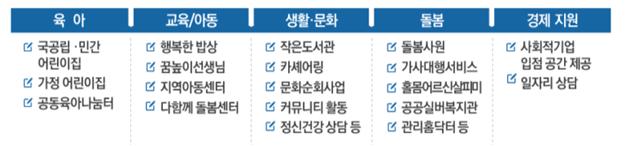
[Asia Economy Reporter Kangwook Cho] The Korea Land and Housing Corporation (LH) has found through a commissioned study that its residential life services, implemented to improve the quality of life for tenants of rental housing, generate benefits more than three times the costs invested.
On the 27th, LH announced the results of a quantitative assessment of the social and economic effects of its residential life services, commissioned from the Korean Service Management Society in January this year.
Since establishing a dedicated residential life services organization in 2016, LH has built a system to provide life support services to tenants of rental housing nationwide. Up to last year, it invested a total of 18.5 billion KRW to provide 23 services to 959 complexes and 790,000 tenants across the country.
This study focused on three representative services among the 23 provided by LH: △ Activation of Small Libraries △ Care Sharing Nest △ Rainbow Care Workers. The analysis used the Social Return On Investment (SROI) method, which quantifies social and economic value created by a company into monetary terms to measure social value.
The analysis showed that the SROI for the three projects was 3.32 points per 1 point of total input value. The scores were △ Small Library Activation project 4.31 △ Care Sharing Nest project 4.29 △ Rainbow Care Workers project 3.23, in descending order.
In particular, surveys of users of the Small Library Activation and Care Sharing Nest services showed positive responses such as "improved convenience and quality of life," "increased satisfaction with living in rental housing," and "helpful for children's education."
Professor Hanju Yoo of Soongsil University, the project leader from the Korean Service Management Society, said, "The average SROI score of the analyzed residential life services was above 3 points, with the Small Library Activation and Care Sharing Nest projects scoring above 4 points, indicating that both social value creation and return on investment in social value were secured."
Based on these study results, LH plans to develop its residential life services focusing on enhancing social value and actively utilize the findings for reflecting in government housing welfare policies and proposing institutional improvements. Additionally, LH will comprehensively reorganize the residential life service operation system, conduct regular quality evaluations, and incorporate the results into advancing the service implementation framework.
An LH official stated, "We plan to continuously measure the effectiveness of the remaining 20 services using the SROI toolkit, not just the three services analyzed intensively," and added, "We will strengthen residential life services further to improve housing welfare for tenants and the public."
© The Asia Business Daily(www.asiae.co.kr). All rights reserved.
![Clutching a Stolen Dior Bag, Saying "I Hate Being Poor but Real"... The Grotesque Con of a "Human Knockoff" [Slate]](https://cwcontent.asiae.co.kr/asiaresize/183/2026021902243444107_1771435474.jpg)















