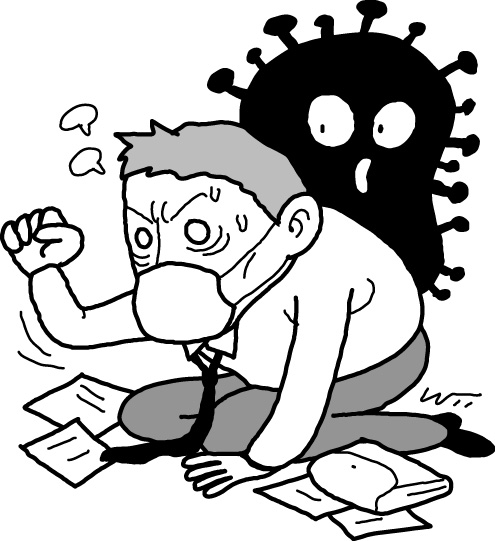
[Asia Economy Reporter Kim Daehyun] Due to the economic downturn caused by the spread of COVID-19, the number of personal and corporate bankruptcy filings significantly increased last year.
According to the Supreme Court's "2021 Judicial Yearbook" released on the 27th, the number of personal bankruptcy cases filed nationwide last year was 50,379. This is an increase of 4,737 cases compared to 45,642 cases in 2019, before the outbreak of COVID-19, marking the highest figure in five years. The courts approved 44,417 of these cases.
Corporate bankruptcy filings totaled 1,069 cases, up 138 from 931 cases in 2019, with the courts accepting 875 of them. This is the first time since related statistics began in 2004 that corporate bankruptcy filings have exceeded 1,000 cases.
During the same period, 49,467 discharge applications were filed, an increase of 10.28% (4,614 cases) from 44,853 cases last year. The courts approved 38,390 of these. Discharge refers to a system that eliminates debt to give a fresh start to those who have lived honestly and diligently but were declared bankrupt due to economic fluctuations or natural disasters. It allows individuals to start anew by freeing them from debt.
On the other hand, personal rehabilitation applications, which allow debtors to be exempted from the remaining debt after faithfully repaying for a certain period, significantly decreased. Last year, 86,553 personal rehabilitation cases were filed, down 6,034 from 92,587 cases in 2019. Rehabilitation is applied for when there is a possibility of business recovery, and the court determines this. The decrease in rehabilitation applications can be interpreted as many people viewing the economic outlook as uncertain or difficult.
Meanwhile, a total of 6,679,233 lawsuits were filed with the courts last year. Among them, civil cases accounted for the largest portion at 72.3% (4,829,616 cases). Criminal cases made up 22.7% (1,516,109 cases), and family cases 2.6% (171,671 cases). Looking only at the 1,012,837 civil substantive cases filed, claims for damages were the most common at 18.4% (65,819 cases). This was followed by unjust enrichment claims (3.2%, 11,326 cases), contract claims (2.2%, 7,859 cases), lease deposit claims (1.6%, 5,755 cases), debt non-existence confirmation (1.6%, 5,650 cases), dividend objections (0.8%, 2,704 cases), and guarantee debt claims (0.3%, 1,165 cases), in that order.
Professor Kim Yuntae of Korea University’s Department of Sociology said, "The proportion of self-employed people in Korea is high at 25%," and added, "Self-employed individuals such as those in restaurants and food service businesses are likely included significantly in these statistics." Professor Kim emphasized, "Even middle-class individuals can face bankruptcy if they have large debts, especially when income stops or due to health deterioration and illness. Since this is caused by the variable of COVID-19 rather than personal fault, the government should actively support low-income groups."
Baek Juseon, president of the Korean Bankruptcy and Rehabilitation Lawyers Association, explained, "Small and medium-sized export companies overseas were first affected by COVID-19, followed by businesses that rely on consumer gatherings," and stated, "It is just and economically positive to provide corresponding support to businesses that suffered losses due to the state's forced business restrictions."
© The Asia Business Daily(www.asiae.co.kr). All rights reserved.
![Clutching a Stolen Dior Bag, Saying "I Hate Being Poor but Real"... The Grotesque Con of a "Human Knockoff" [Slate]](https://cwcontent.asiae.co.kr/asiaresize/183/2026021902243444107_1771435474.jpg)















