Research Team of Kim Daehyung and Hyeon Taekhwan at the Institute for Basic Science
[Asia Economy Reporter Kim Bong-su] Domestic researchers have developed a core technology for a three-dimensional display that can be freely folded like paper.
The Institute for Basic Science (IBS) announced on the 27th that a joint research team led by Deputy Director Kim Dae-hyung and Director Hyun Taek-hwan of the Nanoparticle Research Division succeeded in developing a three-dimensional quantum dot light-emitting diode (QLED) that can be freely folded like paper.
QLEDs, which use quantum dots as the light-emitting material, unlike conventional liquid crystal displays (LCDs), do not require bulky components such as backlights, enabling the production of displays with much thinner thickness. In this regard, the IBS Nanoparticle Research Division developed an ultra-thin QLED with a thickness of about 3μm, approximately 1/30th the thickness of a human hair, in 2015 and produced it in the form of a wearable display.
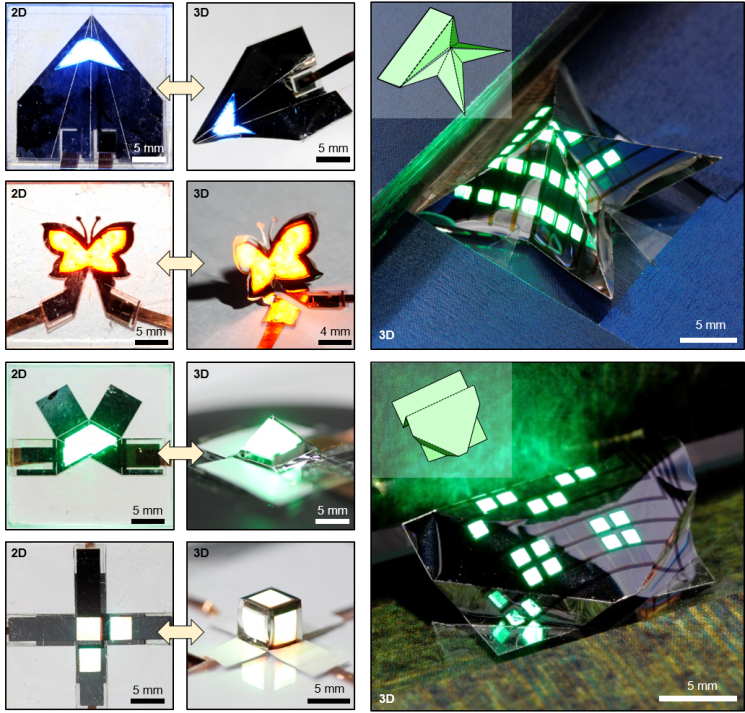
In this study, they went further to enable ultra-thin QLEDs to be freely folded into desired shapes like origami. Based on this, they succeeded in producing three-dimensional foldable QLEDs with complex structures such as butterflies, airplanes, and pyramids.
The research team newly developed a ‘selective laser etching process’ that partially etches the epoxy thin film deposited on the QLED surface using a carbon dioxide laser. The etched parts have a relatively thinner thickness than the surrounding areas, making them easily deformable when external force is applied. In origami terms, this creates a ‘folding line.’ At this time, there is a thin etch-resistant layer composed of a silver and aluminum alloy between the QLED and the epoxy thin film, which effectively prevents internal damage to the QLED caused by the laser.
Through this process, the researchers succeeded in precisely controlling the curvature radius of the foldable QLED and produced foldable QLEDs with a very small curvature radius of less than about 50μm. When the curvature radius becomes smaller than several tens of micrometers, it appears to the naked eye as if it is sharply folded rather than just bent. Moreover, all light-emitting surfaces, including the edges, operated stably even after more than 500 repeated folds.
Using this technology, the research team produced QLEDs with complex three-dimensional shapes such as butterflies and airplanes. In particular, the pyramid-shaped three-dimensional foldable QLED composed of 64 pixels demonstrated the possibility of developing displays that can be freely folded into user-desired shapes by allowing free deformation between two-dimensional and three-dimensional structures.
Deputy Director Kim said, “Thanks to the development of the laser process using an etch-resistant layer composed of an alloy, we were able to produce a three-dimensional foldable QLED that can be freely folded like paper,” and added, “Beyond the 64-pixel display produced in this study, it will be possible to produce QLED displays with more complex form factors in the future.”
Director Hyun also said, “It will be useful in places that require user-customized small displays such as electronic paper, newspapers, and tablets,” and added, “This means that the possibility of producing user-customized displays has been opened.”
The results of this study were published on the 24th in the international academic journal Nature Electronics (IF 33.686).
© The Asia Business Daily(www.asiae.co.kr). All rights reserved.
![Clutching a Stolen Dior Bag, Saying "I Hate Being Poor but Real"... The Grotesque Con of a "Human Knockoff" [Slate]](https://cwcontent.asiae.co.kr/asiaresize/183/2026021902243444107_1771435474.jpg)















