When ICT Regular Workers Increase by 5,000 Compared to 2019
Humanities Decrease by 30,000 and Journalism & Information Studies by 23,000

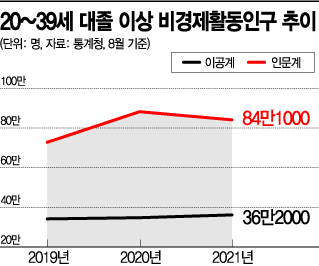
[Sejong=Asia Economy Reporter Moon Chaeseok] It has been revealed that the number of humanities majors in their 20s and 30s who are not seeking employment has increased by more than 110,000 over the past three years. This figure is more than five times higher compared to the 20,000 increase in science and engineering majors who are not engaged in job-seeking activities during the same period. This is interpreted as a reflection of companies' preference for science and engineering majors amid a frozen employment market.
On the 27th, Asia Economy analyzed the microdata from the August Economically Active Population Survey by Statistics Korea and found that the number of economically inactive science and engineering university and graduate school graduates aged 20 to 39 was 362,000 last month, an increase of 20,000 compared to the same month in 2019. Economically inactive population refers to those who have given up job-seeking activities or are completely unable to work, which can also be interpreted as having given up job-seeking due to lack of suitable employment opportunities. In contrast, the number of economically inactive humanities university and graduate school graduates increased by 113,000 to reach 841,000 during the same period.
This phenomenon reflects the harsh reality that employment is considerably difficult for humanities graduates. Professor Yoon Dong-yeol of Konkuk University's Department of Business Administration diagnosed, "For humanities graduates, employment paths are virtually blocked, and many job seekers prepared for civil service or public institution exams, but the recent reduction in public sector recruitment has had an impact."
Employment in science and engineering has been steadily increasing in fields such as information and communication technology (ICT) as non-face-to-face industries have become active due to the spread of COVID-19. Looking at the number of regular employees by university and graduate school major, ICT increased from 120,000 to 125,000 over the three years from 2019 to August 2021. In contrast, humanities majors decreased from 330,000 to 300,000, and employment in media and information studies also declined from 147,000 to 124,000.
In particular, as domestic large corporations focus on carbon neutrality and the expansion of a non-face-to-face society, there are forecasts that the employment gap between humanities and science majors may widen further.
Experts have assessed that short-term job training, internship support, and other job competency development and job-seeking support policies for humanities majors are insufficient. Major government job support policies such as the National Tomorrow Learning Card, National Employment Support System, and K-Digital Training mostly provide cash subsidies for wages to job seekers and participating companies. There is also a limitation in that work experience (specifications) gained at small and medium-sized enterprises participating in government policies is not properly reflected in large corporations' hiring processes. The 'Youth ON Project' launched by the Ministry of Employment and Labor, the main ministry in charge of jobs, is merely a plan for increasing employment in large corporations over two to three years and is widely regarded as not a fundamental solution to overcoming the 'employment gap between humanities and science majors.'
Professor Yoon advised, "As IT software (SW) employment is increasing due to the development of non-face-to-face industries, it is necessary to establish a long-term open human resource development system to meet the demand of companies in this field. It is also necessary to refer to the U.S. case, where university quotas by major are autonomously adjusted according to market demand and supported in line with market economy principles."
© The Asia Business Daily(www.asiae.co.kr). All rights reserved.


















