SPD Leads with 25.8% in Exit Poll
CDU-CSU Alliance Closely Follows at 24.1%
Coalition of Three Parties Needed to Form Cabinet... May Not Happen Within the Year
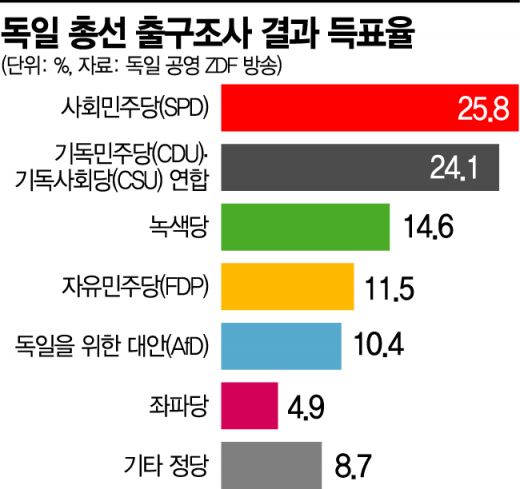
[Asia Economy Reporter Hyunwoo Lee] In the German federal parliamentary election, the Social Democratic Party (SPD) reportedly edged out the ruling Christian Democratic Union (CDU) and Christian Social Union (CSU) alliance by a narrow margin. The political landscape now requires a coalition of at least three parties to form a new cabinet, plunging the 'post-Merkel' cabinet into an unpredictable situation. Particularly, with both the SPD and the CDU/CSU alliance expressing intentions to form a coalition, concerns are rising that forming a cabinet within the year may be difficult.
On the 26th (local time), German public broadcaster ZDF announced the exit poll results at 6 p.m. According to the results, the SPD secured 25.8% of the vote, taking first place, while the CDU/CSU alliance recorded 24.1%, placing second in an extremely close race. Following them, the Green Party received 14.6%, the Free Democratic Party (FDP) 11.5%, and the far-right party Alternative for Germany (AfD) 10.4%. None of the major parties secured a majority of seats to form a single-party government.
Earlier this year, the CDU/CSU alliance's support rate was as high as 37%, making a regime change seem unlikely. However, due to public backlash against prolonged COVID-19 restrictions and poor responses to disasters such as the July floods in the Rhine region, their support plummeted, resulting in what is considered their worst election outcome.
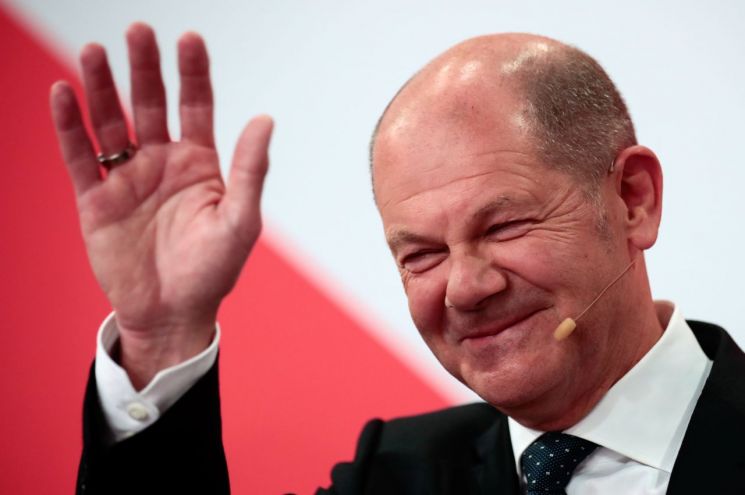 Olaf Scholz, the German Social Democratic Party (SPD) chancellor candidate, is waving and smiling at party members at the Berlin headquarters immediately after the announcement of the exit poll results for the federal parliamentary election on the 26th (local time). Berlin, Germany ? Photo by Reuters and Yonhap News Agency
Conversely, the SPD's support, which had fallen to 13% this spring, nearly doubled within six months. Olaf Scholz, the SPD's chancellor candidate, expressed at a press conference following the exit poll announcement, "I am very pleased with the election results," emphasizing, "Citizens want a change of government after 16 years, and they want the next chancellor to be named Scholz."
However, even if the SPD ultimately wins, forming a single-party government is impossible, leaving German politics in an uncertain state. For the first time since 1953, a coalition of three parties is necessary to launch a new cabinet, making cabinet formation challenging.
Germany's federal election uses a mixed-member proportional representation system with two votes per person. The party vote first determines the total number of seats each party receives, and separately, constituency elections are held to vote for individual candidates. Accordingly, out of the 598 seats mandated by law in the Bundestag, half (299) are elected from constituencies, and the other half are elected proportionally.
However, if a party wins more constituency seats than its proportional allocation, overhang seats are granted. To balance this, other parties receive leveling seats to maintain proportionality according to party votes. Consequently, the number of Bundestag members fluctuates significantly with each election. Currently, the number of members is 709, 111 more than the standard 598 seats. Due to this complex electoral system, it remains unclear whether the SPD or the CDU/CSU alliance will lead the post-Merkel cabinet.
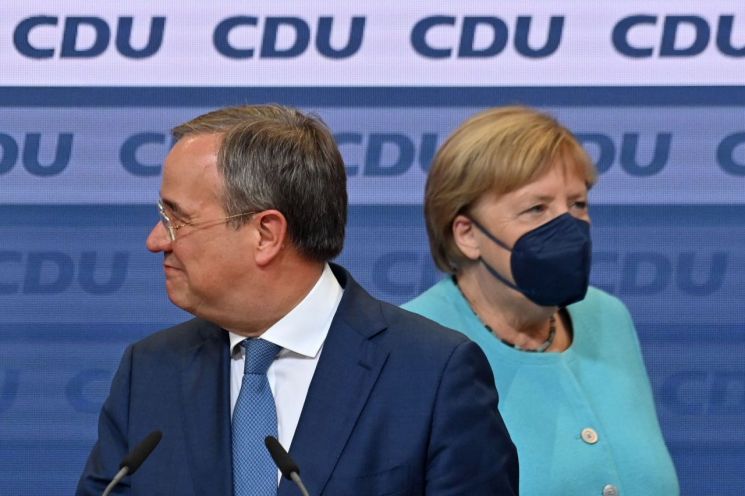 Armin Laschet (left), the German Christian Democratic Union (CDU)·Christian Social Union (CSU) coalition's chancellor candidate, and Angela Merkel, Chancellor of Germany, arrive side by side at the Berlin CDU headquarters after the exit poll results announcement. Berlin, Germany = Photo by AFP and Yonhap News
Various coalition scenarios are already being discussed inside and outside German politics. These include the so-called grand coalition between the SPD and CDU/CSU alliance; the 'traffic light' coalition of the SPD (red), FDP (yellow), and Green Party (green); and the 'Jamaica' coalition of the CDU (black), FDP (yellow), and Green Party (green), among other possibilities.
Both the SPD and the CDU/CSU alliance are asserting their leadership in forming a coalition. Scholz appeared on ZDF and stated, "The voters' will is clear," adding, "I have clearly been entrusted with the task of forming a coalition."
Armin Laschet, the CDU/CSU alliance's chancellor candidate, also said in an interview with ZDF, "To become chancellor in Germany, one must succeed in bringing together various parliamentary groups," emphasizing, "It has not always been the party with the highest vote share that has appointed the chancellor."
© The Asia Business Daily(www.asiae.co.kr). All rights reserved.
![Clutching a Stolen Dior Bag, Saying "I Hate Being Poor but Real"... The Grotesque Con of a "Human Knockoff" [Slate]](https://cwcontent.asiae.co.kr/asiaresize/183/2026021902243444107_1771435474.jpg)

















