Processed Food Prices Await Year-End Increase
Pressure Mounts on Food and Dining Prices for Full-Scale Rise
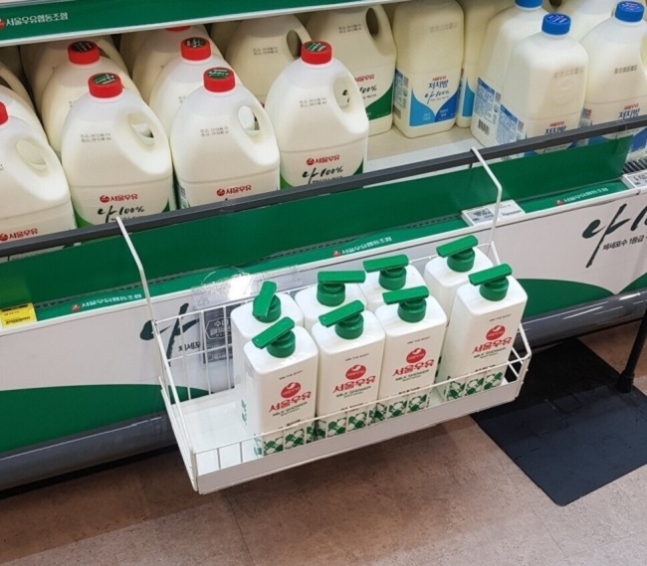
[Asia Economy Reporter Lim Hye-seon] As the domino effect of milk price hikes becomes a reality, food and dining prices are coming under full-scale upward pressure. Starting with dairy products such as butter and cheese made from milk, prices of coffee, ice cream, bread, and more are rising across the board, raising concerns about the emergence of so-called ‘Milkflation’ (a portmanteau of milk and inflation).
Processed Food Prices Rise One After Another Starting with Milk Price
The Seoul Milk Cooperative will raise the price of white milk (1ℓ) from 2,500 won to 2,700 won, a 5.4% increase, starting next month on the 1st. This is Seoul Milk’s first price increase in three years since 2018. The increase follows the Dairy Promotion Board’s decision last month to raise the raw milk price from 926 won to 947 won per liter, a 21 won increase.
Maeil Dairies and Namyang Dairy Products, ranked second and third in the dairy industry, are also weighing the timing and extent of their price hikes. An industry insider said, “There is no disagreement about the milk price increase,” adding, “It is an unavoidable decision due to rising raw material prices, auxiliary materials, and logistics costs.”
Since milk is the main ingredient in cheese, butter, bread, coffee, and ice cream, prices of other processed foods are expected to rise one after another as early as the end of this year or by early next year at the latest. When milk prices rose in 2018, secondary processors and dining franchises quickly reflected the increase, causing food prices to rise consecutively. This year, the price fluctuations are expected to be even greater due to the vertical surge in raw material prices such as flour, sugar, and coffee beans. An official from an ice cream company said, “With rising labor and logistics costs, along with increases in sugar and milk prices, our profit structure has deteriorated to an unbearable level,” adding, “We are already discussing price increases internally.”
Greater Impact on Small Business Owners
The prices of bread and coffee at neighborhood bakeries and coffee shops are also expected to rise. Coffee bean prices have hit record highs, and milk is the second most used ingredient after ice. The Coffee C futures, the international benchmark for coffee bean prices on the New York Commodity Exchange (COMEX), have risen nearly 50% since the beginning of the year. This is due to a sharp decline in coffee production in Brazil and Vietnam, the world’s first and second largest coffee producers, caused by cold waves, droughts, and the impact of COVID-19, while consumption has increased. Domestic coffee bean suppliers have raised prices by 10-20% starting this month.
The rise in raw material prices is increasing the worries of small business owners. Large franchises are less affected immediately by the sudden rise in raw material prices due to annual contracts, whereas small business owners have to bear the full burden of cost increases.
Mr. Kim (45), who runs a coffee shop in Sangam-dong, Seoul, lamented, “With coffee bean and milk prices rising, my profit margin has dropped by more than 30%,” adding, “I have no choice but to raise prices.”
Ms. Lee (41), who operates a cake specialty shop in Hongdae, Seoul, said, “The prices of main ingredients such as milk, eggs, butter, and flour have all increased this year,” adding, “We raised product prices once at the beginning of the year, but if we raise them again, customers might turn away, so I’m stuck and don’t know what to do.”
© The Asia Business Daily(www.asiae.co.kr). All rights reserved.
![Clutching a Stolen Dior Bag, Saying "I Hate Being Poor but Real"... The Grotesque Con of a "Human Knockoff" [Slate]](https://cwcontent.asiae.co.kr/asiaresize/183/2026021902243444107_1771435474.jpg)
















