SPD 26%, CDU/CSU 24.5% Neck-and-Neck
Coalition of Three or More Parties Needed to Form Government... Negotiations Expected to Be Lengthy
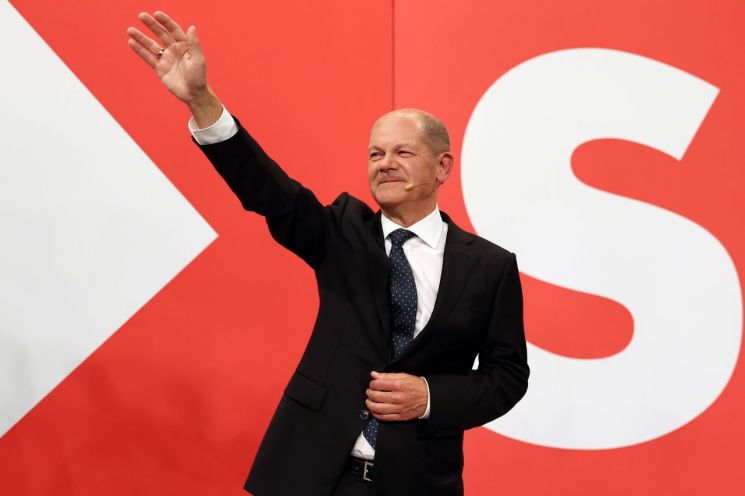
[Asia Economy Reporter Hyunwoo Lee] In the German federal parliamentary election, the Social Democratic Party (SPD) is reported to have narrowly surpassed the ruling Christian Democratic Union (CDU) and Christian Social Union (CSU) alliance, leading to expectations that prolonged confusion over coalition negotiations will continue in German politics. Both sides have declared their intention to form a coalition government, making it difficult to predict who will succeed Chancellor Angela Merkel, raising concerns that Merkel's remaining term may be extended.
On the 26th (local time), German public broadcaster ZDF announced the exit poll results at 6 p.m. According to the results, the SPD secured 26% of the vote, ranking first, while the CDU/CSU alliance recorded 24.5%, placing second in a very close race. Since the German election allocates half of the 756 seats based on party vote percentages and the other half through constituency contests, the exact leading party will only be known once all votes are fully counted.
Earlier this year, the CDU/CSU alliance's support rate reached 37%, and it was expected that there would be no change in government. However, due to inadequate responses to the COVID-19 pandemic and the Rhine River floods in Germany, as well as the plummeting support for Chancellor candidate Armin Laschet, the alliance is evaluated to have recorded its worst election result.
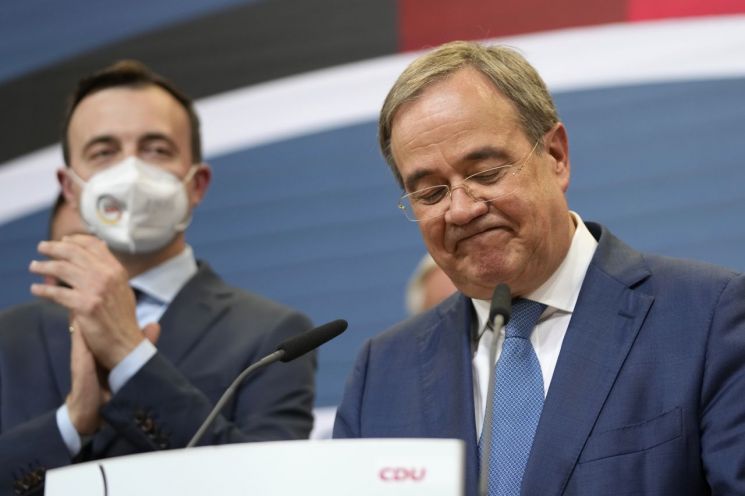
Conversely, the SPD's support, which had fallen to 13% this spring, nearly doubled within half a year. Olaf Scholz, the SPD's chancellor candidate, said at the party headquarters after the exit poll announcement, "We are naturally very pleased with the election results," adding, "Citizens want a change of government and want the next chancellor to be named Scholz, which is why they voted for the SPD."
Following the two major parties, other parties also received double-digit support: the Green Party 14.5%, the Free Democratic Party (FDP) 12%, and the far-right Alternative for Germany (AfD) 10%. Accordingly, both the SPD and the CDU/CSU alliance face a situation where they must form a coalition with at least two of these parties to establish the next cabinet.
With the SPD and CDU/CSU alliance expected to record similar support rates, various coalition formation scenarios are already emerging in German politics. Alongside the possibility of a grand coalition between the SPD and CDU, scenarios include the "traffic light" coalition of the SPD (red), FDP (yellow), and Green Party (green), as well as the "Jamaica" coalition of the CDU (black), FDP (yellow), and Green Party (green), among other possibilities.
© The Asia Business Daily(www.asiae.co.kr). All rights reserved.
![Clutching a Stolen Dior Bag, Saying "I Hate Being Poor but Real"... The Grotesque Con of a "Human Knockoff" [Slate]](https://cwcontent.asiae.co.kr/asiaresize/183/2026021902243444107_1771435474.jpg)
















