Debt Ceiling and Budget Deadline Approaching This Month
If Debt Ceiling Increase Fails, National Default Expected Next Month
Federal Government Shutdown Without Temporary Budget
Speaker Pelosi: "No Doubt on U.S. Credit Allowed"
Republicans: "Cannot Process Debt Ceiling and Temporary Budget Simultaneously"
[Asia Economy New York=Correspondent Baek Jong-min] The U.S. Congress continues its political strife, increasing the possibility of an unprecedented U.S. national default and federal government shutdown. If no agreement is reached by the 31st, a worst-case scenario far worse than the recent default crisis of China's Evergrande Group, which shook the market last week, could occur.
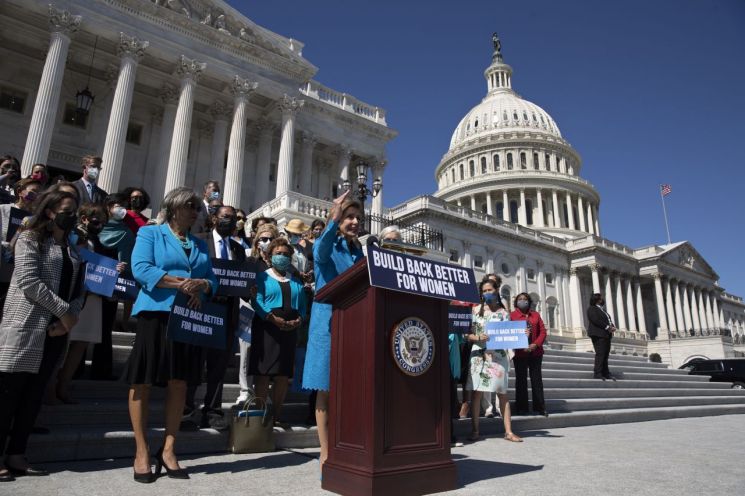 Nancy Pelosi, Speaker of the U.S. House of Representatives, is giving a speech in front of the Capitol.
 [Image source=EPA Yonhap News]
◆Republicans Hold Firm Despite National Default Crisis
Pat Toomey, Republican Senator and Chairman of the Senate Budget Committee, said in an interview with CNN on the 26th (local time), "If the Democrats try to combine the debt ceiling increase with a temporary budget bill, I will oppose it."
The U.S. federal government debt has exceeded the legal limit of $28.78 trillion. If the debt ceiling is not raised, a national default will occur in October when the U.S. will be unable to pay interest on its issued government bonds. Treasury Secretary Janet Yellen has also urged Congress to act, warning that a national default will happen in October if the debt ceiling is not increased.
The House of Representatives, led by the Democrats, passed a bill to raise the federal government debt ceiling and a temporary budget on the 23rd. The Democratic leadership plans to pass it in the Senate on the 27th, but it is uncertain whether it will pass amid Republican opposition.
Mitch McConnell, Republican Senate Minority Leader, intends to use the filibuster to block the debt ceiling increase and the temporary budget bill. While Republicans say a national default must be avoided, they oppose addressing both issues in a single bill.
As Republicans refuse to back down, House Speaker Nancy Pelosi said in an interview with ABC on the same day, "It is irresponsibly hard to put into words," and insisted, "America's credit must not be compromised." Speaker Pelosi recalled that "we must reach a bipartisan agreement," reminding that Democrats had previously reached bipartisan agreements during Republican administrations.
The Democrats plan to use the budget reconciliation process to overcome Republican obstruction, but Senator Joe Manchin is strongly opposed, making even this difficult. The Senate seats are split evenly between Democrats and Republicans, 50 each. If Senator Manchin defects, Democrats cannot secure the 50 votes needed to invoke budget reconciliation.
◆Federal Government Shutdown Also 'Countdown'
Failure to prepare a temporary budget bill is also problematic. In this case, a temporary federal government shutdown will be implemented, inevitably causing chaos such as national park closures, reduced airport security screenings, and suspension of COVID-19 public health services.
One major foreign media outlet predicted that if Republicans oppose the debt ceiling increase and the federal temporary budget bill in the Senate, Democrats will have insufficient time to respond to a shutdown and may separate the debt ceiling increase and temporary budget bill for processing.
Conflicts are also occurring within the Democratic Party. The Democrats planned to vote on a $1.2 trillion infrastructure investment bill on the 27th, which had previously passed the Senate, but Speaker Pelosi said on the same day, "I will not bring a bill to the floor that does not have enough votes."
◆Moderate and Progressive Conflicts Within Democrats Over Infrastructure Budget
Speaker Pelosi said, "We will make progress this week," but she predicted that the $3.5 trillion social infrastructure investment bill "will be reduced." The House Budget Committee passed this bill on the 25th, and it awaits final passage in the full House.
The confusion within the Democratic Party over the infrastructure investment bill stems from conflicts between moderates and progressives. Apart from Republican opposition, internal Democratic conflicts remain unresolved.
Pramila Jayapal, Chair of the Progressive Caucus in the House, took a firm stance. Jayapal, who had warned she would oppose the infrastructure investment bill without agreement on the social infrastructure investment bill, said in an interview with CNN on the same day, "The Democrats do not have enough votes to pass the $1.2 trillion infrastructure investment bill."
Jayapal and other progressive lawmakers argue that the $3.5 trillion social infrastructure investment budget is insufficient. Progressives insist that only by increasing this amount can they agree to the $1.2 trillion infrastructure investment bill. In contrast, moderates argue that the current $3.5 trillion social infrastructure budget is sufficient.
© The Asia Business Daily(www.asiae.co.kr). All rights reserved.
![Clutching a Stolen Dior Bag, Saying "I Hate Being Poor but Real"... The Grotesque Con of a "Human Knockoff" [Slate]](https://cwcontent.asiae.co.kr/asiaresize/183/2026021902243444107_1771435474.jpg)















