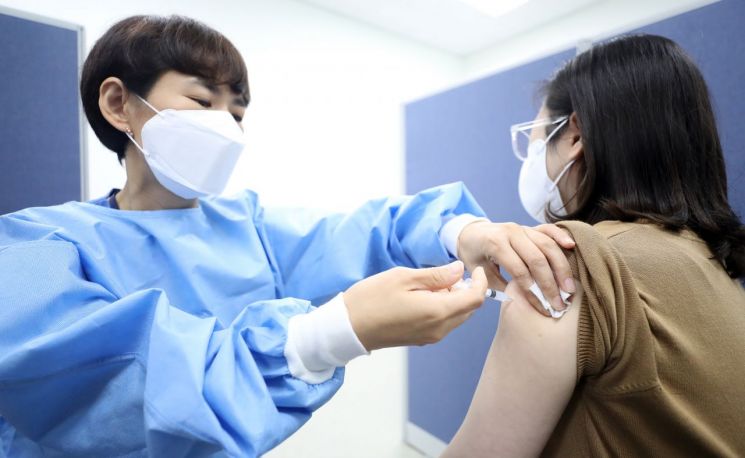
 On the morning of the 17th, a citizen received a COVID-19 vaccine at Hana Hospital, a delegated medical institution for vaccination, located in Heungdeok-gu, Cheongju-si, Chungbuk.
 [Image source=Yonhap News]
[Asia Economy Reporter Lee Chun-hee] As concerns arise that immunity may wane over time after COVID-19 vaccination, additional doses ('booster shots') to enhance effectiveness are expected to be administered as early as next month.
Prime Minister Kim Boo-kyum chaired the Central Disaster and Safety Countermeasure Headquarters meeting on the afternoon of the 26th and stated, "We will soon begin additional vaccinations, so-called booster shots, starting with high-risk groups such as seniors aged 60 and over and healthcare workers."
The specific vaccination plan for the fourth quarter will be announced on the afternoon of the 27th through a briefing by the COVID-19 Vaccination Response Promotion Team of the Korea Disease Control and Prevention Agency (KDCA), following discussions at the Central Disaster and Safety Countermeasure Headquarters. In addition to booster shot details, the plan will include COVID-19 vaccination strategies for pregnant women and children and adolescents, as well as plans for unvaccinated individuals.
Previously, health authorities announced they would consider allowing COVID-19 vaccination for pregnant women and children and adolescents aged 12 to 17, who had been excluded from prior vaccination efforts. They also revealed plans to implement booster shots for vulnerable groups such as residents and inpatients of nursing hospitals and facilities, and immunocompromised individuals who received vaccines early in February and March.
However, it remains uncertain whether booster shots will be administered to the general public beyond these high-risk groups. This is due to recent controversies in the United States regarding booster shot eligibility. Initially, U.S. President Joe Biden announced plans to provide booster shots to all adults aged 18 and over, but the target group was significantly reduced following opposition from experts.
The U.S. Food and Drug Administration (FDA) granted emergency use authorization for a single Pfizer booster shot only for seniors aged 65 and older or high-risk groups regardless of age. Subsequently, the Centers for Disease Control and Prevention (CDC) recommended on the 23rd that booster shots be limited to seniors and similar groups. The eligible age group was drastically narrowed, and unlike President Biden’s original plan to offer boosters to both Pfizer and Moderna recipients, the booster eligibility was limited to Pfizer recipients only.
During this process, experts who had worked at the FDA and the World Health Organization (WHO) published a paper in the medical journal 'The Lancet' warning that "the vaccine’s effectiveness in preventing severe illness and death persists without additional doses, and widespread booster shots may cause additional side effects." In fact, the discussion even led to the resignation of FDA-affiliated experts.
On the other hand, Israel is currently administering booster shots to all citizens aged 12 and older. When Israel began booster vaccinations on July 12, the program was limited to those with waning immunity, but the eligible group has since been significantly expanded. Currently, more than one-third of the population has received booster shots. This suggests that the eligible groups for booster shots in the U.S. and Korea may also expand in the future.
© The Asia Business Daily(www.asiae.co.kr). All rights reserved.
![Clutching a Stolen Dior Bag, Saying "I Hate Being Poor but Real"... The Grotesque Con of a "Human Knockoff" [Slate]](https://cwcontent.asiae.co.kr/asiaresize/183/2026021902243444107_1771435474.jpg)















