Article 216(1)(1) of the Criminal Procedure Act as the Basis for First and Second Trial Decisions
Constitutional Court Rules Unconstitutional → Amendment of the Criminal Procedure Act
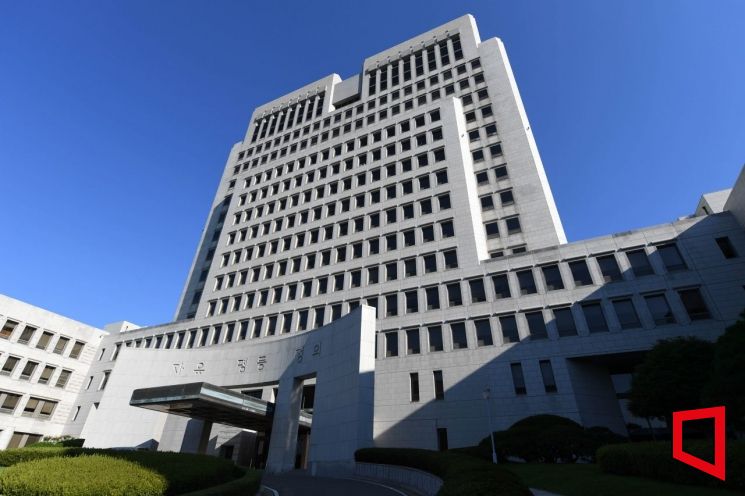 Supreme Court, Seocho-gu, Seoul. Photo by Honam Moon munonam@
[Asia Economy Reporter Kim Daehyun] The Korean Confederation of Trade Unions (KCTU) filed a claim for damages against the government, alleging that the police forcibly entered their office during the 2013 railway union strike. Although they lost in the first and second trials, the Supreme Court ruled that the case must be retried applying the revised Criminal Procedure Act.
On the 26th, the Supreme Court's Second Division (Presiding Justice Min Yusook) announced that it overturned the lower court's ruling, which had dismissed the KCTU's claim for damages against the state, and remanded the case to the Seoul Central District Court.
Previously, in December 2013, the police forcibly entered the KCTU office located in the Kyunghyang Shinmun building in Jung-gu, Seoul, attempting to arrest the railway union leadership who were conducting a strike. The KCTU claimed that the police illegally entered without a search warrant and conducted unlawful official acts, filing a lawsuit seeking damages worth several tens of millions of won against the state and others.
The first and second trials ruled against the plaintiff. The first trial court stated, "The investigation of a suspect in another person's residence, etc., for the execution of an arrest warrant is an exception to the warrant principle and is permitted if necessary," and ruled that "there was a high likelihood that the railway union officials were hiding in the building, making the entry necessary." The second trial upheld this judgment.
However, the Supreme Court ordered a retrial and reconsideration of the case. In April 2018, the Constitutional Court declared Article 216, Paragraph 1, Subparagraph 1 of the Criminal Procedure Act, which was the basis for the previous first and second trial rulings, unconstitutional, and indicated that the revised Criminal Procedure Act should be applied retroactively.
The former Article 216, Paragraph 1, Subparagraph 1 of the Criminal Procedure Act stipulated that 'judicial police officers may arrest or detain a suspect in another person's building without a warrant.' The Constitutional Court ruled that allowing this even when there are no urgent circumstances making it difficult to obtain a warrant before a search violates the 'warrant principle,' which requires a judge's warrant for compulsory measures in criminal procedures.
The revised Criminal Procedure Act the following year added the provision that 'in cases of arrest or detention of a suspect, a search of the suspect is limited to situations where there are urgent circumstances making it difficult to obtain a search warrant in advance.'
The Supreme Court panel stated, "At the time of the constitutional unconstitutionality decision, the constitutionality of the old law provision was an issue in ongoing court cases, so the relevant provisions of the current Criminal Procedure Act apply," and added, "The lower court erred in misunderstanding the legal principles regarding suspect searches for executing arrest warrants, the retroactive effect and scope of the constitutional unconstitutionality decision, and failed to conduct necessary hearings."
© The Asia Business Daily(www.asiae.co.kr). All rights reserved.
![Clutching a Stolen Dior Bag, Saying "I Hate Being Poor but Real"... The Grotesque Con of a "Human Knockoff" [Slate]](https://cwcontent.asiae.co.kr/asiaresize/183/2026021902243444107_1771435474.jpg)















