Second Briefing Session for Areas with High Agreement Rates
Floor Area Ratio Incentives and Expected Contributions Revealed
Planned District Designation Scheduled for Next Month
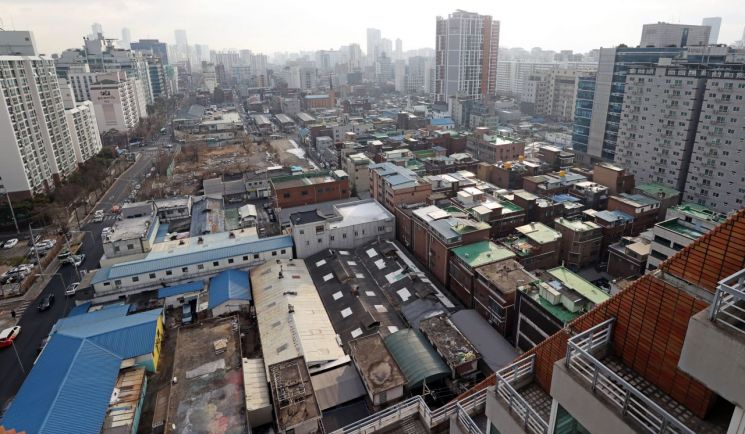
With the enforcement of the enforcement decrees and rules for the 'Special Act on Public Housing' for the 2·4 Housing Supply Plan, the 'Special Act on Vacant Houses and Small-scale Housing Maintenance,' and the 'Special Act on Urban Regeneration Activation and Support,' the government is accelerating the project implementation. For the relatively fast-progressing Urban Public Housing Complex Project, the designated districts are planned to be announced next month.
The Ministry of Land, Infrastructure and Transport (MOLIT) announced on the 26th that, following the enforcement of laws for the 2·4 Plan on the 24th, institutional grounds for various urban housing supply projects have been established, and they will officially begin legal procedures such as designating planned districts.
According to MOLIT, the Urban Public Housing Complex Project has announced 56 candidate sites (76,000 households) over six rounds so far, and has already secured consent from more than two-thirds of participants in 17 sites (25,000 households). Focusing on areas with high consent rates, from the end of this month, the second project plan briefing sessions and district designation proposals will be held, with planned district designations to be carried out next month.
The first area to secure resident consent, Jeungsan 4 District, will hold the second briefing session on the 28th to disclose incentives such as floor area ratio bonuses and expected contributions to residents. In early next month, second briefing sessions will continue for the areas near Yeonsinnae Station, Banghak Station, and the east side of Ssangmun Station.
For districts with low consent rates or many opposing opinions, the government plans to actively promote the project to encourage resident participation, as project incentives have been concretized with the enforcement of the law and the second briefing sessions for leading districts.
Additionally, for small-scale housing maintenance management areas and residential regeneration innovation districts, rapid district designation will be pursued through management plan establishment and resident consent acquisition, focusing on leading project candidate sites. Currently, 20 small-scale housing maintenance management areas (17,000 households) and 7 residential regeneration innovation districts (3,700 households) have been announced as leading project candidates. Areas that have secured more than two-thirds consent are expected to proceed with district designation by the end of the year.
To maximize project stability and speed, MOLIT decided to re-collect consent forms voluntarily submitted by residents before the law’s enforcement during the district designation process. Legally, district designation requires consent from more than two-thirds of landowners and more than half of the area. However, if written consent was submitted before the law’s enforcement, residents can re-consent electronically to ensure smooth project progress.
MOLIT emphasized, "With the legal basis for the project established and expected contributions disclosed through resident briefing sessions, the project procedures are now on track," adding, "We will provide maximum support to ensure that administrative procedures such as planned district designation and official district designation proceed swiftly."
© The Asia Business Daily(www.asiae.co.kr). All rights reserved.
![Clutching a Stolen Dior Bag, Saying "I Hate Being Poor but Real"... The Grotesque Con of a "Human Knockoff" [Slate]](https://cwcontent.asiae.co.kr/asiaresize/183/2026021902243444107_1771435474.jpg)















