Survey on Middle-Aged Workforce Management in 300 Domestic Companies
Rising Labor Costs and Difficulties in New Hiring
5-Year Retirement Extension, 7 out of 10 Companies 'Negative'
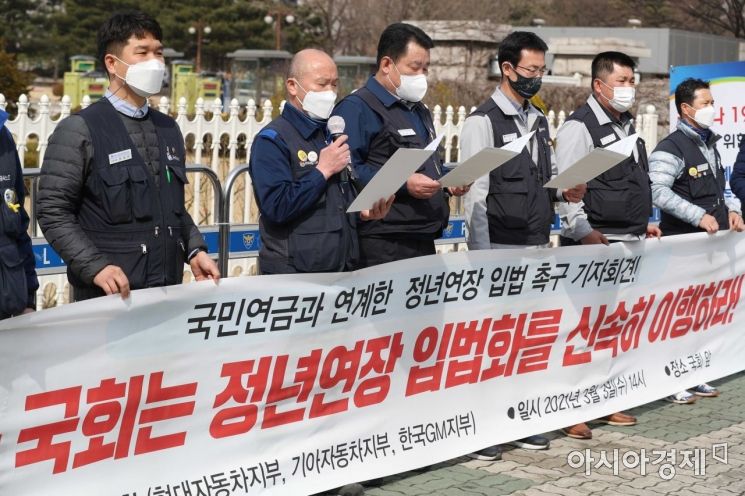 In March this year, the three major automakers Hyundai Motor, Kia Motors, and Korea GM, affiliated with the Korean Metal Workers' Union, held a press conference in front of the National Assembly in Yeouido, Seoul, urging legislation for retirement age extension linked to the National Pension Service. Photo by Moon Honam munonam@
[Asia Economy Reporter Choi Dae-yeol] Although the mandatory retirement age of 60 has entered its fifth year, a survey revealed that many companies are struggling to manage middle-aged and older workers.
According to a survey conducted on the 26th by the Korea Chamber of Commerce and Industry targeting 300 large and small-to-medium enterprises, 89% of companies responded that they face difficulties in managing middle-aged and older personnel. Nearly half of the companies (48%) cited high labor costs as the biggest challenge. Many also found it difficult to bear the burden of new hiring (26%), an increase in low performers (24%), health and safety management (24%), and personnel stagnation (22%).
The most common measure taken in relation to the mandatory retirement age of 60 was the introduction of a wage peak system, adopted by two out of three companies. Some also implemented reduced or adjusted working hours, early retirement schemes, and personnel system reforms. When comparing the work capabilities of middle-aged employees to younger employees, 56% of companies believed they were similar. Meanwhile, 25% thought middle-aged employees performed worse, and 18% thought the opposite.
Professor Cho Jun-mo of Sungkyunkwan University said, "It has been analyzed that youth employment has decreased since the mandatory retirement age of 60 was enforced, which is due to excessively high seniority-based wages that are rarely seen in other major countries." He added, "If labor and management do not cooperate to resolve the excessive seniority-based wages and seniority-based personnel system, it will be difficult to solve the problem of reduced youth employment caused by retirement age extension. Furthermore, even if low birth rates and aging worsen, it will become an obstacle to discussions on employment extension."
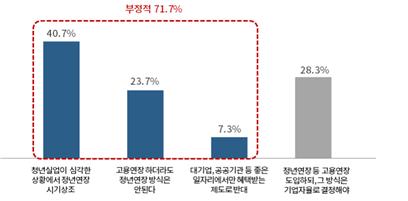
Regarding the recently raised issue of extending the retirement age to 65, 72% of respondents viewed it negatively. Many considered it premature due to severe youth unemployment or were negative about the method of retirement age extension even if employment extension is implemented. Even those who viewed retirement age extension positively believed that the method should be decided autonomously by companies. If the retirement age is extended to 65, 62% of companies expected it to negatively affect maintaining existing employment or new hiring, while the remaining 38% anticipated little impact.
Yoo Il-ho, head of the Employment and Labor Policy Team at the Korea Chamber of Commerce and Industry, said, "If employment extension is pushed forward solely based on the speed of aging without resolving the aftermath of the mandatory retirement age of 60, it could further worsen employment difficulties for the MZ generation. Efforts to increase flexibility in wages and job roles, such as reforming the wage system to focus on job performance and activating job transitions, should take priority."
© The Asia Business Daily(www.asiae.co.kr). All rights reserved.
![Clutching a Stolen Dior Bag, Saying "I Hate Being Poor but Real"... The Grotesque Con of a "Human Knockoff" [Slate]](https://cwcontent.asiae.co.kr/asiaresize/183/2026021902243444107_1771435474.jpg)
















