Seoul City Undertakes Water Flushing of All Transmission and Distribution Pipes and Launches Nation's First Large-Scale Water Main Pilot Cleaning
Periodic Drainage in Water Quality Vulnerable Areas for Quality Control, Early Prevention of Water Quality Accidents with Discharge Devices
Real-Time Water Quality Measurement in 424 Administrative Districts, Establishing a 'Safe Tap Water Network' through Public Water Quality Information
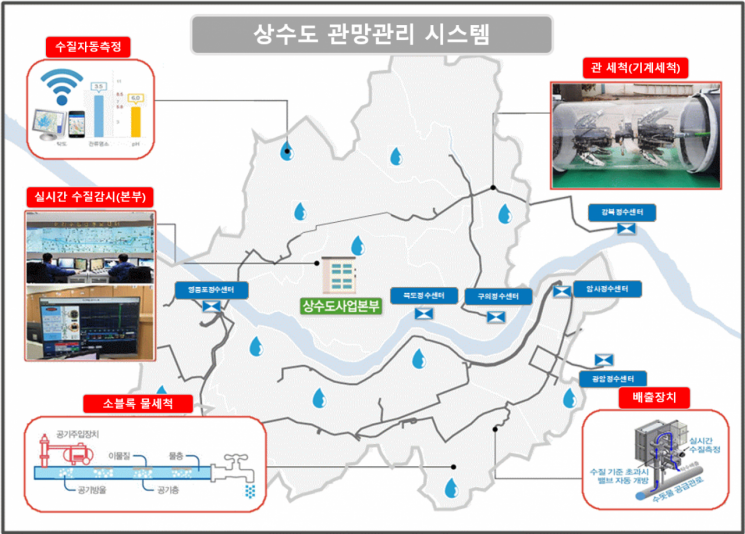
[Asia Economy Reporter Lim Cheol-young] Seoul City announced on the 27th that it plans to establish a ‘Water Supply Network Management System’ by the end of the year, integrating Information and Communication Technology (ICT) and Internet of Things (IoT) technology into the tap water supply process.
The ‘Water Supply Network Management System’ is a comprehensive and systematic network management plan that includes enhanced cleaning of water pipes for efficient network management, early prevention of water quality accidents through water quality management of stagnant water at the end of pipes and discharge devices, expansion of real-time automatic water quality monitoring points, and strengthening of water quality information disclosure.
Seoul City aims to improve the quality of tap water supply by strengthening periodic cleaning of water pipes and establishing a dense real-time water quality monitoring network to quickly block water quality accidents. The goal is to eliminate citizens’ distrust of water pipes and supply healthy and delicious Seoul tap water, Arisu, more safely to each household.
To improve the quality of tap water supply, cleaning of water pipes by pipe diameter is being promoted. Seoul City divides the entire city into 2,037 small blocks and conducts water cleaning every five years on pipelines with a diameter of 350mm or less within each block. As of last year, 419 small blocks and 636 km of water pipes were cleaned, resulting in water quality improvement effects such as an average turbidity reduction of 0.12 NTU and an increase in residual chlorine by 0.07 mg/L after cleaning.
Starting this year, a pilot cleaning of large water pipelines with diameters of 400mm or more is being promoted for the first time nationwide, and plans to expand the application if the field applicability of the method is confirmed. Last year, Seoul City held a technology competition for the first time nationwide to discover excellent cleaning methods for large water pipelines with diameters of 400mm or more, and the selected excellent technologies through the competition are being pilot-applied at 20 sites throughout Seoul this year.
In addition, systematic management of water quality vulnerable areas is being strengthened. Seoul City has installed discharge devices that automatically discharge contaminated water when water quality abnormalities occur at two locations in Yeouido and is conducting pilot operations. Based on the effectiveness analysis, it plans to consider expanding the application to manage stagnant water at the end of pipes. Also, for 161 locations where tap water stagnates at the end of pipes and water quality management is necessary, periodic drainage is conducted every 20 to 50 days for regular management.
Automatic water quality monitoring during the tap water supply process and real-time disclosure of water quality information will also be strengthened. By the end of this year, water quality automatic measuring devices will be expanded to all 424 administrative districts in Seoul, and from 2022, residents will be able to check the water quality of ‘our neighborhood’ in real time. Seoul City plans to build a dense automatic water quality monitoring system covering all 424 administrative districts by installing an additional 307 automatic water quality measuring devices this year, in addition to the 117 devices installed previously for real-time water quality management during the tap water supply process.
Seoul City expects to detect water quality abnormalities early and prevent water quality accidents through this system. Furthermore, it plans to establish a transparent water quality disclosure system to build a safe tap water network that all citizens can trust and drink. Kim Tae-gyun, Head of the Waterworks Business Headquarters, said, “Seoul City has led the advancement of network management by holding the first-ever technology competition to discover large pipe cleaning technologies nationwide,” adding, “We will proactively prevent water quality accidents through thorough water supply network management and safely supply clean tap water.”
© The Asia Business Daily(www.asiae.co.kr). All rights reserved.
![Clutching a Stolen Dior Bag, Saying "I Hate Being Poor but Real"... The Grotesque Con of a "Human Knockoff" [Slate]](https://cwcontent.asiae.co.kr/asiaresize/183/2026021902243444107_1771435474.jpg)















