Increased Mobility, Delta Variant, and Rise in Diagnostic Testing Are Causes
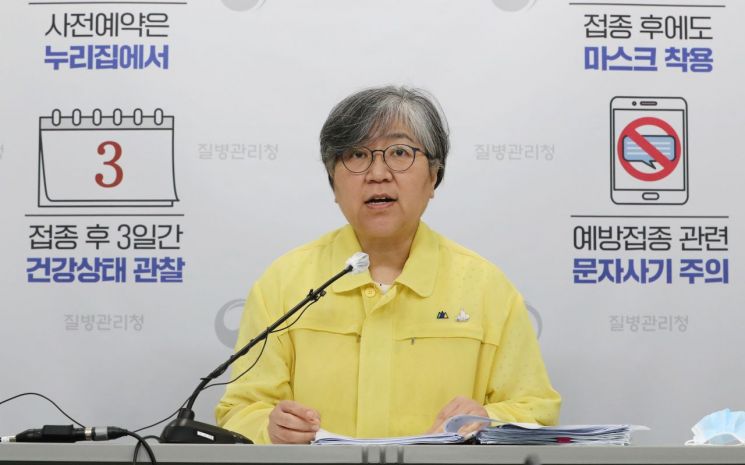
[Asia Economy Reporter Kim Ji-hee] On the 25th, as the number of new domestic COVID-19 cases reached the 3,000 range for the first time, the government expressed concerns that the number of confirmed cases could increase further over the next one to two weeks.
Jung Eun-kyung, Commissioner of the Korea Disease Control and Prevention Agency (KDCA), said at the COVID-19 briefing that afternoon, "During the Chuseok holiday period, increased human contact and mobility led to a sharp rise in patient cases," adding, "The number of confirmed cases could increase significantly over the next one to two weeks." She urged, "Since mobility is expected to increase again during the early October holiday period, please cancel or postpone private gatherings for at least the next two weeks, and especially refrain from using multi-use facilities where wearing masks is difficult."
Commissioner Jung particularly expressed concern about the spread in the metropolitan area. The average daily number of COVID-19 cases over the past week was 2,028, a 12.8% increase compared to the previous week. The incidence rate in the metropolitan area is more than three times higher than in non-metropolitan areas. The metropolitan area saw an average daily increase of 1,542 cases over the past week, up 11.4% from the previous week. Non-metropolitan areas also saw an average of 486 cases daily, a 17.3% increase from the prior week. The proportion of cases with unknown infection routes among all confirmed cases continues to rise, currently at 38%.
The health authorities cited increased movement and contact during the Chuseok holiday, the spread of the highly transmissible Delta variant, and increased diagnostic testing as reasons for the surge in confirmed cases. Commissioner Jung emphasized, "To achieve a phased return to normal life, it is most important to maintain stable quarantine conditions until the end of October, when more than 70% of the entire population will have completed vaccination," and called for active cooperation with quarantine measures.
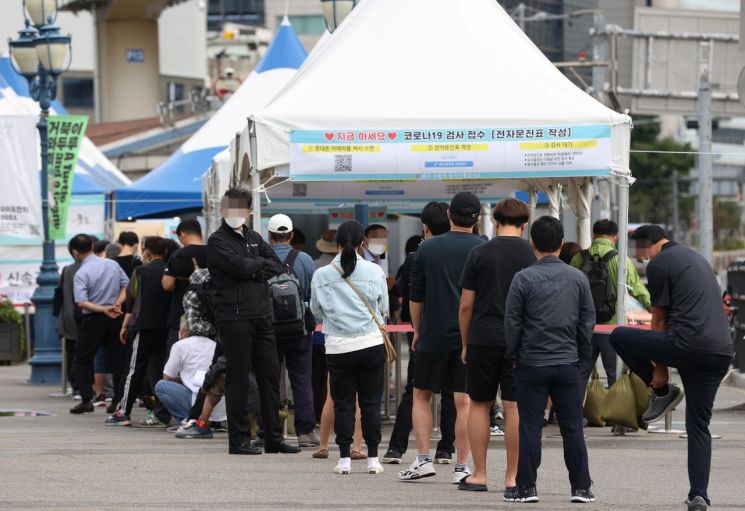
"Next week could see over 3,000 confirmed cases"
As of midnight that day, the number of new COVID-19 cases was 3,273, the highest since the domestic COVID-19 outbreak began. Health authorities explained that the number of confirmed cases could increase further next week. Commissioner Jung said, "The current effective reproduction number is 1.03 and is believed to have increased slightly," adding, "If the current trend continues, there is a possibility that the number of confirmed cases will exceed 3,000."
This spread notably exceeds previous projections made by authorities. Commissioner Jung stated, "The number of confirmed cases can vary depending on several factors including vaccination rates, epidemiological investigation capacity, and the effectiveness and enforcement of social distancing," and added, "According to expert projections, the current scale corresponds to a scenario between the worst and moderate cases."
As the domestic COVID-19 spread remains uncontrolled, there is a sense of alarm regarding the planned transition to 'With COVID' starting next month. Some analysts suggest that since the government has emphasized 'stabilizing the quarantine situation in September' as a prerequisite for phased recovery, the timeline may be delayed.
Commissioner Jung emphasized, "Since daily life will fully resume after the weekend, it is crucial to suppress additional transmission from asymptomatic or mild cases infected during the holiday period at schools, workplaces, and multi-use facilities to avoid strengthening social distancing and to proceed with the phased recovery roadmap as scheduled." Regarding the timing of phased recovery, she added, "It is difficult to answer at this time because the decision depends on monitoring the epidemic situation and the time when 70% of the population completes the second vaccination and immunity is formed by the end of October."
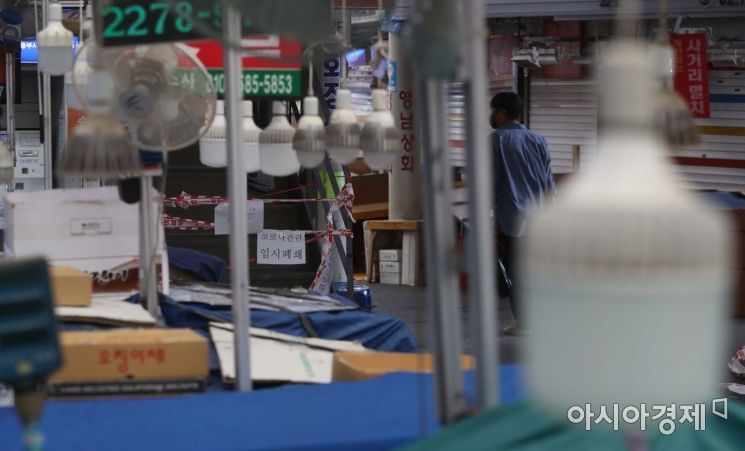 On the 23rd, Jungbu Market in Jung-gu, Seoul, was quiet. There have been a total of 199 confirmed COVID-19 cases related to Jungbu Market. The Seoul Metropolitan Government tested a total of 687 people, including contacts. Excluding the initial confirmed case, 198 tested positive, 451 tested negative, and the rest are awaiting results. Workers at the facility shared restrooms and other common areas, and it was difficult for employees of nearby stores to maintain social distancing. It was confirmed that some confirmed cases continued to work even after showing COVID-19 symptoms. Photo by Moon Honam munonam@
Continued large-scale case surge... Medical response system also 'unstable'
With daily four-digit large-scale confirmed cases continuing for nearly three months and the epidemic size growing, the burden on the medical response system is increasing day by day. For now, health authorities say they can handle around 2,500 cases per day. However, if the spread is not controlled by mid-October, problems in the medical system are inevitable.
Commissioner Jung explained, "Currently, the Central Disaster and Safety Countermeasures Headquarters is issuing administrative orders to secure beds in tertiary general hospitals and general hospitals to respond to critically ill and hospitalized patients," adding, "However, if confirmed cases continue to increase and accumulate, the capacity of beds in residential treatment centers and dedicated hospitals will decrease, so it is necessary to control the current level of quarantine as much as possible."
She continued, "We are preparing a transition of the overall medical response system by increasing critical care capacity, streamlining the operation of residential treatment centers and dedicated hospitals, and expanding home treatment simultaneously," and added, "Currently, even if about 2,500 to 3,000 cases occur daily, beds are being operated at a scale that can respond for at least one to two weeks."
© The Asia Business Daily(www.asiae.co.kr). All rights reserved.
![Clutching a Stolen Dior Bag, Saying "I Hate Being Poor but Real"... The Grotesque Con of a "Human Knockoff" [Slate]](https://cwcontent.asiae.co.kr/asiaresize/183/2026021902243444107_1771435474.jpg)

















