Samsung Likely to Finalize $17 Billion Investment Location as Early as Next Month
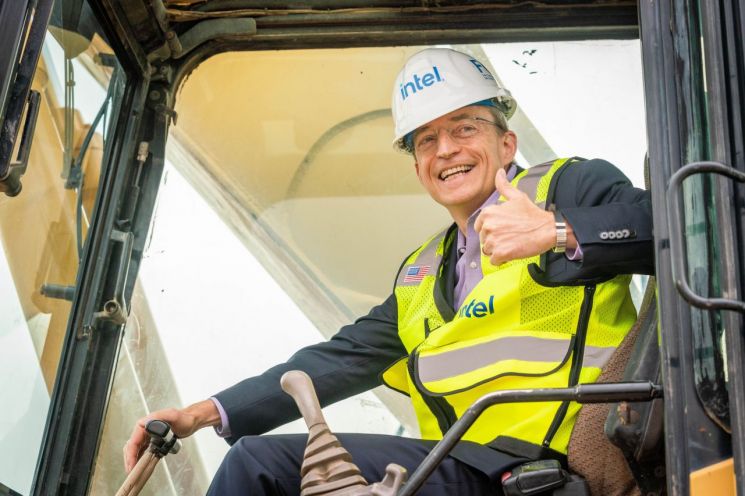
[Asia Economy Reporter Jeong Hyunjin] As the global semiconductor industry fiercely competes in facility investments, Intel on the 24th (local time) began construction of a $20 billion (approximately 23.6 trillion KRW) foundry (semiconductor contract manufacturing) plant in Arizona, USA. Meanwhile, Taiwan's TSMC is also building a factory in Arizona, and Samsung Electronics is deliberating over a $17 billion investment location in the United States.
Pat Gelsinger, Intel's CEO, attended the groundbreaking ceremony held at the Ocotillo campus construction site in Chandler, Arizona, and said, "Today's event will be an important step in increasing our production capacity to meet the incredible growth in semiconductor demand." He added, "With this $20 billion capacity expansion, total investments exceeding $50 billion will have been made over the past 40 years since we started operations in Arizona," emphasizing, "As the only advanced process semiconductor manufacturer based in the United States, we will do our best to help the U.S. regain semiconductor leadership."
This groundbreaking ceremony took place six months after Intel announced in March that it would build two new factories in Arizona. CEO Gelsinger declared, "Intel is back," announcing a re-entry into the foundry business and rapidly rolling out large-scale investments. In addition to Arizona, $3.5 billion will be invested to expand the factory in New Mexico. With the Biden administration determined to regain semiconductor dominance, Intel appears to be actively utilizing government support.
TSMC, the number one foundry company, is also constructing a semiconductor factory in Arizona. TSMC is investing $12 billion in Arizona, having started construction in June, with mass production targeted for 2024. When the shortage of automotive semiconductors continued in the first half of this year, TSMC closely cooperated with the Taiwanese government, which responded to the U.S. government's request, and expanded automotive semiconductor production lines.
Since announcing a $17 billion U.S. semiconductor factory investment in May, Samsung Electronics has been focused on selecting a candidate site. Besides its existing semiconductor factory in Austin, Texas, it is negotiating with local governments over tax incentives in Taylor, Texas; Goodyear and Queen Creek in Arizona; and Genesee County, New York, aiming to select a suitable site for semiconductor expansion in the U.S. Industry insiders say the final site selection is likely to be made as early as next month.
Meanwhile, the White House, a day before Intel's groundbreaking ceremony on the 24th, pressured semiconductor companies to disclose sensitive information during a virtual meeting with the semiconductor industry hosted by Brian Deese, Chair of the National Economic Council (NEC), and Gina Raimondo, Secretary of Commerce. The White House stated that transparency and trust in the semiconductor supply chain need improvement and demanded semiconductor companies submit information related to inventory, orders, and sales within 45 days. While the U.S. government expects voluntary information provision, it clearly indicated that the Defense Production Act (DPA) could be applied, putting the related industry in a difficult position.
© The Asia Business Daily(www.asiae.co.kr). All rights reserved.
![Clutching a Stolen Dior Bag, Saying "I Hate Being Poor but Real"... The Grotesque Con of a "Human Knockoff" [Slate]](https://cwcontent.asiae.co.kr/asiaresize/183/2026021902243444107_1771435474.jpg)















