3,273 New COVID-19 Cases on the 25th... Seoul and Gyeonggi Over 1,000 Cases
[Asia Economy Reporter Kim Ji-hee] As the Chuseok holiday ended, the number of new COVID-19 cases surged, eventually reaching the 3,000 range. This is the first time since the domestic COVID-19 outbreak that daily confirmed cases have exceeded 3,000.
The Central Disease Control Headquarters (CDCH) announced that as of midnight on the 25th, 3,273 new COVID-19 cases were reported, bringing the cumulative total to 298,402. With the effect of reduced testing during the Chuseok holiday period disappearing, the previous day's record high of 2,431 cases was broken again, setting a new record just one day later. The number of new cases increased sharply by 842 compared to the previous day. Compared to last Saturday a week ago, the number is nearly 1,200 higher.
The fourth wave, which began in July, has been continuing for nearly three months in a 'thick and long' pattern. The record of daily four-digit confirmed cases has continued for 81 days since July 7.
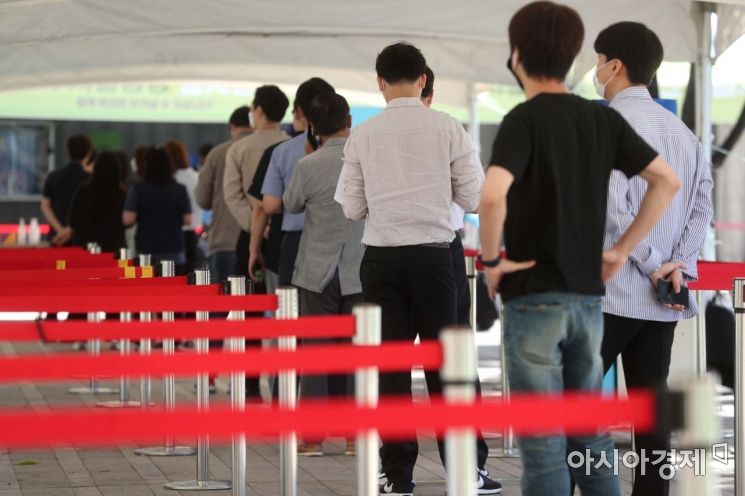 On the 24th, after the Chuseok holiday ended and COVID-19 cases surged, the temporary screening clinic in front of Seoul City Hall was crowded with citizens. The Central Disease Control Headquarters of the Korea Disease Control and Prevention Agency announced that 2,434 new COVID-19 cases were confirmed as of midnight that day. Photo by Moon Honam munonam@
First 2,000 Range in the Capital Area... 77.4%
Looking at the infection routes of new confirmed cases on this day, 3,245 were locally transmitted and 28 were imported. In particular, the number of locally transmitted cases, a key indicator for assessing the quarantine situation, has exceeded 2,000 on average daily over the past week.
By region, Seoul (1,217 cases) and Gyeonggi (1,094 cases) both entered the 1,000 range, with 2,512 cases coming from the capital area alone. The proportion of the capital area among all locally transmitted cases reached 77.4%. This is also the first time that cases in the capital area have exceeded 2,000.
Non-capital areas reported cases as follows: Daegu 118, Chungnam 91, Daejeon 79, Jeonbuk 67, Chungbuk 59, Gyeongbuk 57, Gangwon 56, Busan 51, Gyeongnam 46, Gwangju 30, Jeonnam 28, Ulsan 26, Jeju 15, Sejong 10. With additional confirmed cases reported in all 17 cities and provinces nationwide, 733 people in non-capital areas tested positive for COVID-19.
The number of suspected case tests reported in one day was 63,658, about 7,000 fewer than the previous day. However, more than 160,000 tests were conducted at temporary screening clinics nationwide, bringing the total number of tests to 227,874. In the capital area's temporary screening clinics, 141,593 tests were conducted, resulting in 731 confirmed cases, while 22,623 tests were conducted in non-capital area temporary screening clinics, with 65 positive cases confirmed.
"Chuseok Holiday Impact to Intensify Next Week... Cases May Increase Further"
As movement and contact increased before the Chuseok holiday, the number of confirmed cases gradually rose, but surged immediately after the holiday ended. However, quarantine authorities and experts analyze that the spread may continue next week as the impact of the large-scale population movement during Chuseok fully materializes.
Park Young-jun, head of the epidemiological investigation team at the Central Disease Control Headquarters, said at a briefing the day before, "Considering the trend of increased movement observed before Chuseok, we expect that confirmed cases may continue to increase into early next week or beyond," adding, "Since there are many factors that can cause the number of confirmed cases to either decrease or increase, it is difficult to predict the exact scale at this point."
Lee Ki-il, the first controller of the Central Disaster and Safety Countermeasures Headquarters, also said, "The increase in movement during the Chuseok holiday, increased frequency of personal contact, and relaxation of quarantine measures are analyzed as the main causes of the increase in confirmed cases," and predicted, "Cases may increase further next week as people who traveled to provinces return and continue to get tested."
As large-scale confirmed cases continue, the number of critically ill patients and deaths is also rising. On this day, the number of critically ill patients increased by 30 from the previous day to 339. Deaths increased by 7 from the previous day, bringing the cumulative total to 2,441. The domestic average fatality rate is 0.82%.
© The Asia Business Daily(www.asiae.co.kr). All rights reserved.

















