Core Procedures for Public Support Such as Resident Consent, Land Expropriation, and Permits Proceed Quickly
Sales Conducted by Private Methods, Avoiding Sale Price Ceiling System to Maximize Private Profit
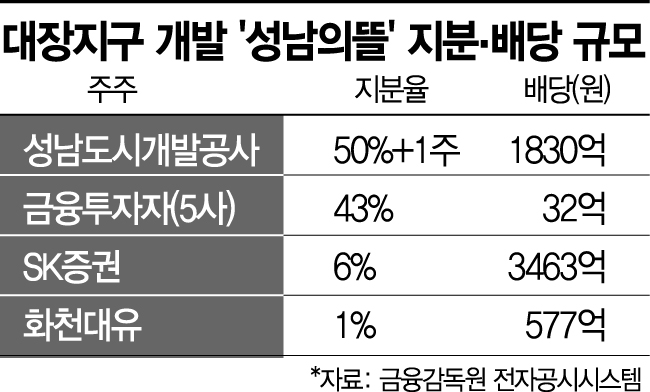
As the controversy over preferential treatment surrounding the Pangyo Daejang District project in Seongnam, Gyeonggi Province continues to escalate, industry insiders are paying attention to evaluations that the structure of this project is a case that maximally exploited loopholes in the urban development project system. It is said to be a project structure that eliminated the biggest obstacles?resident consent and permit risks?through the participation of public institutions such as local governments, while maximizing private sector profits. There are even criticisms that it is a "private development disguised in public clothing."
According to the industry on the 24th, contrary to Gyeonggi Province Governor Lee Jae-myung’s claim of "public development," the Daejang District project is fundamentally interpreted as a private development project. Although Seongnam Urban Development Corporation participated with a stake of "50% plus one share," the project finance vehicle (PFV) ‘Seongnam Uteul’ itself is a private corporation, and the actual project was led by Hwacheon Daeyu Asset Management (Hwacheon Daeyu), an asset management company (AMC).
As a result, key procedures of the development project such as resident consent, land acquisition, and permits were swiftly carried out with active public support, while the sales proceeded in a private manner. Experts analyze that this allowed them to avoid the hurdle of the price ceiling system for sales, thereby maximizing the profits of the private developer.
An official from a development company explained, "Urban development projects are called the ‘dream territory’ for private developers." The reason is that although the project scale itself is so large that astronomical profits are expected, the hurdles such as resident consent and permits are not easy to overcome, so without sufficient financial power and project know-how, it is difficult to take on such projects.
The industry analyzes that the participation of Seongnam Urban Development Corporation could have been a ‘masterstroke’ for private developers. The consent requirement, which was the biggest obstacle, was reduced from two-thirds to half of the total land area, and the burden of land acquisition costs was also greatly reduced. The development and compensation for the Daejang-dong project were carried out according to the ‘Urban Development Act’ and the ‘Act on Acquisition and Compensation of Land for Public Projects’ (Land Compensation Act). Thanks to this, the compensation amount was reportedly set at around 2 million KRW per 3.3㎡, about half of the market price at the time.
Since Seongnam City, the permit authority, participated as the project entity, related risks also disappeared. The Gyeonggi Research Institute also stated in its report "In-depth Study on Cases of Public Return of Development Profits" that "Seongnam Urban Development Corporation, a company 100% invested by Seongnam City, directly and indirectly supported permit work, increasing the likelihood of the project’s success."
Although Hwacheon Daeyu had the burden of distributing 183 billion KRW in dividend profits to Seongnam Urban Development Corporation, there is also an analysis that this was sufficiently offset by the five-block sales project obtained through private contracts. Hwacheon Daeyu’s sales profits from sales reached 82.2 billion KRW in 2019 and 153 billion KRW last year. Because of this, some speculate that the land supply agreement with Hwacheon Daeyu might have been a quid pro quo for the dividends paid to Seongnam Urban Development Corporation.
An official from development company A evaluated, "Governor Lee claims that development profits were recovered through the Daejang District development, but conversely, from the perspective of private companies promoting urban development projects, it became a project structure that removed risk factors and maximized profits."
© The Asia Business Daily(www.asiae.co.kr). All rights reserved.
![Clutching a Stolen Dior Bag, Saying "I Hate Being Poor but Real"... The Grotesque Con of a "Human Knockoff" [Slate]](https://cwcontent.asiae.co.kr/asiaresize/183/2026021902243444107_1771435474.jpg)















