Statement Expected to Curb China Announced at Talks on the 24th
China-Indonesia-Malaysia Oppose AUKUS
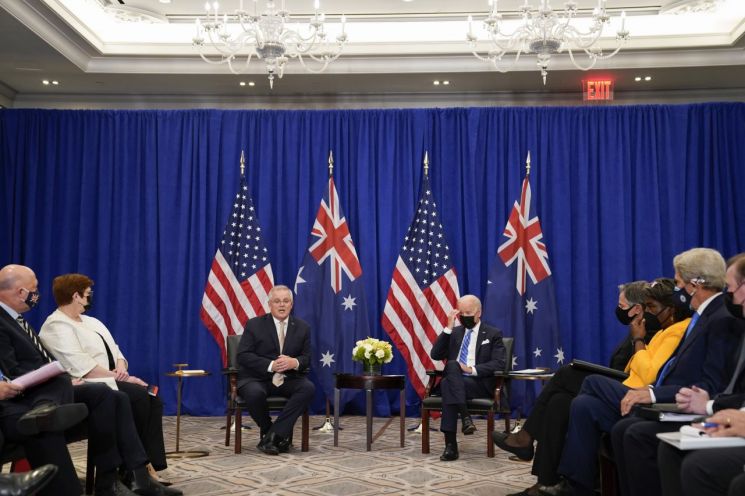
[Asia Economy Beijing=Correspondents Youngshin Cho and Hyunwoo Lee] International attention is focused on the first face-to-face meeting of the Quad leaders, a U.S.-led military alliance aimed at countering China. Especially since the meeting is held immediately after the launch of AUKUS, a security pact between the U.S., the U.K., and Australia, a joint statement with a strengthened China-containment stance is expected. China is responding head-on to U.S. pressure by strengthening diplomatic relations with ASEAN countries.
According to foreign media including the AP on the 23rd (local time), a senior White House official said at a press briefing, "On the 24th, the leaders of the four Quad member countries?the U.S., Japan, Australia, and India?will hold their first face-to-face meeting at the White House. The leaders plan to focus on discussions about COVID-19 vaccines, infrastructure, and technology cooperation." Although the Quad leaders held a virtual inaugural meeting in March after the alliance was formed, this is their first in-person meeting.
The Nihon Keizai Shimbun (Nikkei) reported that it obtained a draft of the joint statement to be announced at this Quad meeting, noting that the statement is likely to include content emphasizing respect for human rights as a shared principle in the use of advanced technology, aimed at countering China.
Specifically, the draft includes the use of ‘Open RAN’ technology, which allows member countries to connect equipment from different telecommunications companies. Nikkei interprets this as a move to counter Huawei, which controls 30% of the global base station market.
Meanwhile, to respond to U.S. security alliances such as AUKUS and the Quad, China is strengthening diplomatic efforts with Southeast Asian countries. The Chinese state-run Global Times reported that Malaysia’s Foreign Minister Hishammuddin Hussein is scheduled to visit China soon and will discuss the risks posed by AUKUS with the Chinese government.
Minister Hussein previously held preliminary discussions on the AUKUS issue with related countries including Brunei, the ASEAN chair, as well as Cambodia, Myanmar, Laos, and Vietnam. With some ASEAN countries sympathizing with China’s opposition to AUKUS, the pact is expected to become a new source of conflict in the South China Sea.
The Global Times also cited a Philippine military expert saying, "Nuclear-powered submarines use enriched uranium that can be directly converted into nuclear weapons, which violates the 1971 Southeast Asia Nuclear-Weapon-Free Zone (ZOPFAN) agreement and the Nuclear Non-Proliferation Treaty (NPT)."
Xinhua News Agency also reported that Malaysia and Indonesia are the most strongly opposed to the launch of AUKUS, noting that Indonesian President Joko Widodo even canceled Australian Prime Minister Scott Morrison’s visit to Indonesia citing other commitments.
© The Asia Business Daily(www.asiae.co.kr). All rights reserved.
![Clutching a Stolen Dior Bag, Saying "I Hate Being Poor but Real"... The Grotesque Con of a "Human Knockoff" [Slate]](https://cwcontent.asiae.co.kr/asiaresize/183/2026021902243444107_1771435474.jpg)















