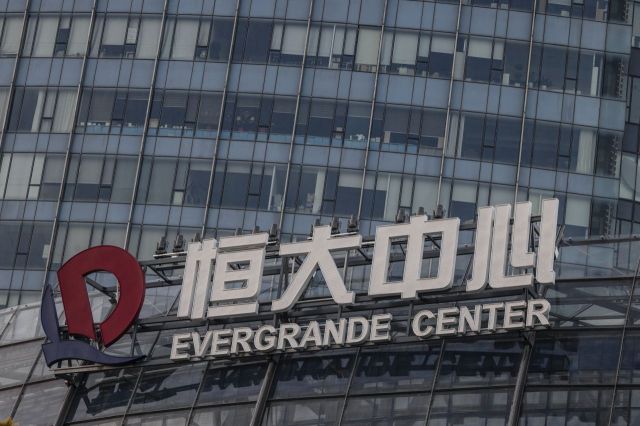
 Outside the Evergrande (恒大) Center building in Shanghai, China, on the 21st, showing the company logo. (Photo by EPA Yonhap News)
[Asia Economy Reporter Geum Bo-ryeong] The liquidity crisis of Evergrande (恒大·Hengda), a Chinese real estate developer with debts reaching 350 trillion won, has rapidly emerged as a factor unsettling the global financial market, yet Chinese authorities remain silent.
In the market, there was initially speculation that the Chinese Communist Party, which has promoted the national policy of "common prosperity," is unlikely to step in to rescue Evergrande. However, if Evergrande goes bankrupt and causes a significant shock to the real economy, with signs of a full-scale spillover to the banking sector, it is also expected that Chinese authorities will eventually intervene and attempt to acquire Evergrande as a state-owned enterprise.
Despite ongoing concerns related to the Evergrande crisis, Chinese authorities and state-run media have yet to issue an official stance. For now, it is interpreted that the authorities prefer to monitor the situation rather than intervene immediately.
The market initially focused on the State Council executive meeting chaired by Premier Li Keqiang on the 22nd. However, the State Council's press release after the meeting only mentioned "closely tracking and analyzing economic trends to maintain continuity and stability of macro policies, finely adjusting policies between economic cycles in advance, and strengthening the linkage of fiscal, financial, and employment policies." It did not directly mention the Evergrande crisis. Instead, Chinese authorities hinted that bankruptcy of Evergrande is not impossible.
The international credit rating agency Standard & Poor's (S&P) recently stated in a report, "The Chinese government is unlikely to support Evergrande unless the stability of the system is at risk," adding, "If the Chinese government intervenes, it would weaken the authorities' campaign to tighten control over the real estate sector." This suggests that Chinese authorities are expected not to rescue Evergrande.
On the 23rd (local time), the Wall Street Journal (WSJ) also reported, citing sources familiar with the matter, that the likelihood of government intervention to rescue Evergrande has further diminished. According to the sources, local government agencies and state-owned enterprises have been instructed to intervene at the last moment if Evergrande Group fails to handle matters in an orderly manner.
However, some experts argue that given the difficulty in accurately gauging the extent of Evergrande's impact across the real and financial sectors, Chinese authorities cannot simply remain passive.
One foreign media outlet said, "Many financial institutions are exposed to Evergrande through direct loans or bond holdings, and once a default occurs, there will be a sell-off in the high-yield bond market," adding, "Economists do not think the Evergrande issue will be on the scale of Lehman Brothers, but it is certainly a complex problem for Beijing's policymakers."
Ultimately, if the Evergrande crisis leads to the collapse of about 8,000 partner companies, employment insecurity for hundreds of thousands, and signs of a financial crisis, Chinese authorities may intervene and propose measures such as debt restructuring or acquisition by state-owned enterprises.
Hong Kong's Ming Pao, citing the economic media Asia Markets, reported on the same day that Chinese authorities are considering dividing Evergrande into three entities, including the real estate sector, and that an announcement could be made within days. In this case, the core real estate development sector would be converted into a state-owned enterprise.
© The Asia Business Daily(www.asiae.co.kr). All rights reserved.
![Clutching a Stolen Dior Bag, Saying "I Hate Being Poor but Real"... The Grotesque Con of a "Human Knockoff" [Slate]](https://cwcontent.asiae.co.kr/asiaresize/183/2026021902243444107_1771435474.jpg)















