[Asia Economy Reporter Jeong Hyunjin] An analysis revealed that the top 100 domestic companies have deepened their dependence on overseas markets since the COVID-19 pandemic. Amid a domestic market slump that has intensified polarization among companies, sales recovery was particularly notable in overseas markets centered on the Americas and Europe, where vaccination campaigns have been in full swing.
On the 23rd, the Korea Economic Research Institute under the Federation of Korean Industries analyzed the consolidated financial statements of the top 100 domestic companies. It found that their total sales in the first half of this year amounted to KRW 723.6 trillion, an increase of KRW 49.5 trillion compared to KRW 674.1 trillion in the first half of 2019, before COVID-19. Of this increase, KRW 46.4 trillion, or 93.7%, originated from overseas markets.
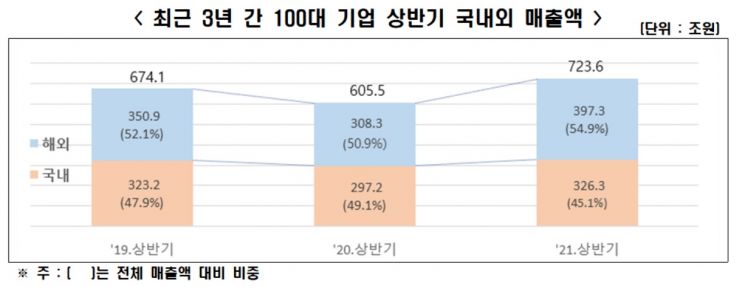
The overseas sales of the top 100 companies in the first half of this year reached KRW 397.3 trillion, a 13.2% increase compared to KRW 350.9 trillion in the first half of 2019, just before COVID-19. Meanwhile, domestic sales for these companies in the first half of this year were KRW 326.3 trillion, showing only a 1.0% increase compared to the first half of 2019. The dependence on overseas markets, measured as the proportion of overseas sales in total sales, rose by 2.8 percentage points to 54.9% in the first half of this year compared to the first half of 2019.
Regarding domestic sales, polarization by company size was evident. Except for the top companies, many firms have yet to recover from the COVID-19 shock in the domestic market, according to the Korea Economic Research Institute. The domestic sales of the top 20 companies in the first half of this year were KRW 148.1 trillion, a 13.1% increase from KRW 131 trillion in the first half of 2019. Conversely, the domestic sales of the lower 80 companies in the first half of this year were KRW 178.2 trillion, a 7.3% decrease compared to the first half of 2019.
The Korea Economic Research Institute also noted that the sales quintile ratio of the top 100 companies expanded from 10.7 times to 11.3 times during the same period, indicating that polarization by company size in the domestic market has intensified compared to before COVID-19.
By region, sales growth was particularly prominent in the Americas and Europe, where vaccination campaigns were actively underway. The sales of the top 100 companies in the Americas in the first half of this year reached KRW 127.8 trillion, a 23.1% increase compared to the first half of 2019. During the same period, sales in Europe rose from KRW 63.6 trillion to KRW 80.1 trillion, a 25.9% increase. In contrast, the Asia region, where vaccinations have progressed more slowly, saw only a 1.6% increase in sales in the first half of 2021 compared to the first half of 2019.
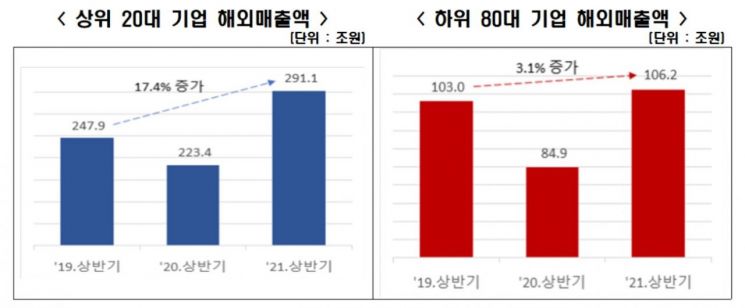
By company size, both the top 20 and the lower 80 companies improved their overseas sales in the first half of this year compared to the first half of 2019, but the increase was more significant among the top 20 companies. The overseas sales of the top 20 companies in the first half of this year were KRW 291.1 trillion, a 17.4% increase from KRW 247.9 trillion in the first half of 2019. The lower 80 companies recorded overseas sales of KRW 106.2 trillion, a 3.1% increase compared to the first half of 2019.
By industry, six sectors including pharmaceuticals and medical, electrical and electronics, and transportation equipment saw increases in both domestic and overseas sales in the first half of this year compared to the first half of 2019. The pharmaceuticals and medical sector experienced a surge in demand for COVID-19 diagnostic kits, with domestic sales increasing by 23.4% and overseas sales soaring by 1068.2% compared to the first half of 2019. The electrical and electronics sector saw domestic sales rise by 19.6% and overseas sales by 19.0%, driven by increased demand for mobile devices, PCs, and semiconductors due to the rise of non-face-to-face activities and telecommuting. The transportation equipment sector benefited from new car launches by Hyundai and Kia continuing from last year, with domestic sales up 13.1% and overseas sales up 10.6% compared to the first half of 2019.
However, three sectors including machinery and shipbuilding saw declines in both domestic and overseas sales in the first half of this year. The machinery sector's domestic and overseas sales fell by 22.7% and 36.4%, respectively, compared to the first half of 2019, affected by the downturn in China's construction market. The shipbuilding sector, which takes about one and a half to two years for ship orders to be reflected in sales, also saw domestic and overseas sales decrease by 22.2% and 75.6%, respectively, compared to the first half of 2019, due to a gap in orders caused by past industry downturns.
Choo Kwang-ho, Director of Economic Policy at the Korea Economic Research Institute, said, "The prolonged social distancing due to the spread of variant viruses has slowed the pace of domestic recovery in South Korea. We need to focus policy efforts on increasing vaccination rates and preparing measures to revitalize the domestic economy."
© The Asia Business Daily(www.asiae.co.kr). All rights reserved.
![Clutching a Stolen Dior Bag, Saying "I Hate Being Poor but Real"... The Grotesque Con of a "Human Knockoff" [Slate]](https://cwcontent.asiae.co.kr/asiaresize/183/2026021902243444107_1771435474.jpg)
















