Rising House Prices Increase Conflicts Over Real Estate Inheritance
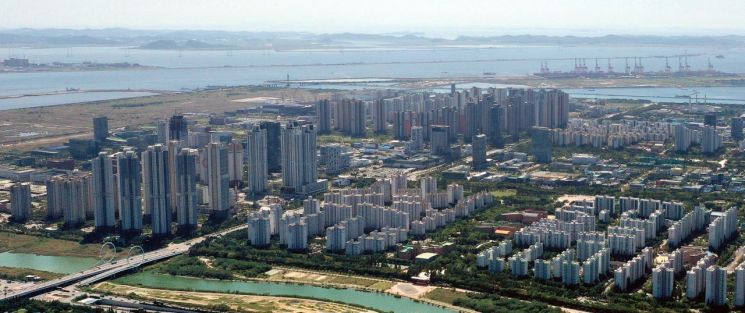 On the afternoon of the 15th, high-rise apartment buildings stand tall in Dongchun-dong and Songdo International City, as seen from Cheongryangsan in Dongchun-dong, Yeonsu-gu, Incheon. According to the Korea Real Estate Board, Seoul housing prices increased from 0.60% in July to 0.68% last month, marking the highest growth rate in about a year since July of last year (0.71%). Housing prices in Gyeonggi (1.52%→1.68%) and Incheon (1.33%→1.38%) also saw an expanded rate of increase compared to the previous month. Notably, the housing price growth rates in both Gyeonggi and Incheon exceeded twice that of Seoul.
 Amid a recent surge in apartment gifts due to skyrocketing apartment prices, disputes over property inheritance have also increased in tandem. In particular, real estate-related inheritance disputes tend to rise around the holidays.
According to the Court Administration on the 19th, claims for the return of statutory reserved portions increased about 4.6 times from 295 cases in 2008 to 1,371 cases in 2018. Over the 10 years from 2008, the number of related lawsuits increased by about 17% annually on average. Real estate specialized law firms unanimously say, "Legal consultations regarding statutory reserved portions (inheritance disputes) increase as the holidays approach."
The term 'statutory reserved portion (遺留分)' refers to the legally designated share of the inheritance property that must go to certain heirs such as direct descendants (children and grandchildren), spouses, direct ascendants (parents and grandparents), and siblings. Under the current Civil Act, statutory reserved portions are recognized so that spouses, children, and other heirs can each have a certain share of the parent's inheritance. The legally determined inheritance shares are in a 1.5 to 1 ratio between the spouse and children, and among children, the shares are equal at 1 to 1 regardless of eldest or younger son, or son or daughter.
◆ "Why did only my older brother inherit the Gangnam apartment?"... Opposition to exclusion from inheritance= Generally, disputes arise when heirs file lawsuits claiming they did not receive their rightful share during the inheritance process. The case of Mr. A is a representative example.
Mr. A received an apartment worth 1 billion KRW as a gift from his father five years before the father passed away. Recently, while settling the father's estate, his younger sister Ms. B found out about this late and filed a claim for the return of the statutory reserved portion, demanding that Mr. A return her rightful share of the inheritance.
In cases like this, even if a parent leaves all their property to one child, the child who did not receive any property can file a lawsuit and recover a share equivalent to half of the inheritance portion. In other words, Ms. B can inherit half of the apartment's share, and since the statutory reserved portion can be exercised on half of the legal inheritance share, she can claim an inheritance worth 250 million KRW, which is one-quarter of the apartment.
 The top 20% of housing prices in the Seoul metropolitan area have exceeded an average of 1.5 billion KRW for the first time. According to the monthly housing price trend time series statistics from KB Kookmin Bank's Liv Real Estate on the 2nd, the top 20% housing prices in the metropolitan area in August recorded an average of 1,508.93 million KRW. This is the highest since KB began releasing metropolitan area statistics in April 2013.
◆ "I lived hard alone taking care of our parents..." Cases where equal distribution feels unfair= Disputes can also arise even when inheritance property is distributed equally among all siblings.
For example, when one sibling has taken care of the parents alone under difficult circumstances, but the parents divided the property equally among all siblings. In such cases, the contribution portion system can be used to recognize the efforts made in supporting the parents.
The contribution portion system refers to adding a contribution amount when calculating inheritance shares if one of the co-heirs has specially supported the deceased for a significant period by living together, nursing, or other means, or has made a special contribution to maintaining or increasing the deceased's property.
◆ "I'm afraid my children will fight over money after I die" How to prevent legal disputes= Since there is a high possibility of disputes over inheritance property, many donors worry about legal conflicts among their children.
Experts advise that donors should legally protect the rights of all their children during their lifetime.
Attorney Eom Jeong-sook (Beopdo Comprehensive Law Office) said, "There are methods such as gifting only half of the owned property or gifting only the amount corresponding to the statutory reserved portion." Regardless of the method, the key is to protect half of the inheritance property that the children originally should receive.
The inheritance amount guaranteed by the statutory reserved portion is half of the original inheritance amount. For example, if there are two children and two houses worth 100 million KRW each, the total property is 200 million KRW, so each child's original inheritance share is 100 million KRW. The statutory reserved portion is half of this, so each child should be able to inherit at least 50 million KRW.
Attorney Eom advised, "Most family lawsuits occur because the statutory reserved portion of a specific child was not protected during lifetime gifting. If property is inherited within the limits that protect the statutory reserved portions of all children, family harmony can be maintained."
© The Asia Business Daily(www.asiae.co.kr). All rights reserved.
![Clutching a Stolen Dior Bag, Saying "I Hate Being Poor but Real"... The Grotesque Con of a "Human Knockoff" [Slate]](https://cwcontent.asiae.co.kr/asiaresize/183/2026021902243444107_1771435474.jpg)

















