60 Days Until Suneung, Study Tips for Chuseok Holiday
Set Short-Term Goals to Improve Weaknesses
Top Students Focus on Problem Solving, Mid-Level Students Target Weak Areas
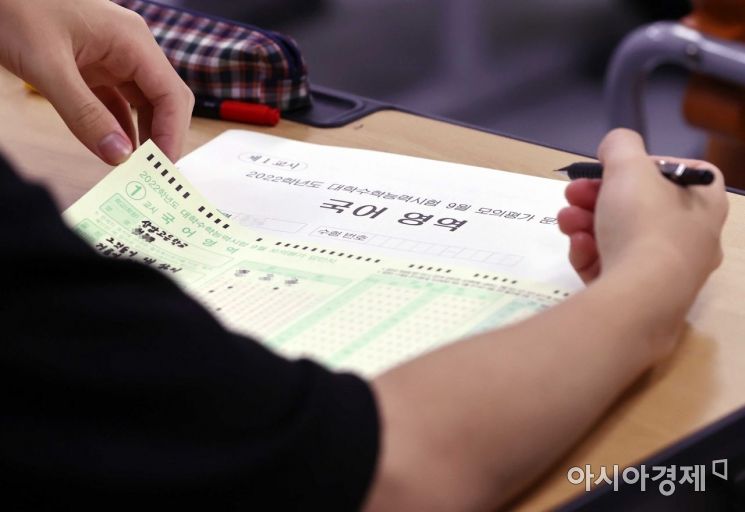 On the 1st, third-year high school students at Sangam High School in Mapo-gu, Seoul, are preparing for the September mock exam of the 2022 College Scholastic Ability Test./Photo by Kang Jin-hyung aymsdream@
[Asia Economy Reporter Han Jinju] The College Scholastic Ability Test (CSAT) day (November 18) is now 60 days away during the Chuseok holiday. It is advisable to maintain your usual study rhythm during the Chuseok holiday while using the time as an opportunity to address your weaknesses. If students let their study habits slip during the holiday, they may experience stress from changes in their condition after the holiday ends, which can disrupt their study rhythm. It is important not to break the usual study rhythm and to continue studying as usual.
Adjust daily patterns, set short-term goals for spare time, or utilize spare moments
It is also necessary to start adjusting your daily routine to match the CSAT schedule. The CSAT begins with the Korean language test at 8:40 a.m. and ends with the second foreign language or Chinese characters test at 5:45 p.m. Although the time spent at school is not much different, the perceived fatigue is much greater because students take the test with more tension and concentration. You need to adjust your usual rhythm so that you can fully concentrate during the exam. Even normally, you should try to maintain full concentration until the test finishes.
Because the Chuseok holiday is long, even students who usually manage themselves well may find it difficult to maintain tension. In such cases, it is recommended to set “short-term goals” to sustain concentration. Set short-term goals focusing on subjects and question types that usually take a lot of time or are difficult and have been postponed.
If it is difficult to concentrate for long periods during the holiday, use study methods that utilize spare time. To use spare time efficiently, it is good to prepare materials that can be studied in short units. It is recommended to use concise summary notes, vocabulary books, listening tests that can be completed in a short time, or short video lectures.
Top-tier students focus on problem solving, mid-tier on weakness improvement, lower-tier on concept review
Top-tier students should have finished organizing concepts and analyzing question trends and now focus on intensive problem solving. It is most important to solve a variety of problems in large quantities and maintain a sense of problem solving. Rather than focusing only on new types or high-difficulty problems, it is better to practice solving all questions evenly so that even easy questions can be answered correctly without mistakes. Even for questions answered correctly, if the solving process is not clear, it is necessary to review the concepts again and firmly internalize them.
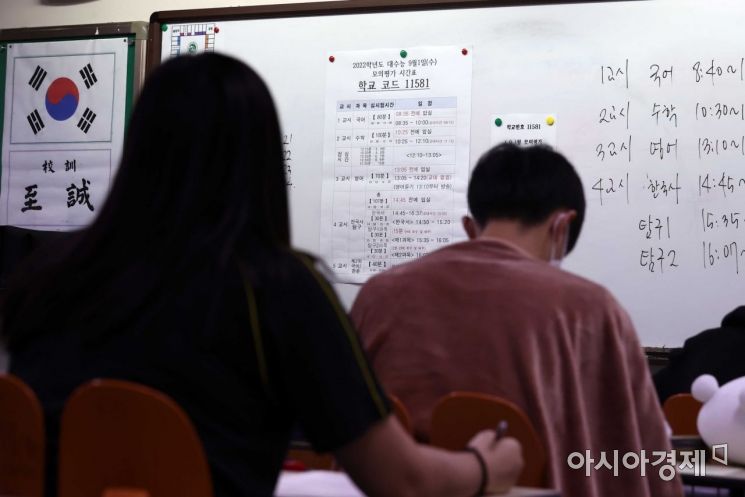 On the 1st, third-year high school students at Sangam High School in Mapo-gu, Seoul, are preparing for the September 2022 College Scholastic Ability Test (CSAT) mock exam. Photo by Jinhyung Kang aymsdream@
Mid-tier students need to identify their weak areas. Mid-tier students tend to study subjects they are confident in, but unresolved weak areas cause repeated mistakes and stagnant scores. It is better to check your weak areas, thoroughly understand the concepts, and then start solving problems. After organizing concepts, repeatedly solving EBS-linked textbooks or past CSAT questions helps adapt as much as possible to the CSAT question types.
Lower-tier students should not panic thinking it is too late or give up on the CSAT but rather return to basics and step-by-step build up concept understanding. Without concept understanding, no matter how many problems are solved, it will not translate into skill. It is good to organize key concepts by unit one by one and check whether you can solve the corresponding parts in CSAT-linked textbooks. Studying relatively easier topics first and gradually expanding the study scope can also be an effective method.
Check past questions for Korean, English, and Math; organize concepts for inquiry subjects
For the Korean section, accurate understanding of passages is most important. It is advisable to consistently understand 2-3 passages daily and practice problem solving using EBS-linked textbooks as a base, along with past CSAT and mock exams. If humanities students find science passages difficult, try focusing on science passages only, and if natural science students find economics passages difficult, similarly focus on economics passages to strengthen weak areas.
For Math, the scope expands to the entire curriculum starting from the September mock exam, so it is necessary to first understand question trends through past questions. Practicing frequently appearing question types by unit is most important. In Math, rather than focusing on how many problems you solve, it is crucial to solve even one problem accurately. You need to study carefully, checking whether you understand the concepts correctly and whether there are no errors in the solving process. New types of high-difficulty problems can be hinted at in the June and September mock exams, so it is essential to review this year’s mock exam questions as well.
For English, it is better to study listening, vocabulary, and reading comprehension a little every day rather than cramming all at once. Listening and vocabulary practice is more efficient when done during breaks or spare moments rather than setting separate study times. For reading comprehension, it is important to become familiar by repeatedly reviewing past passages.
The inquiry subjects are areas where results can be improved even in a short period. It is most effective to first firmly organize the curriculum concepts and then start solving problems. Organizing key concepts by unit in a notebook or explaining them to a friend to confirm understanding are good methods. Since the test time for inquiry subjects is short?30 minutes per subject?it is necessary to repeatedly practice solving questions with full concentration for 30 minutes to avoid time shortage during the actual exam.
Woo Yeon-cheol, head of the Admissions Strategy Research Institute at Jinhaksa, advised, “Many students lose tension as the early application period ends and the Chuseok holiday overlaps. To ensure that your efforts so far are not wasted, you need to adapt to the CSAT rhythm during the remaining period and study by making concrete study plans to successfully finish the CSAT.”
© The Asia Business Daily(www.asiae.co.kr). All rights reserved.
![Clutching a Stolen Dior Bag, Saying "I Hate Being Poor but Real"... The Grotesque Con of a "Human Knockoff" [Slate]](https://cwcontent.asiae.co.kr/asiaresize/183/2026021902243444107_1771435474.jpg)
















