Opacity in Private Equity Transactions and Burden of Asset Management Fees Passed On
Issues Such as Fund Liquidity at the Time of Insurance Payouts
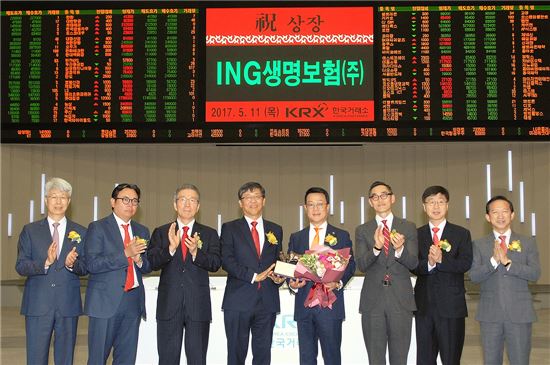 From the left, Ho-cheol Lee, Chairman of the Korea IR Council; Ki-joon Kim, Head of Morgan Stanley Korea IB Division; Soo-chang Lee, Chairman of the Life Insurance Association; Eun-tae Lee, Head of the Korea Exchange KOSPI Market Division; Moon-guk Jung, CEO of ING Life Insurance; Jong-ha Yoon, Vice Chairman of MBK Partners; Jung-woon Kim, Vice Chairman of the Korea Listed Companies Association; Yong-am Yoon, CEO of Samsung Securities
[Asia Economy Reporter Oh Hyung-gil] Private equity firm MBK Partners acquired Orange Life (formerly ING Life) for 1.8 trillion won, achieving a 217% return in just five years and earning a profit exceeding 2 trillion won.
As cases of private equity firms acquiring insurance companies increase, concerns have been raised that this could cause severe disadvantages to consumers such as insurance policyholders. The operational style of private equity firms, which pursue short-term profits, does not align with life insurance companies or whole life pensions that focus on long-term contracts, and since private equity firms are subject to relatively less regulation, consumers may suffer unexpected damages.
Kim Yoon-jin, a researcher at the Korea Insurance Research Institute, pointed out in a recent report titled "Acquisition of Life Insurance Businesses by U.S. Private Equity Firms and Concerns" that "the number and scale of acquisitions of life insurance and whole life pension sectors by U.S. private equity firms are increasing," and warned that "the opacity of private equity transactions, increased asset management fees, and investment risks could lead to consumer harm."
She also argued, "There are concerns about whether private equity firms, which pursue short-term profits, are suitable for the life insurance business that mainly involves long-term contracts."
Last month, Blackstone, the world's largest private equity firm, purchased a 9.9% stake in the life insurance and pension division of American International Group (AIG) for $2.2 billion (approximately 2.53 trillion won), highlighting the active separation and sale of life insurance companies' businesses.
In the U.S., private equity acquisitions of life insurance business units reached 154 cases in 2019 and 191 cases in 2020, with the total amount paid by private equity firms for life insurance companies reaching $12 billion so far this year.
Researcher Kim explained, "Due to prolonged low interest rates, U.S. life insurance companies are facing issues such as declining returns, expanding negative margins, and deteriorating capital soundness. With accounting changes to be applied from 2023, an increase in insurance liabilities is expected." She added, "Structural changes in insurance companies are required due to environmental changes in the insurance industry, such as digital transformation. U.S. life insurance companies are restructuring business units with low profitability and growth potential (whole life pensions, long-term care insurance, universal life insurance, etc.)."
She further pointed out, "Private equity firms are not subject to disclosure obligations and face weaker regulations compared to general funds or the insurance industry, which can lead to opaque transactions. Issues such as the passing on of asset management fee burdens and liquidity events at the time of insurance payouts may also result in consumer harm."
In response, consumer organizations have also campaigned against private equity firms acquiring insurance companies. Last year, the Financial Consumer Federation, Financial Justice Solidarity, Financial Consumer Network, Consumers Together, Consumer Rights Citizens' Coalition, and the "Joint Countermeasure Committee Against Private Equity Insurance Company Acquisitions" were formed.
They argued that, unlike banks which are fundamentally restricted to 4% ownership by non-financial major shareholders under Article 16-2 of the Banking Act, the Insurance Business Act, which requires greater protection of policyholders' assets, lacks such restrictions, making insurance companies vulnerable prey to private equity firms.
© The Asia Business Daily(www.asiae.co.kr). All rights reserved.
![Clutching a Stolen Dior Bag, Saying "I Hate Being Poor but Real"... The Grotesque Con of a "Human Knockoff" [Slate]](https://cwcontent.asiae.co.kr/asiaresize/183/2026021902243444107_1771435474.jpg)














