KoDHIA-Assemblyman Jeong Taeho Holds Forum on Legislation for Fostering Digital Health Industry
[Asia Economy Reporter Eunmo Koo] To systematically support and foster the digital health industry, a promising future national industry, voices have emerged calling for granting it legal status as an industry through legislation and establishing a comprehensive development plan to resolve various uncertainties.
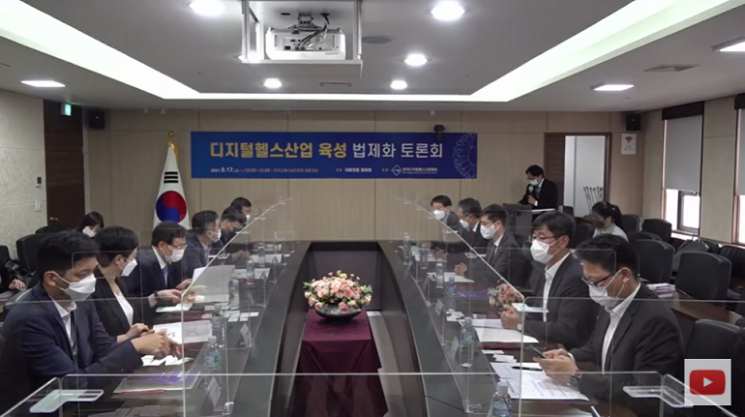
The Korea Digital Health Industry Association (KoDHIA), together with Assemblyman Taeho Jeong of the Democratic Party (member of the National Assembly’s Industry, Trade, Energy, Small and Medium Enterprises Committee), held a forum on the theme of "The Necessity of Fostering and Legislating the Digital Health Industry" on the 17th at the main conference room of the Korea Educational Facilities Safety Institute.
The forum, broadcast live via the YouTube channel "Jeong Taeho TV," featured Min Kyungpil, Head of Business at digital health startup Huray Positive, and Lawyer Ui-seok Kim from Kim & Chang Law Firm, who each presented on the industrial characteristics and legal status of digital health. Afterwards, CEOs from the digital health industry and officials from the Ministry of Trade, Industry and Energy participated as panelists to discuss the necessity of legislation for fostering the digital health industry. The discussion was chaired by Professor Woongbeom Pyeon of Seoul National University School of Dentistry.
Head Min Kyungpil highlighted the unique industrial characteristics of digital health, which converges with heterogeneous industries such as medical, finance, and pharmaceuticals, emphasizing that "the digital health industry has a high impact due to digital innovation, and its value expansion speed and volume are very large through integration with technological elements."
Lawyer Ui-seok Kim, who followed with a presentation, stated, "Support grounds are scattered across multiple laws, and there is insufficient support basis for convergent new industries, which may limit systematic fostering and support," adding, "There is a need to promote a comprehensive basic fostering law as a control tower for the comprehensive establishment and implementation of digital health industry policies, activation of related markets, development of competitive new businesses, and inducement of free market competition."
The digital health industry is a comprehensive service industry that integrates digital-based technologies applied to information, devices, software, systems, and platforms with health information. It leads service innovation by converging with various heterogeneous industries such as healthcare, telecommunications, insurance, and IT, and is recognized as an essential industry responding to the non-face-to-face society triggered by the COVID-19 pandemic.
According to the Korea Economic Research Institute, the employment inducement coefficient of the digital health industry is 16.7%, which is 1.92 times the average of all industries (8.7%). The U.S. market research firm Statista forecasts that the global market size of the digital health industry will grow from $106 billion (approximately 124.9 trillion KRW) in 2019 to $639 billion (approximately 753.1 trillion KRW) in 2026, growing at an annual rate of 29.3%.
Although South Korea supports the digital health industry within the scope of biohealth as a government strategic project, experts agree that it does not reflect the unique industrial characteristics of an ecosystem formed by the convergence of various business models such as medical and non-medical services, software and hardware, data and artificial intelligence, and that its legal status as an industry remains unclear.
In fact, despite being a future promising industry strategically fostered by the government, the digital health industry lacks related fostering laws, unlike bio (Advanced Bio Act), pharmaceuticals (Pharmaceutical Industry Promotion Act), and medical devices (Medical Device Industry Promotion Act).
Kim Hyungwook, Chairman of the Korea Digital Health Industry Association, said, "Due to insufficient linkage and cooperation among sectors such as technology development, workforce training, demand creation, and business transformation, as well as inadequate policy implementation systems and support measures, companies in the digital health industry face significant difficulties and uncertainties regarding investment."
Assemblyman Taeho Jeong emphasized, "Although the government is actively fostering the digital health industry through the Digital New Deal, the legal foundation is insufficient," adding, "It is crucial to support legislation to resolve legal uncertainties for digital health companies and secure industrial competitiveness."
© The Asia Business Daily(www.asiae.co.kr). All rights reserved.
![Clutching a Stolen Dior Bag, Saying "I Hate Being Poor but Real"... The Grotesque Con of a "Human Knockoff" [Slate]](https://cwcontent.asiae.co.kr/asiaresize/183/2026021902243444107_1771435474.jpg)















