China Shows Keen Interest in Hyundai Motor's Hydrogen Fuel Cell Technology... Considering Additional Investment Based on Market Maturity
Hydrogen Production, Storage, and Transportation Are Challenges for Building a Hydrogen Society
[Guangzhou (China) = Jo Young-shin, Beijing Correspondent] "Guangdong Province is the best-prepared province among China's 31 provinces and municipalities for a hydrogen society. This is why Hyundai Motor established a hydrogen fuel cell corporation and set up a local production line."
On the 14th, at the 'Korea-China Hydrogen Economy Cooperation Seminar' held in Guangzhou, Guangdong Province, China, Oh Seung-chan, General Manager of Hyundai Motor Guangzhou Hydrogen Fuel Cell Corporation (HTWO), explained the background of local investment. Guangzhou HTWO is Hyundai Motor Group's first overseas hydrogen fuel cell system production plant. HTWO, which held its groundbreaking ceremony in March, will be completed by the end of next year and produce 6,400 hydrogen fuel cell systems annually.
General Manager Oh evaluated, "Guangdong Province has a firm and clear will to prepare for a hydrogen society and lead its development," adding, "Guangdong Province not only has well-established hydrogen-related infrastructure but also a well-built industrial chain including fuel cell parts companies."
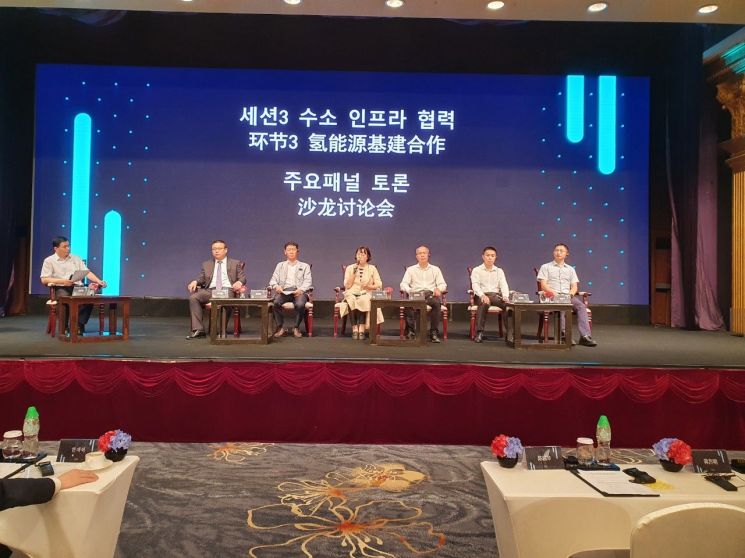 The Consulate General of the Republic of Korea in Guangzhou and the Guangdong Provincial Department of Commerce held the "Korea-China Hydrogen Economy Cooperation Seminar" on the 14th at the Guangzhou Garden Hotel. The seminar saw significant participation from Korean companies such as Hyundai Motor, POSCO, Doosan, and Hyosung, as well as Chinese hydrogen-related companies including Hongta Xingye Co., Ltd.
◆ Korea is a Tier 1 Hydrogen (H) Country = Zhang Fangming, Director of the Guangzhou Energy Research Institute at the Chinese Academy of Sciences, evaluated Korea as a Tier 1 (major) country in hydrogen technology alongside the United States, Europe, and Japan at the seminar. He cited Hyundai Motor as a representative company.
General Manager Oh responded to this evaluation by saying, "Hyundai Motor has been steadily researching hydrogen for 20 years," explaining, "Hydrogen-related technology is complex and requires a lot of time."
Regarding the hydrogen fuel cell system, General Manager Oh said, "It is the core technology of hydrogen vehicles that converts hydrogen into electricity," elaborating, "Electric energy rotates the motor, and the motor's rotational force drives the vehicle."
He added, "China plans to first apply hydrogen technology to commercial vehicles such as buses and trucks, and later to passenger cars," while cautiously stating, "Hyundai Motor will consider entering the complete vehicle market depending on the hydrogen maturity and market conditions in China."
Regarding concerns about core technology leakage, General Manager Oh emphasized, "It is true that there is a technological gap with Korea, but China is also developing technology, and the gap will narrow over time," adding, "Hyundai Motor has produced 18,000 hydrogen fuel cell systems over the past four years, applied them to complete vehicles, and exported hydrogen vehicles to advanced hydrogen countries such as Europe and the United States."
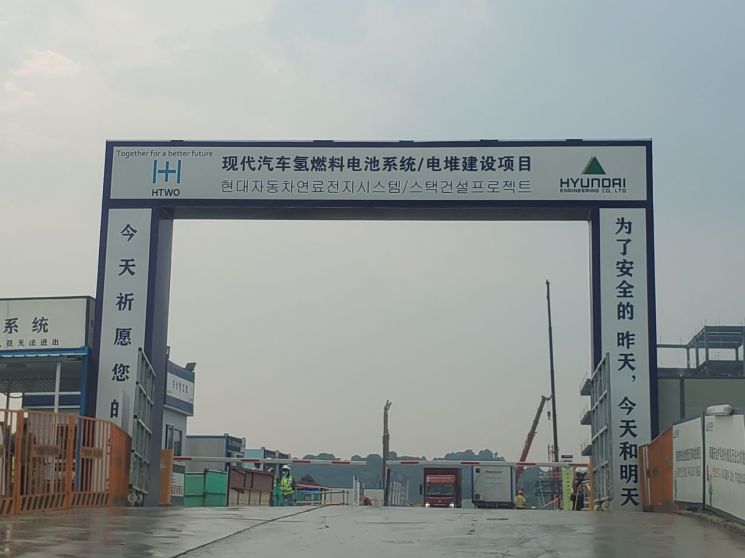 Hyundai Motor Company is building a hydrogen fuel cell system production plant in the Huangpu Development Zone, Guangzhou, Guangdong Province, China. This plant, scheduled for completion by the end of next year, will produce 6,400 hydrogen fuel cell systems annually and sell them to local Chinese companies.
◆ China Takes First Steps Toward Hydrogen Society, Hopes for Cooperation with Korea = The word 'hydrogen' appeared in Chinese government reports for the first time in 2019. Before that, the term had never appeared in official government reports. The Chinese government announced last year that it would focus on hydrogen as a future industry during the 14th Five-Year Plan period (2021?2025).
President Xi Jinping declared carbon neutrality by 2060 at the United Nations (UN) General Assembly in September last year. He also set a detailed goal to reduce carbon emissions annually starting from 2030, the year when carbon emissions are expected to peak.
To this end, the Chinese government designated Beijing, Shanghai, and Guangdong Province as hydrogen pilot city clusters this year, announcing specific support policies for the next four years, including the spread of hydrogen fuel cell vehicles (hydrogen vehicles), expansion of hydrogen charging stations, nurturing of core parts, stable hydrogen supply, and hydrogen subsidies (1.7 billion yuan per city). Guangdong Province set goals to distribute 10,000 hydrogen vehicles, install 200 charging stations, and maintain a hydrogen price of 35 yuan per kilogram (approximately 6,370 KRW) by 2025.
Chen Weihua, Deputy Director of the Guangdong Provincial Department of Commerce, said at the seminar, "The Chinese government has a strong will to transition to zero carbon," adding, "Guangdong Province will contribute to the development of the hydrogen industry by establishing a hydrogen fuel cell industrial cluster." He also emphasized, "The Chinese government is promoting the 'Greater Bay Area (GBA)' project, integrating Guangdong Province, Shenzhen, Hong Kong, and Macau into a single economic zone, and Guangzhou's Huangpu District is part of the GBA." He further stressed, "Guangzhou in Guangdong Province will become a strategic hub for the hydrogen industry by building hydrogen charging stations (rest stops) every 34 km along highways connected to Guangzhou."
Han Jae-hyuk, Consul General in Guangzhou, said, "Hydrogen energy will become a universal energy through international cooperation," and "Korea will seek policy directions with the Chinese government, including Guangdong Province."
Chinese hydrogen-related research institutes and companies attending the seminar unanimously said, "If you go alone, you can go fast, but you cannot go far," urging to "go far together" for building a hydrogen society.
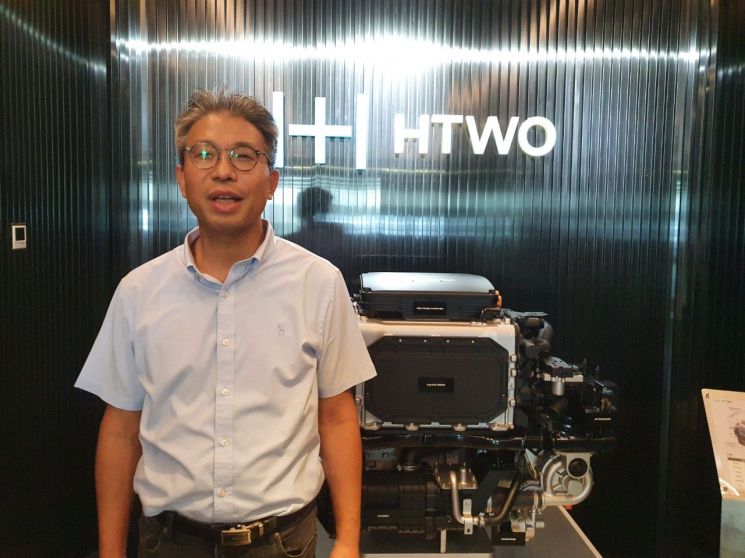 Seungchan Oh, General Manager of Hyundai Motor Company's Guangzhou Hydrogen Fuel Cell Corporation (HTWO), is explaining the hydrogen fuel cell system.
◆ The Key to a Hydrogen Society is Production and Transportation = The top priority for using hydrogen as an energy source like oil is economically viable production.
Hydrogen is abundant, accounting for 75% of the mass of the universe, but it is not easy to produce. Hydrogen can be obtained by electrolyzing water with electricity generated from natural energy sources such as solar and wind power, or extracted from by-products generated in petrochemical processes.
Another challenge is transportation. Gaseous hydrogen must be converted into liquid or solid form for transportation. Although solidification methods exist, they are not yet commercially viable. Liquid hydrogen requires cooling to minus (-) 253 degrees Celsius, which demands enormous energy. Additionally, hydrogen loss during transportation is significant.
To solve these problems, methods of transporting hydrogen combined with other substances are being discussed. A representative substance is nitrogen (N). By combining nitrogen and hydrogen to produce ammonia (NH3) and then liquefying it, transportation becomes easier. Ammonia liquefies at minus 33 degrees Celsius.
Choi Ji-eun, Head of Management Planning at POSCO China, said at the seminar, "Mixing hydrogen and nitrogen to produce ammonia for transportation, followed by a reforming process to remove nitrogen from ammonia, is more economical," adding that POSCO is striving to develop hydrogen with major countries worldwide. She also said that if economically viable hydrogen can be produced and transported, cooperation with Chinese companies is possible.
Li Tianzi, Vice General Manager of Hongta Xingye Co., Ltd., introduced, "Production of hydrogen is a challenge, but storage and transportation are also difficult. Hongta Xingye currently owns a rare earth mine in the Inner Mongolia Autonomous Region and is researching methods to store and transport hydrogen without loss using rare earth elements as a medium."
© The Asia Business Daily(www.asiae.co.kr). All rights reserved.
![Clutching a Stolen Dior Bag, Saying "I Hate Being Poor but Real"... The Grotesque Con of a "Human Knockoff" [Slate]](https://cwcontent.asiae.co.kr/asiaresize/183/2026021902243444107_1771435474.jpg)

















