Gwangju Institute of Science and Technology "Literarily Realizing the Design and Architecture of the 4-Dimensional World Based on the Theory of Relativity"
 Poet Lee Sang. Photo by Namuwiki
[Asia Economy Reporter Kim Bong-su] The enigmatic poems of the genius poet Lee Sang (1910?1937), who is celebrating his 111th birth anniversary this year, have been deciphered after 90 years by a physics student.
According to the Gwangju Institute of Science and Technology (GIST), Sanghyun Oh, a physics doctoral student at the University of California, Merced, together with Soojeong Lee from GIST's Basic Education Department, recently published a paper in which they succeeded in solving the mysteries related to the titles and some contents of Lee Sang's notable difficult poems "Samchag Seolgye-do" (Three-Angle Design Drawing, 1931) and "Geonchuk Muhan Yukmyeongakche" (Architectural Infinite Hexahedral, 1932).
The two analyzed and interpreted the coined terms "Samchag" (three-angle), "Yukmyeongak" (hexahedral angle), and "Muhan Yukmyeongakche" (infinite hexahedral) appearing in the titles of Lee Sang's difficult poems based on four-dimensional geometry. According to their findings, "Samchag" refers to the three angles used when representing directions in four-dimensional space using hyperspherical coordinates. The research revealed that this term was devised based on the idea that these three angles constitute a single "3-dimensional angle."
"Yukmyeongak" refers to the angles of a polyhedral four-dimensional figure, a term created based on the fact that six faces meet at a point in a four-dimensional figure. The research team confirmed that "Yukmyeongakche" means a polyhedral four-dimensional figure, and "Muhan Yukmyeongakche" refers to a four-dimensional figure composed of infinitely many points.
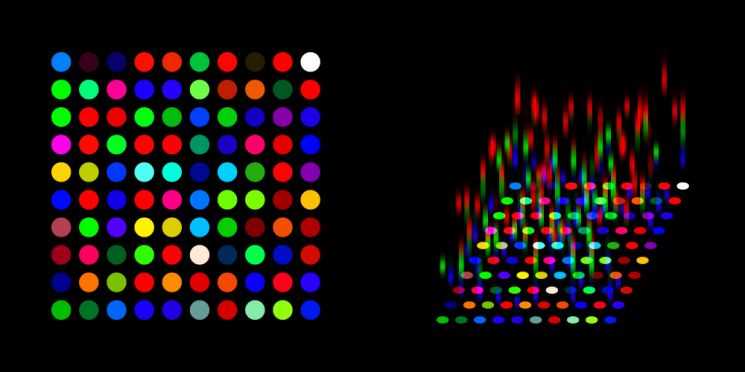
Additionally, the research team revealed that the "spectrum" in "Samchag Seolgye-do - Seon-e Gwanhan Gakseo 1" (Three-Angle Design Drawing - Angle Document on Lines 1) represents the light spectrum expressed as a point set, serving as a device that extends space from two dimensions to three dimensions (see the upper illustration). In "Geonchuk Muhan Yukmyeongakche - AU MAGASIN DE NOUVEAUTES," the verse "Sagak-ui jung-ui sagak-ui jung-ui sagak-ui jung-ui sagak ui jung-ui sagak" (Square within a square within a square within a square within a square) was interpreted as sequentially expanding spatial dimensions, ultimately referring to a square existing in four-dimensional space (see the lower illustration).
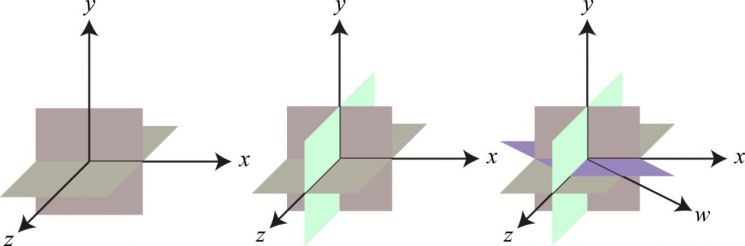
The two stated, "This paper clarifies that Lee Sang's early poetry was an attempt to literarily realize design and architecture in four-dimensional spacetime based on the theory of relativity," and added, "This study highlights the path through which Lee Sang's four-dimensional geometric thinking and original imagination were embodied in his works, and it is significant as it lays the groundwork for subsequent research to unravel Lee Sang's difficult poems."
The research results were published on the 31st of last month in issue 54 of the 'Journal of Korean Culture,' issued by the International Forum of Korean Language and Literature.
© The Asia Business Daily(www.asiae.co.kr). All rights reserved.


















