Global Power Generation: Nuclear Share Expected to Increase from 10% in 2020 to 12% in 2050
South Korea's Nuclear Share to Reach Half of Global Level by 2050
Green Hydrogen Production Possible with Nuclear Power... "Decarbonization Not Achievable with Renewable Energy Alone, Plans Must Be Revised"
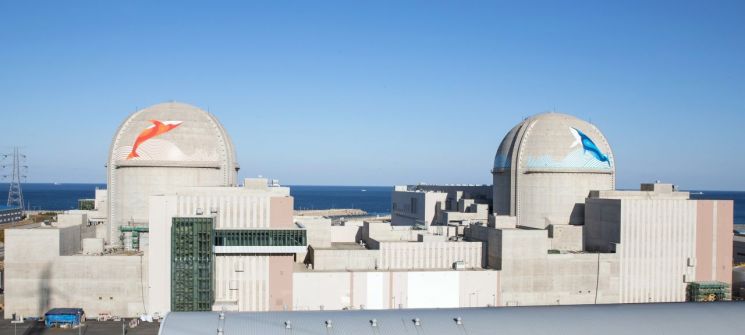
[Sejong=Asia Economy Reporter Kwon Haeyoung] The International Atomic Energy Agency (IAEA) has raised its potential growth forecast for global nuclear power generation by 2050, bringing renewed attention to the role of nuclear power plants as a 'carbon-free energy source.' The IAEA, increasing its nuclear power outlook for the first time in a decade, stated that nuclear power is an important energy source for addressing climate change and reducing carbon emissions. However, the Korean government, which is tightening its carbon neutrality policies, plans to continuously reduce the share of nuclear power generation, drawing criticism for going against the global trend.
According to the Carbon Neutrality Committee's '2050 Carbon Neutrality Scenario' announced on the 17th, Korea plans to shut down nuclear power plants by 2050, reducing the domestic share of nuclear power generation from the current 25% to 6.1?7.2% by 2050.
On the 16th (local time), the IAEA predicted that the share of nuclear power in global electricity generation would increase from 10% in 2020 to 12% in 2050, but Korea is instead signaling a reduction in nuclear power share. The domestic share of nuclear power generation is expected to fall to the 6% range by 2050, about half of the IAEA's global forecast of 12%.
The Carbon Neutrality Committee plans to fill the gap left by nuclear power with renewable energy. According to the committee's scenario, the share of renewable energy will expand from the current 6.2% to 56.6?70.8% by 2050.
Experts point out that achieving carbon neutrality by drastically lowering nuclear power dependence and increasing only renewable energy generation is impossible.
Professor Joo Han-kyu of the Department of Nuclear Engineering at Seoul National University said, "Solar power can only generate electricity during the day, so the electricity produced at night must be stored in batteries, but the cost of energy storage systems (ESS) is very high." He added, "Eventually, storage costs may exceed generation costs, creating a situation where the tail is bigger than the belly. The cost of maintaining the power system will increase, potentially tripling electricity rates."
The small modular reactors (SMRs) and hydrogen production technologies using nuclear power, which the IAEA considers innovative nuclear technologies, are also expected to accelerate carbon neutrality.
In particular, as the government and major companies push forward with the hydrogen economy, the need for research and development of green hydrogen production using nuclear power is increasing. Green hydrogen refers to hydrogen produced by electrolyzing water using electricity generated from renewable energy, and hydrogen produced using nuclear power, a carbon-free energy source, also qualifies as green hydrogen.
Professor Jeong Dong-wook of the Department of Energy Systems Engineering at Chung-Ang University said, "Currently, hydrogen production is economically inefficient, but producing hydrogen with nuclear power is more efficient compared to renewable energy." He advised, "Since there is significant global investment in developing hydrogen production technologies based on nuclear power, we should also actively consider using nuclear power for hydrogen production."
Professor Joo Han-kyu emphasized, "Achieving carbon neutrality with only renewable energy is impossible," and added, "After the new government takes office next year, a realistic carbon neutrality scenario including nuclear power must be reestablished."
Some argue that the global forecast increase is a 'statistical distortion' caused by some countries, including China, expanding their nuclear power share. While nuclear power can contribute to achieving carbon neutrality, it is difficult to continuously increase the share of nuclear power due to local acceptance issues.
An energy expert said, "There is a statistical distortion where global nuclear power generation is increasing overall due to expansion in countries like China and Russia," adding, "Even France, a nuclear power leader, is reducing its nuclear power share. While nuclear power, as a base load and carbon-free energy source, clearly has a role, it is difficult to continuously increase nuclear power generation domestically due to acceptance issues."
© The Asia Business Daily(www.asiae.co.kr). All rights reserved.
![Clutching a Stolen Dior Bag, Saying "I Hate Being Poor but Real"... The Grotesque Con of a "Human Knockoff" [Slate]](https://cwcontent.asiae.co.kr/asiaresize/183/2026021902243444107_1771435474.jpg)















