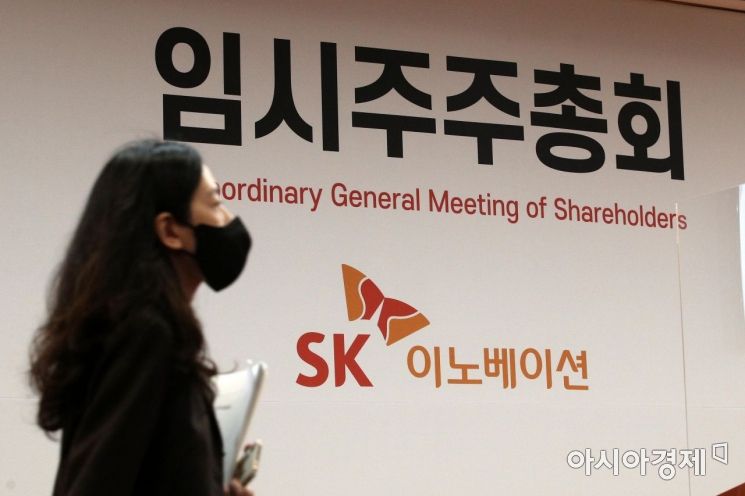
 The scene of SK Innovation's extraordinary general meeting of shareholders held on the 16th at the SK Seorin Building in Jongno-gu, Seoul. SK Innovation held the extraordinary general meeting of shareholders on this day and resolved the physical division plan for the battery and oil exploration & production (E&P) businesses. Photo by Hyunmin Kim kimhyun81@
[Asia Economy Reporter Ji Yeon-jin] Leading electric vehicle battery companies are struggling due to split issues. Following LG Chem's spin-off of its battery subsidiary, the stock price has declined due to the pursuit of an initial public offering (IPO) and battery fire accidents, causing other companies' stock prices to fluctuate whenever split issues arise.
According to the Financial Supervisory Service's electronic disclosure system on the 17th, SK Innovation held an extraordinary general meeting of shareholders the previous day and approved the agenda to spin off its battery business as originally planned. SK Innovation's stock began to plunge on the 15th, when the split issue was highlighted ahead of the extraordinary shareholders' meeting, falling more than 7% over two days. At that time, a media outlet reported that "Samsung SDI has started reviewing plans to separate its battery business," causing Samsung SDI's stock to drop sharply by 5% during trading and close down more than 3% the previous day. Samsung SDI stated in a disclosure the previous day that "the content is not true." On the morning of the same day, SK Innovation opened at 234,500 KRW, down 1.05% on the KOSPI market, and the decline was expanding. Samsung SDI was recording a slight decline.
The weakness of the two stocks is interpreted as a learning effect from LG Chem. LG Chem, once considered the leading K-battery company, surged last year due to a stock investment boom and expectations for electric vehicle battery growth but fell 13.6% over ten days after announcing the spin-off of its battery business. The stock price then recovered, and with the spin-off of its battery subsidiary LG Energy Solution, it became a "king stock" exceeding 1 million KRW earlier this year, supported by electric vehicle sales. However, the news of LG Energy Solution's IPO pursuit led to a sharp decline. Additionally, the stock price retreated whenever battery-related accidents occurred. After GM's recall news of the electric vehicle Bolt was announced last month, LG Chem's stock price fell more than 20% over a month, reaching its lowest level this year and losing its position as the leading battery stock to Samsung SDI. The market expects LG Energy Solution's GM Bolt recall costs to range from at least 423 billion KRW to a maximum of 555 billion KRW, causing repercussions for LG Chem.
However, the securities industry forecasts that unlike LG Chem, SK Innovation, which has no battery fire accidents, has an opportunity to increase its market share through the business split. Hwang Kyu-won, a researcher at Yuanta Securities, said, "Although there is concern about a 28% dilution of shares due to the battery split approval, securing investment funds is expected to expand market share," adding, "From an investor's perspective, it's a winning hand." Regarding Samsung SDI, nine securities firms predicted a stock price increase in the second half of the year, with two of them setting target prices more than 100 KRW higher.
© The Asia Business Daily(www.asiae.co.kr). All rights reserved.

















