First Transfer of Nuclear Propulsion Technology Since 1958
China Strongly Criticizes, Saying "Cold War Mentality Must Be Abandoned"
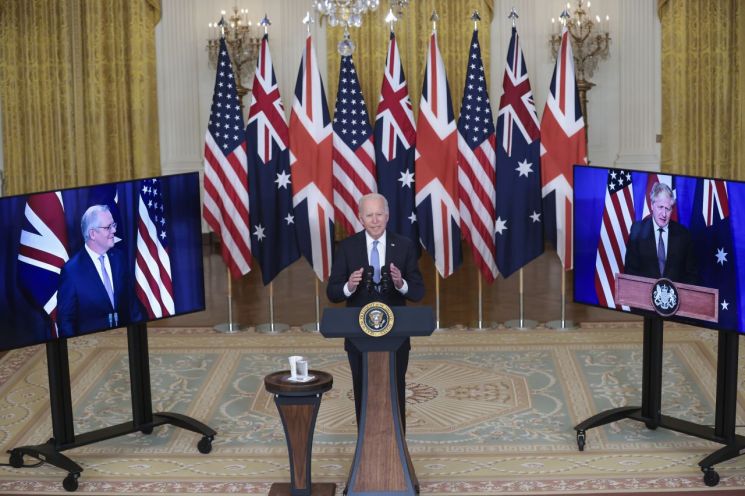 On the 15th (local time), U.S. President Joe Biden (center) held a video conference at the White House in Washington with UK Prime Minister Boris Johnson (right) and Australian Prime Minister Scott Morrison. On this day, the three countries?the United States, the United Kingdom, and Australia?announced the launch of a new security alliance called 'AUKUS' to counter China and stated they would begin providing technical support for Australia's acquisition of nuclear submarines. Washington DC, USA = Photo by EPA Yonhap News
[Asia Economy Reporter Hyunwoo Lee] The United States, the United Kingdom, and Australia announced the launch of a new security consultation body in the Indo-Pacific region called ‘AUKUS.’ It is being evaluated as a powerful military consultation body to counter China, following the Quad.
The three countries stated that their first goal for AUKUS is to provide technical support for Australia to possess nuclear submarines, emphasizing their full commitment to deterring Chinese military power. This is the first time since World War II that the U.S. has officially announced the transfer of nuclear propulsion technology to a third country other than its close ally, the UK. China immediately opposed the launch of AUKUS, saying, "We must move beyond Cold War thinking."
On the 15th (local time), U.S. President Joe Biden, UK Prime Minister Boris Johnson, and Australian Prime Minister Scott Morrison announced the launch of AUKUS, a new security consultation body among the three countries, through a video conference. At a joint press conference following the video meeting, the leaders explained the reason for launching AUKUS, saying, "Based on the enduring ideals and shared commitments of a rules-based international order, we have decided to deepen diplomatic, security, and defense cooperation in the Indo-Pacific region, including cooperation with partner countries."
"Supporting Australia’s possession of nuclear submarines"... First technology transfer since the UK agreement in 1958
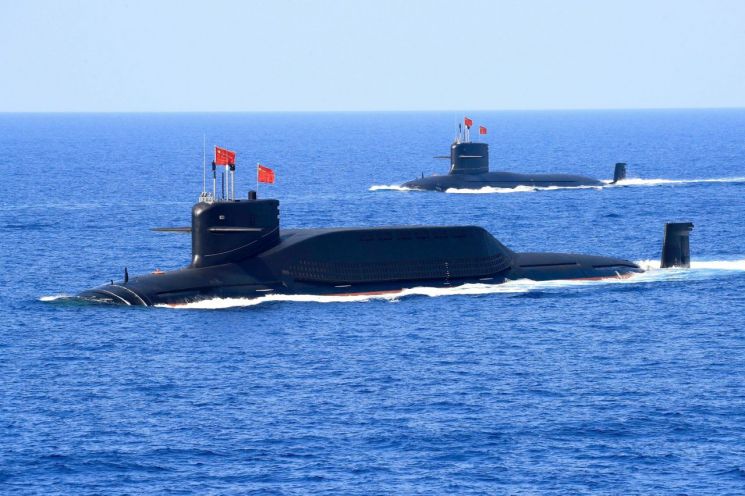
The three leaders announced that their first planned goal for AUKUS is to support Australia’s possession of nuclear submarines. The three countries will form working groups to transfer and share technology for Australia’s nuclear submarine possession and plan to conduct joint research over the next 18 months. Additionally, they plan to strengthen cooperation in new military technologies such as cyber, artificial intelligence, and underwater capabilities, as well as promote security and information technology sharing to counter China.
Particularly, attention is focused on the background of the U.S. officially announcing the transfer of technology to a third country for the first time since signing a nuclear propulsion engine technology transfer agreement with the UK in 1958. The U.S. political media outlet Politico quoted a senior U.S. official who hosted a press briefing at the White House, saying, "Nuclear propulsion technology is extremely sensitive technology, and frankly, this technology transfer is an exception to many aspects of our policy," adding, "This is a ‘one-off’ event, and we do not expect technology transfers in other situations going forward."
A strategic move for military deterrence against China... U.S. allies likely to have growing expectations for nuclear propulsion technology transfer
The reason for transferring nuclear propulsion technology to Australia is interpreted as securing military deterrence against China. Earlier, the Australian government announced in May that it is pushing to introduce nuclear submarines through the French defense company Naval Group with a budget of 90 billion Australian dollars (about 77 trillion KRW). However, concerns arose that the launch would be significantly delayed compared to the initially planned 2025, which could cause difficulties in deterring Chinese military power.
As the U.S. exceptionally proceeds with transferring nuclear propulsion technology to Australia, expectations for technical support for other allies pursuing nuclear submarine development, such as South Korea, are also expected to grow. President Biden emphasized at the press conference that "We will continue cooperation with ASEAN, the Quad, the Indo-Pacific, Europe, and allies and partners worldwide."
Regarding criticisms and concerns about nuclear proliferation raised by some, the leaders drew a clear line. Prime Minister Johnson emphasized, "What is being supported for Australia is nuclear-powered submarines, not submarines equipped with nuclear warheads." Prime Minister Morrison also stressed, "Australia is not seeking to acquire nuclear weapons or establish civilian nuclear capabilities. We continue to fulfill our nuclear non-proliferation obligations."
Chinese government immediately opposes: "Must abandon Cold War thinking"
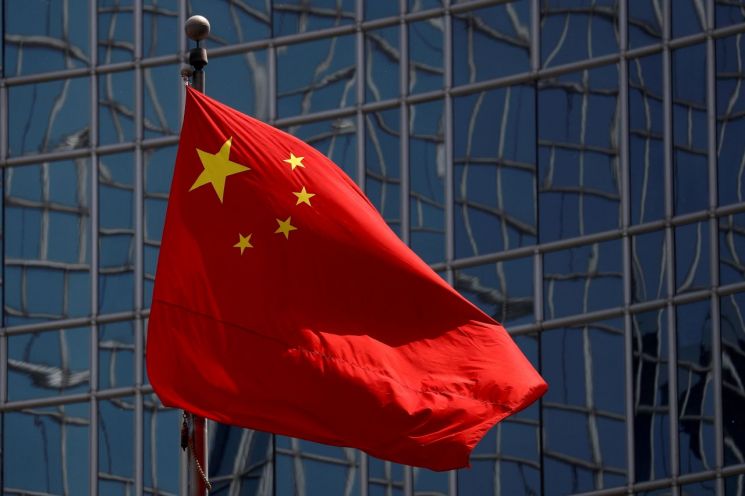
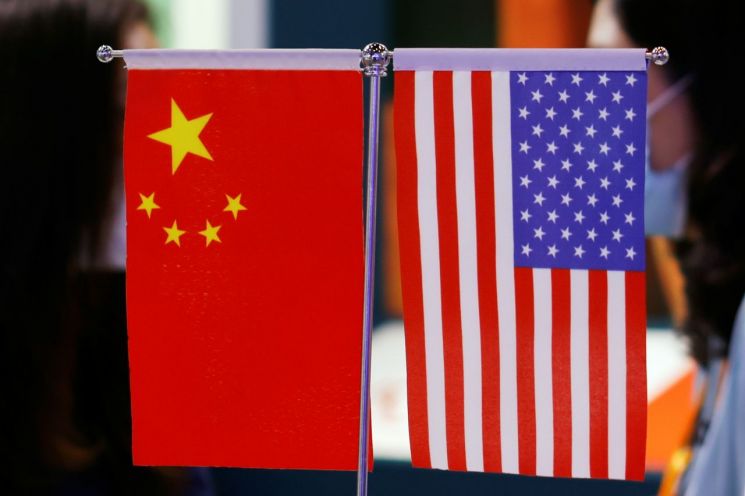
On the other hand, the Chinese government strongly opposed the news of AUKUS’s launch immediately after it was announced. Liu Fengyu, spokesperson for the Chinese Embassy in the U.S., issued a statement right after the AUKUS launch announcement, saying, "Exclusive blocs that harm or target the interests of third countries should not be built," and strongly criticized, "In particular, Cold War thinking and ideological prejudices must be cast aside."
© The Asia Business Daily(www.asiae.co.kr). All rights reserved.
![Clutching a Stolen Dior Bag, Saying "I Hate Being Poor but Real"... The Grotesque Con of a "Human Knockoff" [Slate]](https://cwcontent.asiae.co.kr/asiaresize/183/2026021902243444107_1771435474.jpg)


















