Government Announces National Food Plan (2021-2025)
Public Rice Stockpile to Increase by 100,000 Tons to 450,000 Tons Next Year... First Increase Since 2005 System Introduction
Strengthening Wheat Self-Sufficiency Below 1%... Expanding Soybean Self-Sufficiency from 26.7% to 33%
Reducing Food Disparity in Income Quintiles 1-5 from 11.4%p to 7%p by 2030
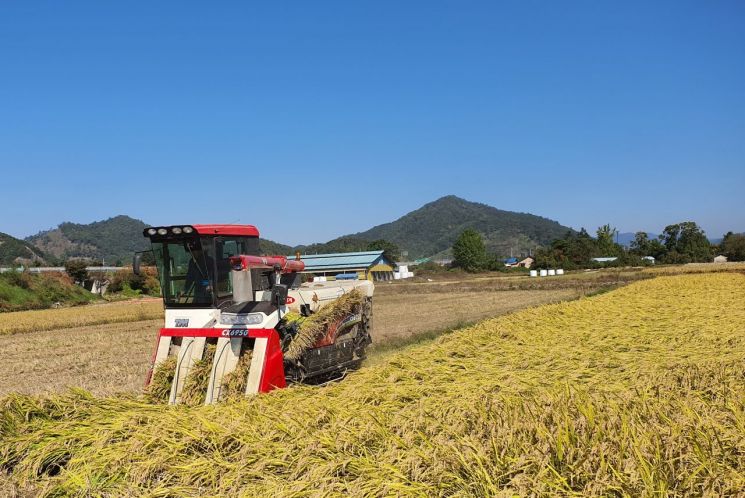
[Sejong=Asia Economy Reporter Moon Chaeseok] The government has decided to increase the supply of public stockpiled rice for the first time ever next year. Despite a decrease in rice consumption, the government plans to boldly increase supply due to the risk of 'rice shortage' caused by frequent monsoons resulting from climate change. The wheat self-sufficiency rate, which is below 1%, is set to be raised to 5% by 2025.
Rice consumption decreases... but supply increases to prepare for climate change-induced disaster risks
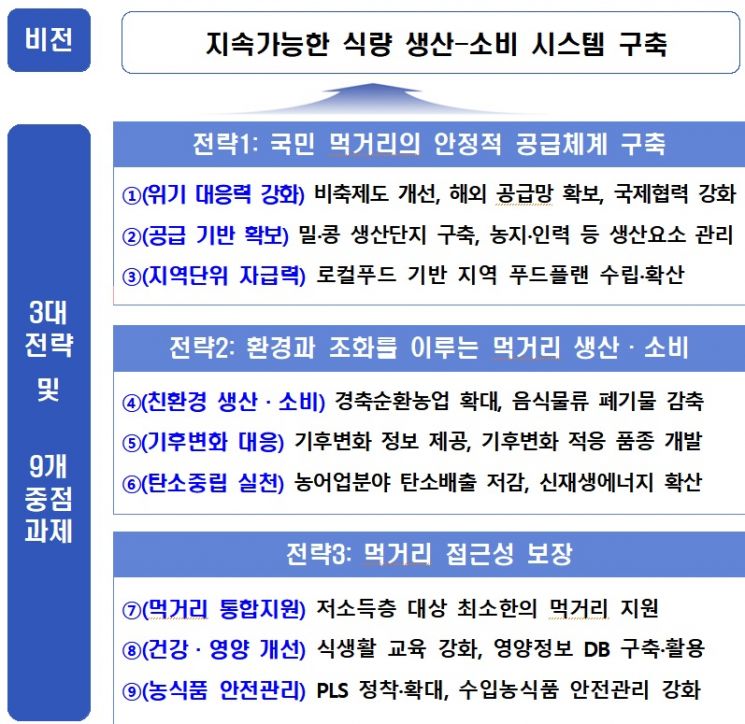
On the 16th, the government announced the 'National Food Plan' (2021?2025) containing these details. Based on this plan, from 2026 onward, it will be established every 10 years, with supplementary updates every 5 years considering progress and changing circumstances. The Ministry of Agriculture, Food and Rural Affairs led the policy formulation together with the Ministry of Environment, Ministry of Oceans and Fisheries, Ministry of Food and Drug Safety, Ministry of Education, Ministry of Health and Welfare, and Rural Development Administration. This is part of the 'Establishment of a National Food Plan,' one of the 100 major national tasks of the Moon Jae-in administration.
Recently, due to rising international grain prices and logistics disruptions caused by COVID-19, the importance of food security has increased, prompting the government to prepare countermeasures. The three key policy directions are: ▲ Establishing a stable supply system for the nation's food ▲ Producing and consuming food in harmony with the environment ▲ Enhancing food accessibility for vulnerable groups. A Ministry of Agriculture, Food and Rural Affairs official said, "The goal of the National Food Plan is to provide safe food to the public stably," adding, "We will actively cooperate with related ministries and civil society to ensure the plan is firmly implemented."
The core is to increase the purchase volume of public stockpiles of major food crops such as rice, wheat, and soybeans to ensure stable food supply even in the event of disasters caused by climate change. The rice stockpile will increase from 350,000 tons last year to 450,000 tons next year; wheat from 3,000 tons to 14,000 tons; and soybeans from 17,000 tons to 25,000 tons.
Notably, the government plans to increase the supply of rice. According to Statistics Korea, per capita rice consumption last year was 57.7 kg, down 1.5 kg from 2019. This is 43.5% of the 132.4 kg consumed in 1980, showing a steady decline. However, due to the longest monsoon period on record last year lasting 53 days, rice production fell to 3,507,000 tons, the lowest in 51 years, prompting the government to release 317,000 tons of rice into the market. Because climate change makes production volumes unpredictable, the government decided to increase public stockpiled rice for the first time next year. A Ministry of Agriculture, Food and Rural Affairs official explained, "Since the public stockpiling system began in 2005, this is the first time the supply volume has increased, and the purchase volume has increased the most," adding, "This is to strengthen the government's supply capacity in emergencies for rice, the staple food."
'Second staple food' wheat self-sufficiency rate in the 0% range... "Achieve 5% by 2025"
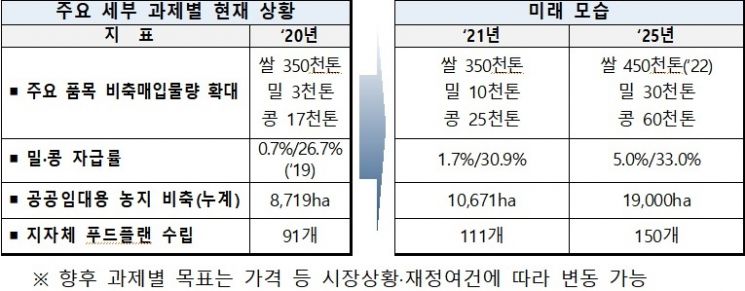
The self-sufficiency rates of wheat and soybeans, which are the next most consumed after rice, are also planned to be raised to 5% and 33%, respectively, by 2025. As of last year, the self-sufficiency rates were only 0.7% for wheat and 26.7% for soybeans.
In particular, the wheat self-sufficiency rate, known as the 'second staple food,' has clearly declined from 1.7% in 2010 to 0.7%. To increase production, the government plans to expand specialized production complexes from 27 wheat sites and 44 paddy soybean sites this year to 50 and 200 sites respectively by 2025. Additionally, the government will actively support companies in securing overseas grain supply chains to discover large domestic demand sources for Korean wheat and soybeans.
Furthermore, the government will expand the establishment of regional food plans. The number of local governments with plans was 91 last year and is planned to increase to 150 by 2025. Based on these food plans, phased support will be provided to raise not only the national self-sufficiency rate of major grains but also regional self-sufficiency. To this end, a dedicated FD (Family Doctor) will be supported for local governments to establish plans. The FD will regularly visit the field to diagnose and consult from plan formulation to execution.
Also, to prepare for climate change, attention has been given to establishing an eco-friendly production system. The government plans to newly foster 72 eco-friendly agricultural complex districts by 2025. Next year, a regional livestock-crop recycling model will be developed to utilize fertilizers and electricity produced from livestock manure in agriculture. Moreover, the number of 'climate-adaptive varieties' will increase by 60 from 303 this year to 363 in 2025.
Income quintiles 1?5 'food gap' eased from 11.4%p to 7%p
The government aims to reduce disparities between income quintiles by strengthening the 'right to food' for vulnerable groups. The right to food means the right of all citizens to demand the state provide at least a minimum amount of safe food. Nutritional intake gaps by income level in Korea have been widening. Among high-income groups, the proportion of those with insufficient nutrition slightly decreased from 9.4% in 2011 to 9.0% in 2019, but among low-income groups, it increased from 12.6% to 18.9% during the same period.
The government is preparing to conduct a preliminary feasibility study next year to fully promote the agricultural food voucher program. It will also pursue ▲ building and expanding an integrated database (DB) of food nutrition information by ministry ▲ expanding the Positive List System (PLS) for pesticide residue limits to livestock and fishery products from 2024.
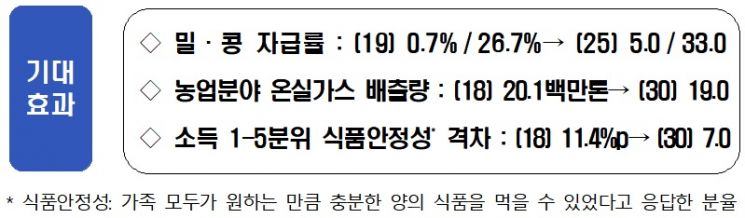
Through these efforts, the government aims to reduce the food security gap between income quintiles 1 to 5 from 11.4 percentage points in 2018 to 7.0 percentage points by 2030. Food security here refers to the proportion of families who responded that they were able to eat sufficient amounts of food as desired.
© The Asia Business Daily(www.asiae.co.kr). All rights reserved.
![Clutching a Stolen Dior Bag, Saying "I Hate Being Poor but Real"... The Grotesque Con of a "Human Knockoff" [Slate]](https://cwcontent.asiae.co.kr/asiaresize/183/2026021902243444107_1771435474.jpg)

















