Among 1,262 Fires During Chuseok Holiday, 465 Occur in Residential Homes
[Asia Economy Reporter Lim Cheol-young] With Chuseok approaching, special caution is needed regarding fires caused by cooking and diseases that are likely to occur outdoors in autumn.
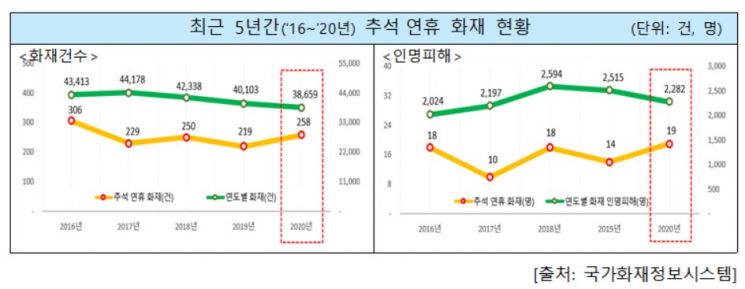
According to the Ministry of the Interior and Safety on the 19th, the average number of fires during the Chuseok holiday period over the past five years (2016?2020) was 253 per year, resulting in 2 deaths and about 15 injuries annually. Although the total number of fires has been gradually decreasing each year, fires still occur during the Chuseok period. In particular, last year, when people spent Chuseok at their own homes due to COVID-19 social distancing, there was a slight increase with 258 fires causing 19 casualties.
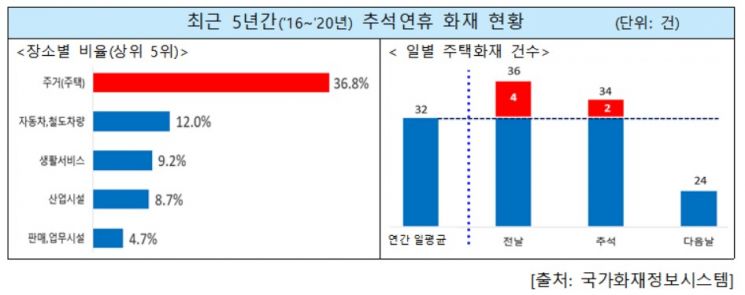
Among the 1,262 fires occurring during the Chuseok holiday, 465 were reported in residential homes. Fires were most frequent on the day before Chuseok, averaging 36 cases, and on Chuseok day itself, with about 34 cases on average, which is higher than the annual daily average of 32 cases. Of the residential fires, 57.8% (269 out of 465) were caused by carelessness such as cooking, 21.1% (98 cases) by electrical factors, 5.4% (25 cases) by mechanical factors, and 4.1% (19 cases) were related to arson.
Additionally, when going outdoors for ancestral rites or other activities during Chuseok, caution is needed regarding hornet stings and febrile diseases caused by ticks. Among autumn diseases, scrub typhus is the most common and has shown a continuous increasing trend, with an average of 8,155 patients annually since 2012, including 12 deaths.
In response, the Ministry of the Interior and Safety urged that if cooking oil commonly used in kitchens overheats and catches fire, the gas and power should be cut off immediately. The ministry explained, "If water is poured in a hurry, the oil vapor and steam combine, and the oil can spread along the water, causing the fire to expand further," and added, "hot overheated oil splashing in all directions upon contact with water can easily cause burns, so never try to extinguish the fire with water."
Attention should also be paid to hornet stings. When hiking or visiting ancestral graves outdoors, if hornets frequently enter and exit from underground or between tree branches, there may be a nearby nest. Among bees, hornets are particularly dangerous as one can sting multiple times. The Ministry of the Interior and Safety advised, "If hornets are nearby but you have not been stung yet, avoid sudden movements that may provoke them and slowly leave the area. If you accidentally disturb a nest and hornets attack, no matter how many times you are stung, you must evacuate to a place about 20 meters away."
To avoid scrub typhus, when going outdoors for hiking or ancestral rites, wear long clothing to reduce skin exposure and use mats to avoid sitting or lying directly on grass. Be careful not to sit on bare ground or stones, and do not leave outerwear on the grass. Using tick repellents is also helpful.
Ko Gwang-wan, Director of the Prevention and Safety Policy Division, said, “As Chuseok approaches, please pay special attention to fire safety when preparing food, and be cautious of hornets and ticks when going outdoors for ancestral rites, wishing everyone a peaceful holiday.”
© The Asia Business Daily(www.asiae.co.kr). All rights reserved.
![Clutching a Stolen Dior Bag, Saying "I Hate Being Poor but Real"... The Grotesque Con of a "Human Knockoff" [Slate]](https://cwcontent.asiae.co.kr/asiaresize/183/2026021902243444107_1771435474.jpg)
















