Nationwide Housing Prices Rise 0.96%
Upward Trend Strengthens Despite Tightened Loan Restrictions
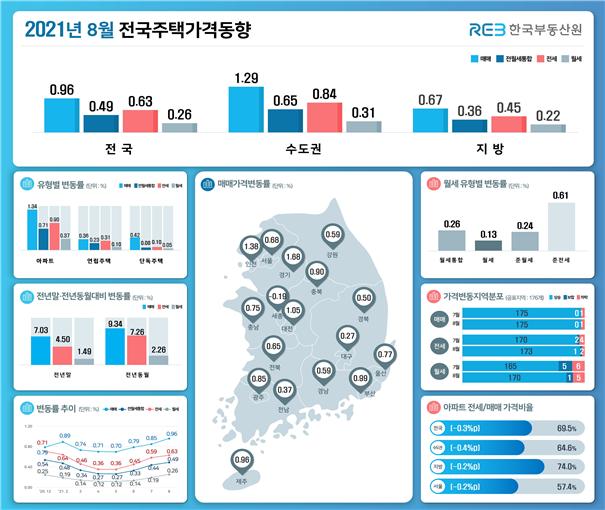
[Asia Economy Reporter Kangwook Cho] Last month, nationwide housing prices rose at the steepest rate in 10 years. In Gyeonggi-do, prices increased by 1.68% over the month, marking the highest rise in 14 years and 8 months. Despite the government unveiling large-scale housing supply expansion plans and tightening market loans, the upward trend in housing prices appears to be intensifying.
According to the nationwide housing price trend report released by the Korea Real Estate Board on the 15th, last month, the nationwide housing (including apartments, detached houses, and row houses) sales prices rose by 0.96%. This is 0.11 percentage points higher than the previous month's 0.85%, marking the highest level in 10 years and 4 months since April 2011, when it recorded 1.14%. Additionally, this is the highest figure since the Real Estate Board began compiling monthly statistics in January 2013.
The area leading the housing price increase was Gyeonggi-do. The rate of increase grew from 1.52% in July to 1.68% in August, the highest in 14 years and 8 months since January 2007, when it recorded a 2.4% rise. Incheon also rose by 1.38% during the same period. The sharp rise in housing prices in the Gyeonggi and Incheon regions is interpreted as a result of buying demand shifting to relatively cheaper suburban areas as housing prices in Seoul continued to rise.
Seoul also saw an increase of 0.68% last month, expanding from the previous month's 0.60%. Seoul's housing prices had increased consecutively for four months from November last year to February this year at rates of 0.17%, 0.26%, 0.40%, and 0.51%, respectively, before decreasing for two consecutive months in March (0.38%) and April (0.35%) due to the 2·4 measures. However, prices rebounded to 0.40% in May and continued to rise by 0.49% in June and 0.60% in July, marking the highest increase in 1 year and 1 month since July last year (0.71%).
Among Seoul's 25 districts, Nowon-gu recorded the highest increase at 1.34%. Dobong-gu also rose by more than 1% at 1.07%, while the Gangnam 3 districts?Gangnam, Seocho, and Songpa?showed increases ranging from 0.80% to 0.88%, exceeding the Seoul average.
Accordingly, housing prices in the metropolitan area also rose by 1.29% last month, marking the highest level in 13 years and 2 months since June 2008 (1.8%).
In provincial areas, metropolitan cities such as Daejeon (1.05%), Busan (0.99%), and Gwangju (0.85%) showed high rates of increase. However, Sejong City was the only one among the 17 metropolitan cities and provinces to experience a decline in housing prices last month, falling by -0.19%.
Prices for jeonse (long-term lease) and monthly rent continue to rise as well. The nationwide average jeonse price increased by 0.63%, expanding from the previous month's 0.59%. In Seoul, prices rose by 0.55% due to relocation demand from redevelopment projects, while Gyeonggi and Incheon saw increases of 1.03% and 0.91%, respectively. Overall, the metropolitan area's jeonse prices rose by 0.84% last month, setting the highest increase so far this year.
A Korea Real Estate Board official explained, "Seoul has seen a continuous increase in the rate of rise for three months, with a persistent shortage of jeonse listings," adding, "Gyeonggi and Incheon are also seeing increased rises centered on areas with good transportation access and residential conditions."
© The Asia Business Daily(www.asiae.co.kr). All rights reserved.
![Clutching a Stolen Dior Bag, Saying "I Hate Being Poor but Real"... The Grotesque Con of a "Human Knockoff" [Slate]](https://cwcontent.asiae.co.kr/asiaresize/183/2026021902243444107_1771435474.jpg)















