Institute for Basic Science Support Achieves World's First Success in Fluorine-Doped Powder Graphene Production
Solves Energy Storage Capacity Issue of High-Performance Supercapacitors
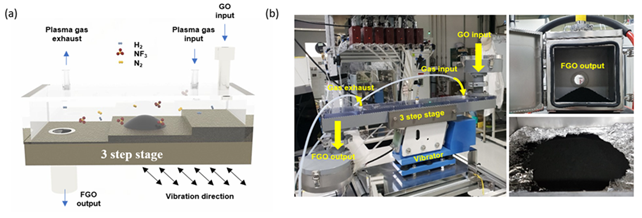 The Korea Basic Science Institute has developed the world's first method for producing fluorine-doped graphene to improve the performance of high-performance supercapacitors. The photo shows the dielectric barrier discharge reactor designed for this purpose.
[Asia Economy Reporter Kim Bong-su] Domestic researchers have developed the world's first method for mass-producing fluorine-doped graphene powder using atmospheric pressure plasma. This breakthrough addresses the capacity limitations of high-performance supercapacitors (high-power, rapid-charging energy storage devices), which are key to achieving carbon neutrality goals in industries such as eco-friendly vehicles, smart meters, heavy machinery, logistics automation equipment, and telecommunications, thereby increasing the potential for commercialization.
The Korea Basic Science Institute announced on the 15th that Dr. Moon Jun-hee's research team from the Materials Analysis Research Division has improved the performance of supercapacitors, high-power electrical energy storage devices, by introducing fluorine-doped powder-type graphene as an electrode material.
Supercapacitors are mainly used in renewable energy power generation systems that manage power demand because they can be rapidly charged and deliver high power instantaneously. However, they have the limitation of lower energy storage capacity compared to conventional batteries. Consequently, there has been a continuous need to develop non-metallic materials to reduce synthesis costs and lighten the electrode materials used in supercapacitors. Globally, research on energy storage devices utilizing graphene, a carbon-based nanomaterial with excellent electrical, mechanical, physical, and chemical properties, as an electrode material is actively underway.
Doping processes that mix impurities are widely used to enhance the energy storage capacity of powder-type graphene, which has high electrical conductivity and a large specific surface area. Until now, solution-based wet processes have been used for doping powder-type graphene, but these methods require additional steps to remove impurities during doping and have difficulty controlling the appropriate content of doping elements.
The research team devised a dry process method that directly bonds fluorine ions to powder graphene by generating plasma at atmospheric pressure using a dielectric-barrier discharge (DBD) reactor developed in-house. The specially designed reactor interior features a vibrating plate moving at a constant speed to disperse the powder graphene uniformly, allowing it to react evenly with fluorine ions and move through the reaction channel. This method enables continuous feeding of powder graphene, making large-scale fluorine doping of powder graphene possible.
Carbon-based nanomaterials are widely used as electrode materials for supercapacitors due to their light weight, high electrical conductivity, and low cost. The bonds between carbon atoms exhibit covalent bonding formed by electron pairs between non-metal elements with a strong tendency to accept electrons. Through fluorine doping, if the bonding between atoms takes on ionic bonding characteristics formed by electrostatic attraction, the dielectric constant can be improved, and charge storage capacity can be dramatically increased, as discovered through this experiment and quantum mechanical calculations.
Dr. Moon stated, "We proposed a method to synthesize fluorine-ion bonded graphene in large quantities within a short time and confirmed that the synthesized material can realize high-performance supercapacitors," adding, "We were able to verify the possibility of industrialization beyond laboratory-scale supercapacitor material synthesis."
The research results were published online on the 31st of last month in the international chemistry journal Chemical Engineering Journal.
© The Asia Business Daily(www.asiae.co.kr). All rights reserved.
![Clutching a Stolen Dior Bag, Saying "I Hate Being Poor but Real"... The Grotesque Con of a "Human Knockoff" [Slate]](https://cwcontent.asiae.co.kr/asiaresize/183/2026021902243444107_1771435474.jpg)















